
Russia Has Sold Over 550 Su-30 Jets Abroad - Examining the Flanker’s Future Amid Continuing Orders
Military Watch Magazine Editorial Staff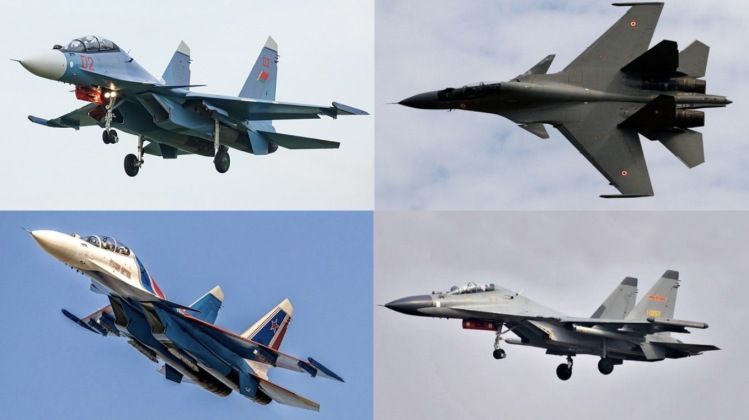
Su-30SM, Su-30MKI, Su-30MKK, Su-30 Russian Knights. (clockwise from top left)
Entering service in the Russian Air Force in 1996, the Su-30 twin engine heavyweight fighter was developed as an advanced derivative of the Soviet Su-27 Flanker design with a standardised twin seat configuration and a less specialised role. The aircraft designed to be highly capable in air to air, anti shipping and air to ground roles rather than focusing exclusively on air superiority as the Su-27 had been, and by using the same basic airframe and many of the same weapons and similar maintenance infrastructure it allowed Russia to modernise and diversify its fleet without much of an additional logistical burden. The Su-30 inherited the Su-27’s extremely manoeuvrable high performance airframe, and although development was impeded by economic crisis in Russia itself following the Soviet collapse the prospects of lucrative export sales meant that it was one of a minority of programs for new combat aircraft which was not cancelled and would survive the 1990s. Other than new avionics better suited to engaging targets on the ground and at sea, the Su-30 boasted more powerful engines, a higher use of composite materials, new sensors and electronic warfare systems, and access to a wide range of new weaponry. The fighter was also the first in the world to integrate thrust vectoring engines for enhanced manoeuvrability - and it would remain the only aircraft with such capabilities until the U.S. Air Force introduced the F-22 raptor heavyweight fighter in 2005.
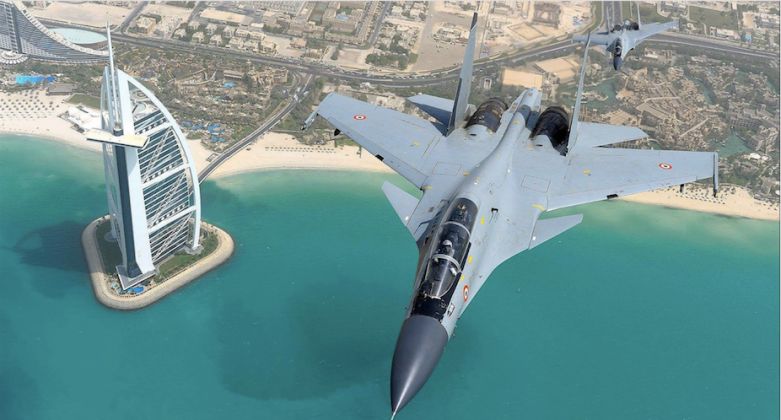
The Su-30 design has been improved considerably over the last 25 years, and today is produced on a larger scale than any other Russian fighter primarily as the Su-30MKI and Su-30SM variants, the latter which is widely considered the most cost effective aircraft in production in the country with a flyaway cost estimated at around $20 million per aircraft. Although the cost is several times higher when marketed for export, factoring in coverage of research and development costs, weapons, spare parts, training, support infrastructure and in most cases a wider profit margin, the Su-30 has still proven to be one of the most successful designs in the world on export markets. Over 550 have been sold including over 350 acquired by the Indian Air Force, its largest client, and 97 acquired by China, its first foreign client. China placed its first order for the aircraft in 1997, acquiring the Su-30MKK variant which was specialised in a maritime strike role to counter ongoing threats from the U.S. Navy in the vicinity of the Taiwan Strait, and would go on to purchase 73 of these and 24 of the Su-30MK2 variant over the next seven years before moving on to produce more capable fighters domestically. India, for its part, produces the fighters under licence until today as the Su-30MKI - an aircraft which is considerably more expensive than those in the Russian or American fleets due to the high cost of licence manufacturing in India and of integrating non-Russian subsystems.
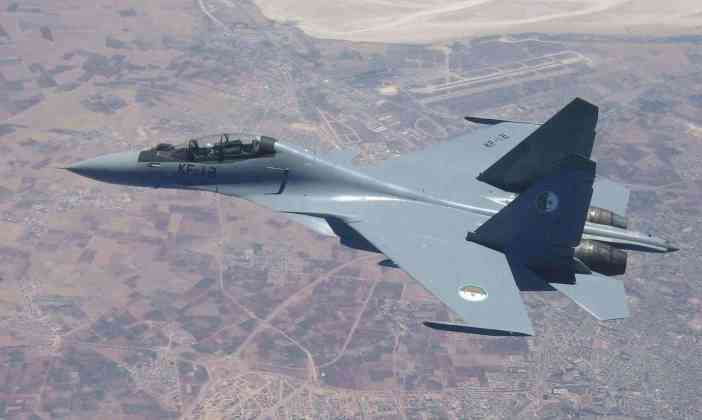
Only two sales of the Su-30 have been made outside Asia and Africa, with Venezuela and Belarus respectively acquiring 24 Su-30MK2 and 12 Su-30SM platforms which are by far the most capable jets in both fleets today. The fighter has been particularly popular in Southeast Asia for its high endurance and versatility and viability for both maritime strike and air to air missions, and is deployed by Vietnam, Indonesia and Malaysia with Myanmar recently placing an order of its own for the latest Su-30SM variant. Alongside Myanmar, the fighter’s most recent orders have come from Armenia, Kazakhstan and Belarus with all acquiring the most advanced Su-30SM variant, as well as from Angola which purchased the older Su-30K variants second hand after they were very briefly operated by the Indian Air Force and later modernised in Belarus. Although the Su-30 has notably made no penetration into the lucrative Middle Eastern markets, with Syria and Yemen being the only clients for Russian fighters in the region and both of these facing almost ten years of civil warned and preferring lighter and cheaper MiG-29 jets, this could well change in the near future.
A number of countries have shown considerable interest in the Su-30SM, most notably Iran which has reportedly considered manufacturing over 100 of the fighters under license domestically. An Iranian order for at least one class of high end fighter jet is expected to be announced by the end of 2020, with the Western-drafted UN arms embargo on the country set to be lifted in October 2020 as part of the terms fo the JCPOA nuclear deal. The Su-30SM is a leading contender, although it will be competing against other promising platforms such as the lighter but in many ways more modern MiG-35 and China’s J-10C. Other possible operators of the Su-30 include Sri Lanka, which has shown interest in acquiring around half a dozen jets second hand, as well as Ethiopia which already operates the Su-27 and is looking to replace its MiG-23s with a modern strike aircraft amid growing tensions with some of its Arab neighbours. Azerbaijan is also considering the aircraft to replace its ageing MiG-29A fighters, and in response to Armenia’s acquisition of the Su-30SM it is reportedly considering the Su-35, MiG-35 and the Su-30SM for its own fleet. Egypt, too, could be a leading potential client after acquiring the Su-35, with the two aircraft highly compatible with one another.
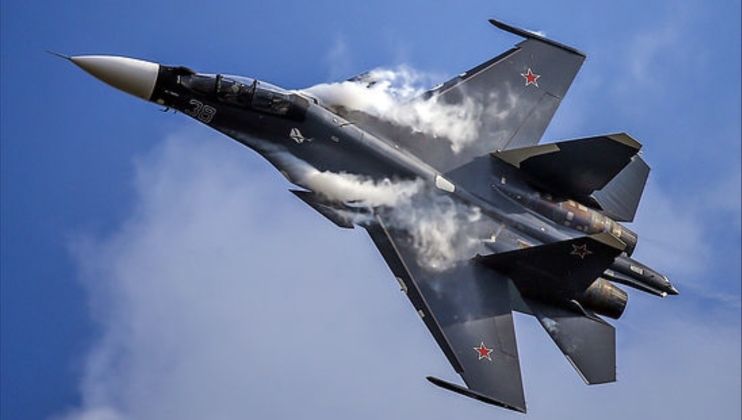
A number of new upgrades for the Su-30 are currently being planned, including integration of AL-41 engines for enhanced manoeuvrability and addition of a new and more powerful radar and new hypersonic missile types for both anti shipping and air to air roles. These are expected to improve the fighter’s popularity on international markets considerably. Nevertheless, it remains to be seen whether the Russian Air Force will continue to acquire of the Su-30 beyond 2027, when its current State Armaments Plan will conclude, with many analysts expecting that further orders for the aircraft and others will be cut to allow the service to focus on more advanced designs - namely the Su-57 and MiG-41. The possibility remains that the Su-30 could remain in production for export - or even under license production in Iran - or that Russia will somehow merge the Su-30 and Su-35 production lines to produce them as a single fighter class in both single and twin seat configurations. This will be more possible as the Su-30 and Su-35 begin to more closely resemble each other in terms of capabilities, with the former set potentially to ingrate the latter’s AL-41 engine, R-37M missiles and even its Irbis-E radar while the Su-35 itself is seeing improvements made to its air to ground and anti ship capabilities to bring them closer to those of the Su-30. Ultimately as one of Russia's most capable exports, and with considerable room to improve, the Su-30 is expected to remain in production in some form well into the 2030s - likely in a heavily modernised form which is far more capable than its current one.
