
First Ever U.S. F-22 Raptor Stealth Fighter Deployment in Israel Exposed in New Chinese Satellite Footage
Military Watch Magazine Editorial Staff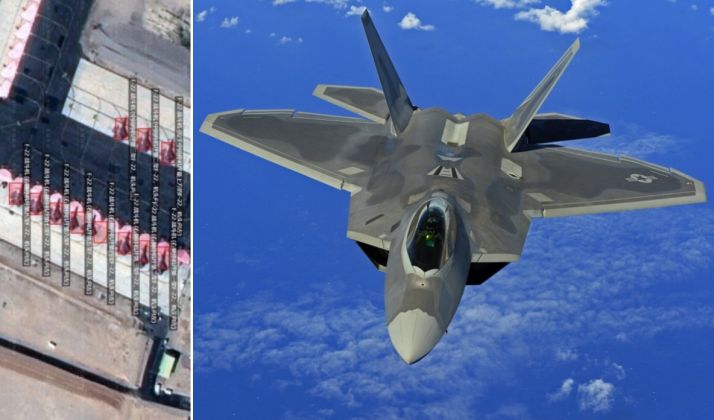
F-22s at Ovda Air Base in Israel and F-22 in Flight
A private Chinese satellite firm has released satellite images of 11 F-22 Raptor fifth generation fighters at the Ovda Air Base in Israel. A total of 12 F-22s were photographed while transiting the United Kingdom, suggesting one may not have headed to Israel, or may have been in flight at the time the images were taken. Located in the very south of Israel in the southern Negev Desert, around 40 kilometres north of Eilat, the facility is most prominent for its former hosting of aggressor squadrons for training, and current hosting of Arrow anti-ballistic missile systems. With no fighter squadrons permanently based there, the facility provides significant room to accommodate U.S. fighter units, and has two runways with lengths of 3,000 and 2,600 meters and a heliport. The deployment represents part of a much broader regional military buildup aimed at Iran.
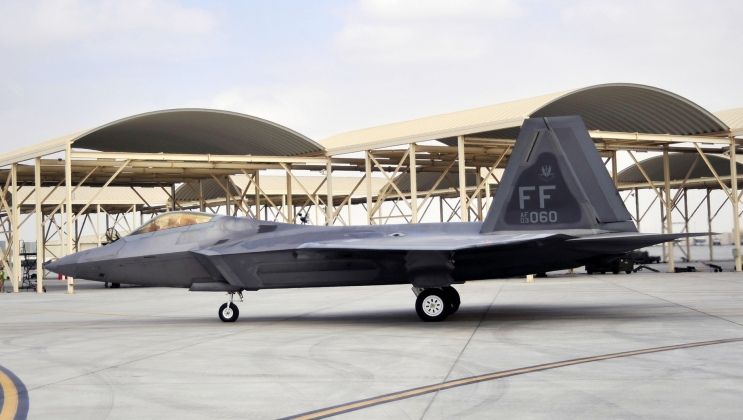
F-22s have seen far fewer deployments outside the United States, with no units permanently stationed abroad, unlike the F-15, F-16 and F-35 which are permanently stationed at multiple facilities across the world. This reflects both the more limited numbers of F-22s that are in service, with over 75 percent of production numbers having been cancelled, as well as the type’s very low versatility and low availability rates which limits its suitability for foreign deployments. Despite being one of the newest fighter types in the Air Force, the F-22’s availability rates have remained by far the poorest at well below 50 percent, with this expected to worsen as the fleet ages and airframes become more worn out. In May 2021 the Air Force confirmed that the F-22 was not part of its future plans for the fighter fleet, with the aircraft intended for an early retirement despite the Cold War era F-15s and F-16s it was designed to replace being retained in service and continuing to be produced.
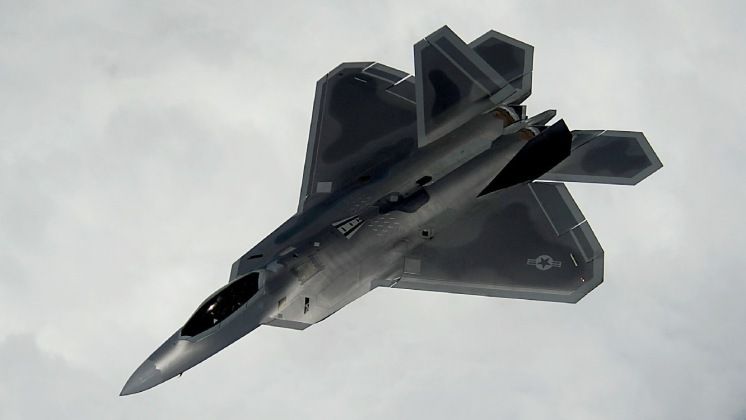
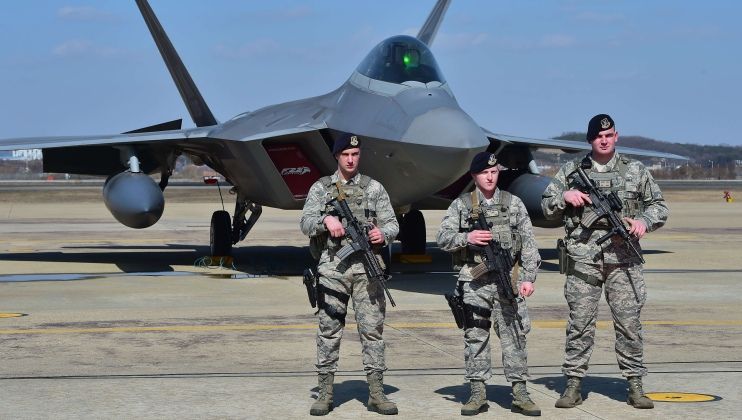
Preceding the service entry of the F-35 and F-15EX, and the modernisation of the F-15E Strike Eagle fleet, the F-22 had an elite status within the U.S. Air Force, leading it to be deployed during times of high tensions. This included a deployment to Osan Air Base in South Korea, which is a active air base located close to the Korean Demilitarized Zone, during high tensions with North Korea in early 2016 and late 2017, and a subsequent deployment to Al Dhafra Air Base in the United Arab Emirates in 2019 at a time of high tensions with Iran. When based at Al Dhafra, the fighters also operated extensively inside Syrian airspace against the objections of the Syrian government, supporting U.S. forces in maintaining an illegal occupation of territory in the country’s northeast to appropriate and sell off oil resources there as part of a campaign to starve the Syrian economy. The United States worked particularly close with Israel, Turkey and Qatar to maximise pressure on the Syrian state, culminating in its total defeat in December 2024 after an almost 13 year long collective campaign.
The Air Force’s efforts from the early 2020s to begin retiring F-22s that were only a fraction of the way through their service lives, while continuing to invest in the procurement of new F-15s, the Raptor’s direct predecessor and a design that is 30 years older, provided a strong indicator that the F-22 program had been far from successful. Although designed as a high performing air superiority fighter, the F-22’s increasingly obsolete avionics leave it at a severe disadvantage against the F-35 which is in production today. The fighter’s utility in a potential war with Iran remains in question, with its short range, ageing radar, and lack of any air-to-ground missiles limiting its ability to launch strikes, collect intelligence or support the destruction of air defences as EA-18Gs, F-15s, F-35s and other aircraft can. Iran’s obsolete fighter fleet, meanwhile, poses little challenge to U.S. air dominance, meaning the F-22’s specialised air-to-air capabilities will likely be of limited value. A limited payload and endurance, meanwhile, make the F-22 far less optimal for anti-drone duties than fighters such as the F-15. A primary function of the deployment to Israel may thus be to boost local morale due to the F-22’s reputation, which has been built up over decades with extensive public relations efforts.
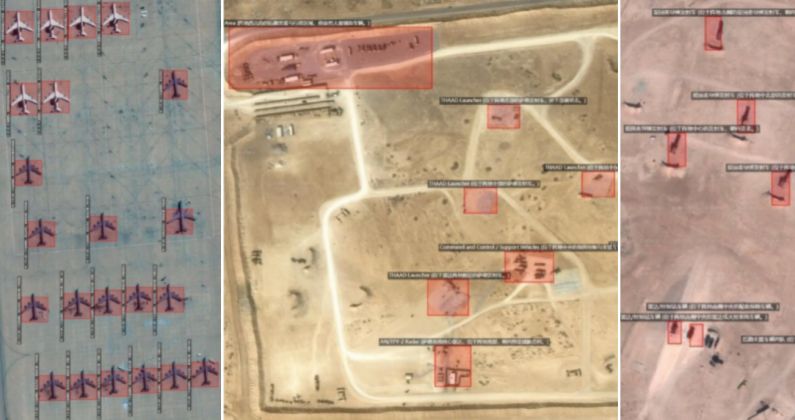
The release of images of the F-22s in Israel closely follows the release of Chinese satellite imagery confirming a large buildup of U.S. Air Force support aircraft at Prince Sultan Airbase in Saudi Arabia, including the stationing of 16 KC-135 aerial tankers and six E-3 Sentry airborne warning and control systems (AWACS). Chinese satellite imagery previously confirmed a number of deployments by the U.S. Army and Air Force across the Middle East, including a surge in Air Force deployments of KC-135s to Al Udeid Air Base in Qatar, with at least 16 of the aircraft seen at runways at the facility. Satellite earlier in the months exposed the exact positions of an Army MIM-104 Patriot air defence system at the same facility. Prior publication of imagery confirmed the deployment of a Army THAAD anti-ballistic missile systems at Muwaffaq Salti Air Base in Jordan, where EA-18G electric attack jets and F-15E strike fighters have also been deployed.
