
U.S. Navy’s Top Supercarrier USS Gerald Ford Suffers Raw Sewage Overflows During Deployment Against Iran
Military Watch Magazine Editorial Staff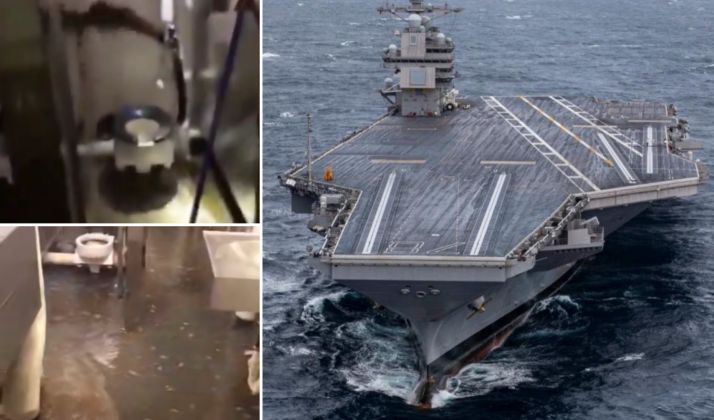
Sewage Overflows on the USS Gerald Ford
Footage from the U.S. Navy’s newest supercarrier the USS Gerald Ford on February 24 has showed a major flood of raw sewage flowing through the ship, following persistent issues of clogged toilets and backed-up sewage. This follows years of reports that the ship’s narrow pipes have frequently been blocked, triggering sewage system breakdowns across the ship. Issues reportedly worsened in January, while the carrier was deployed to the Caribbean to support an attack on Venezuela and the abduction of its president, Nicholas Maduro. The USS Gerald Ford had been ordered to Caribbean waters alongside much of its strike group in late October, after which images released by the U.S. Department of War in late November confirmed that the carrier’s air wing had begun to conduct flight operations in the region. The ship had then been repositioned closer to Venezuela in mid-December, and following successful attacks on Venezuela, was redeployed to the Eastern Mediterranean in late February to support a broader U.S. military buildup against Iran.
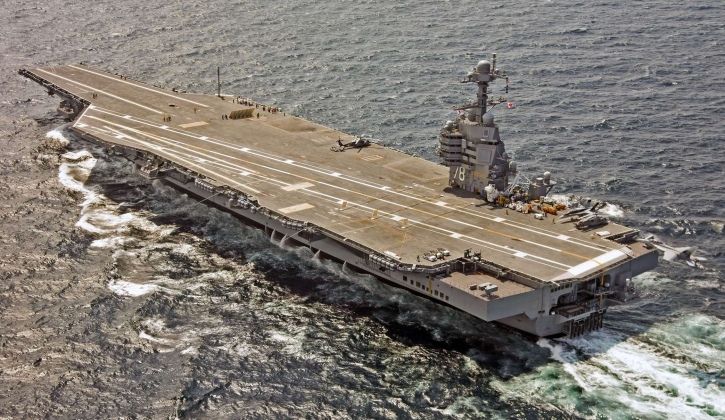
Most of the USS Gerald Ford’s approximately over 600 toilets have reportedly become non-functional at times, forcing sailors to wait up to 45 minutes or more for working facilities. According to the Navy Times, the supercarrier received an average of one "sewage-related maintenance call per day" during its 2025 deployment. Internal records show hundreds of failures of the USS Gerald Ford’s sewage system over short periods, including an internal report of 205 breakdowns in four days during 2025, forcing the carrier to seek external assistance dozens of times since 2023 to try to keep the system serviceable. The use of a specialised acid flush, costing around $400,000 per use, has sometimes been necessary to clear buildup and can only be done in port, not at sea. The requirement for sailors and technicians to work long hours to manage the problem has reportedly contributed to low morale, exacerbating the demoralisation already caused by the significant extension of the supercarrier’s deployment long past usual durations. U.S. Navy officials say the toilet problems haven’t compromised mission capabilities, but they are a serious quality-of-life concern.
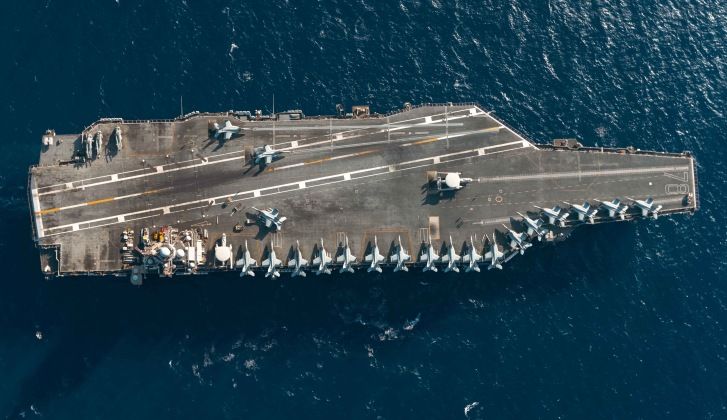
Issues with the USS Gerald Ford have been wide ranging, affecting its weapons elevators, electromagnetic catapults, human waste management and sensors. A Project on Government Oversight report accordingly referred to the program as an example of “how not to build a ship,” with radars proving to be sufficient flawed that it was decided an entirely new sensor suite would need to be developed for future Gerald Ford class ships. These issues caused major delays, and while the ship belatedly entered service in June 2017, it could not commence its first operational deployment for over five years until October 2022. At over $17.5 billion it is the most costly warship ever built, coasting over twice as much as its Nimitz Class predecessors. Delays the integration of the F-35C fifth generation fighter with the ship’s electromagnetic catapult system have been severe, leaving its air wing reliant solely on fourth generation F-18 fighters, and allowing China to integrate the rival J-35 fifth generation fighter with the electromagnetic catapult system of its first supercarrier the Fujian before the U.S. could with its equivalent aircraft, despite an American headstart of over a decade.
