
Russia’s Su-57 Next Generation Fighter Finally Joins The Air Force - Why It Took So Much Longer Than Expected
Military Watch Magazine Editorial Staff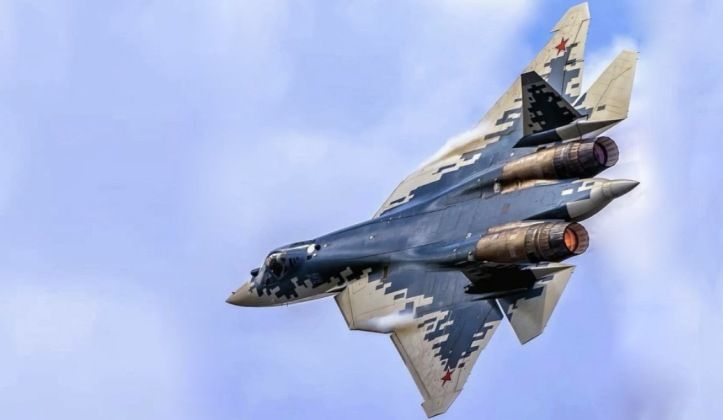
Russian Su-57 Next Generation Fighter
Almost eleven years after the fighter’s first flight in January 2010, the Su-57 next generation heavyweight combat jet has finally entered service in the Russian Air Force. This makes it the fourth fighter with fifth generation capabilities to enter service worldwide, alongside the American F-22 and F-35 and the Chinese J-20 which entered service from 2005, 2014 and 2017 respectively. The fighter’s entry into service comes almost exactly 15 years after the U.S. Air Force received its first next generation fighter, the F-22 Raptor, which joined the fleet on December 15th 2005. Delays to the Su-57’s entry into service are though to be due to changes to the required specifications and the emergence of much more ambitious requirements to counter expected threats from the Western world. While Russian military sources have consistently expressed confidence that the country's ‘4++ generation’ aircraft such as the Su-35 are more than sufficient to counter threats from Western fifth generation fighters such as the F-22, the Su-57 can best be seen not as a Russian counterpart to the older American fighter - but rather as a challenger to much more ambitious sixth generation fighters currently under development. Russia had notably previously developed a less ambitious fifth generation fighter with performance parameters and a design closer to that of the F-22, under the MiG 1.44 program, although this was ultimately cancelled in favour of the much more advanced Su-57.
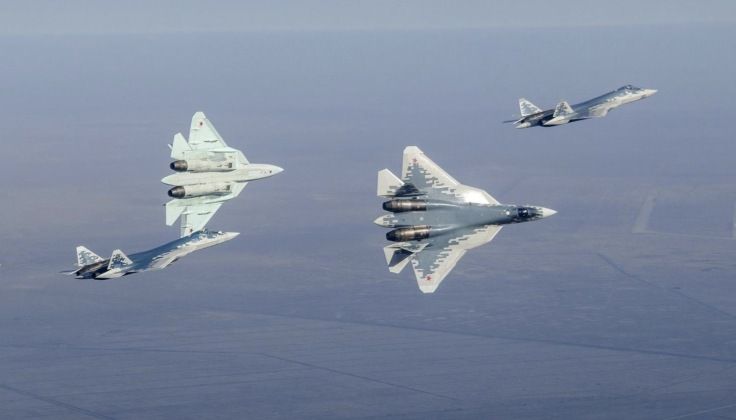
While the Su-57’s entry into service 15 years behind the F-22 has led a number of Western analysts to claim this as a sign that Russia’s defence sector is far behind that of the United States, the much greater sophistication of the newer fighter and the far more advanced technologies tested on its airframe indicate otherwise. Even for the relatively basic initial production variants of the Su-57, the fighter has access to a range of advanced features the American F-22 lacks including, among others, helmet mounted sights, three dimensional thrust vectoring engines, infra red search and track systems, multiple AESA radars including rear and cheek mounted ones, and access to R-37M hypersonic air to air missiles with over double the range of those deployed by the F-22. The Su-57 also deploys K-77 APAA guided air to air missiles - a weapon to which the U.S. currently has no equivalent. Despite its advanced capabilities, however, the Russian Air Force is expected to receive less than two dozen of the initial production variants of the Su-57 before moving on to more advanced ‘5+ generation’ or sixth generation variants. These will integrate Saturn 30 engines, which are expected to be around 30% more powerful than those deployed by currently the F-22 Raptor, as well as artificial intelligence, hypersonic ballistic missiles and and options for an unmanned flight mode.
