
Approaching Sixth Generation Capabilities; Russia Integrating Advanced Artificial Intelligence Systems Onto its Su-57 Fighter Design
Military Watch Magazine Editorial Staff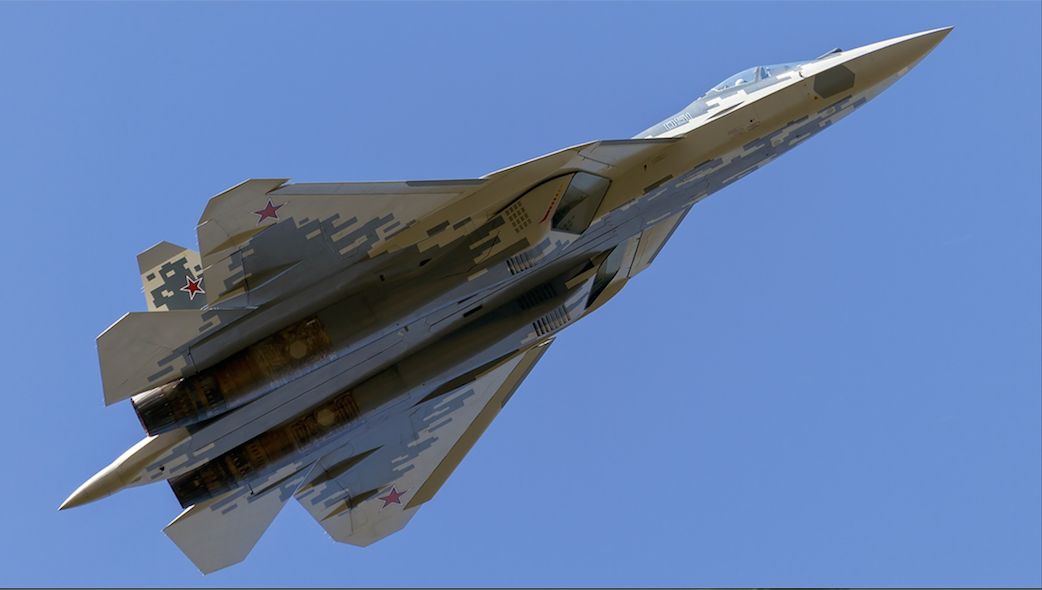
Russian Su-57 Next Generation Air Superiority Fighter
Following on from reports that the Russian military has begun testing sixth generation fighter technologies on the airframe of the Su-57 next generation air superiority platform, reports from the country’s military aviation industry indicate that work has begun to integrate artificial intelligence (AI) systems onto prototypes of the new combat jet for testing. An unnamed defence industry sources cited by Russian media stated regarding the development: "There are plans to equip Su-57 warplanes with an AI system that will bring it closer to a sixth-generation unmanned aircraft.” Whether AI systems will be used by planned unmanned variants of the fighter only, or whether they will also be deployed by manned variants to assist the pilot remains to be seen.
With mass production of the Su-57 postponed, and early production variants of the fighter with fifth generation capabilities entering service in relatively small numbers, the development of sixth generation systems for the aircraft has been a priority for the aircraft’s developer, United Aircraft Corporation. With the Russian Air Force perceiving relatively little need for fifth generation variants of the fighter, given its faith in ‘4++ generation’ fighters such as the Su-35 and MiG-35 to engage the most capable Western fighter jets currently in service, mass production is set to be initiated only after the Su-57 attains sixth generation capabilities - possibly under a different designation entirely such as Su-60. As a result, with the airframe of the jet designed specifically with the integration of future next generation technologies in mind, the Su-57 is almost certain to enter service in far greater numbers as a sixth generation jet than it will in fifth generation variants.
The use of artificial intelligence is set to be a game changer for the Russian fighter, making manned versions considerably easier to operate and more survivable in the face of threats while opening a number of new possibilities for unmanned variants. With human pilots unable to endure g forces significantly over 9g, seriously restricting the manoeuvrability of fighter jets, unmanned variants piloted by AI will be able to pull manoeuvres impossible for today’s combat aircraft without rendering unconscious and possibly killing the pilots. Use of an artificial pilot rather than a remote pilot does much to reduce the risk to the aircraft, with today’s drones highly vulnerable to having their signals overridden or cut off entirely by hostiles. The Iranian hijakcing of the U.S. RQ-170 stealth drone, a remotely piloted platform they proceeded to land at one of their own airbases for study, serves as a key example of the weaknesses of a remotely piloted jet. The United States for its part, following an attempt to develop a remotely piloted stealth fighter under the Northrop Grumman X-47B project, appears to have also abandoned such plans in favour of developing a sixth generation jet with the option for an artificial pilot. Development of AI technologies thus appears the most effective means of developing an unmanned fighter, a potential game changer for the Russian Air Force.
