
MiG-35 Set to Enter Service Ahead of Schedule; The Critical Role of Russia’s Next Generation Light Fighter and How it Mirrors America's F-35
Military Watch Magazine Editorial Staff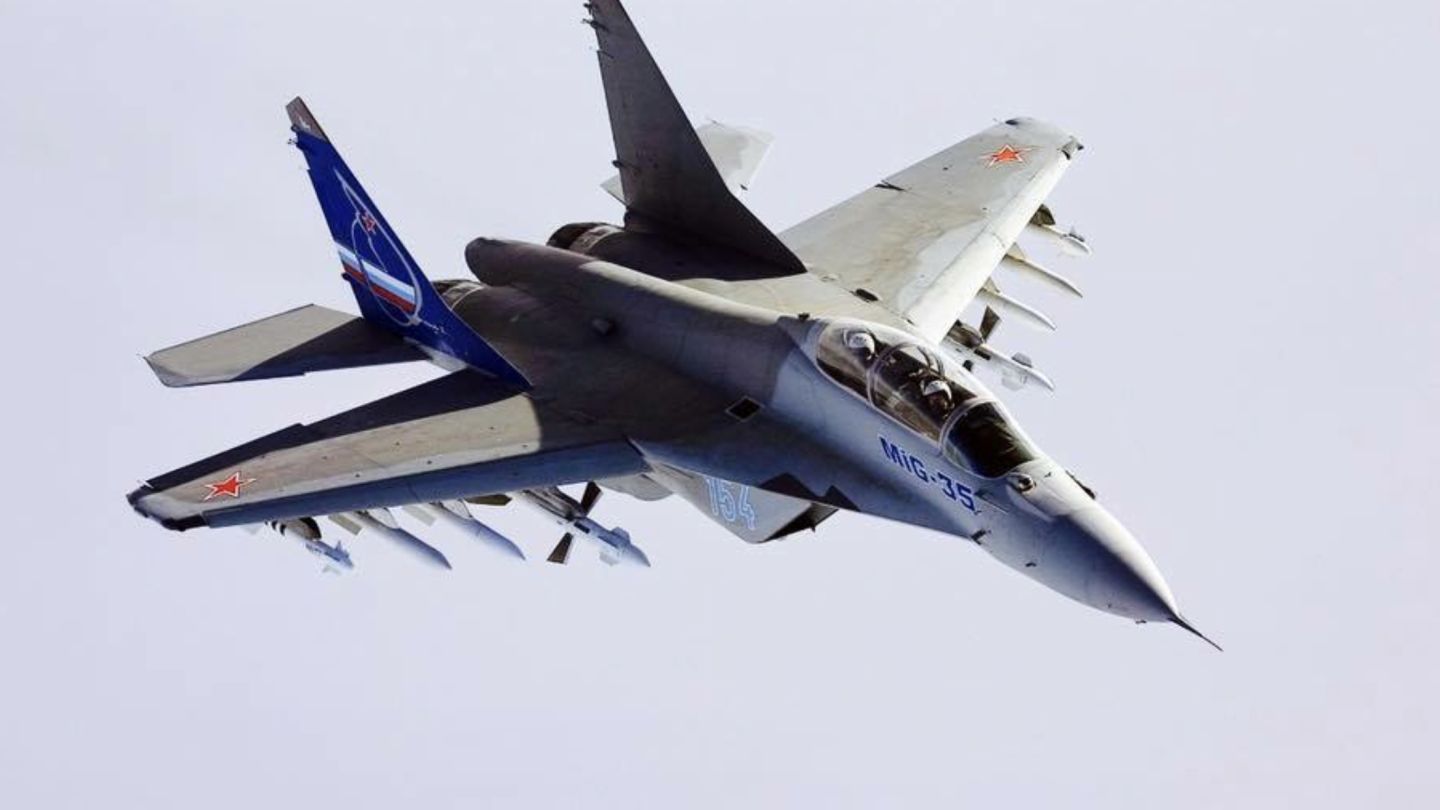
Russian Air Force MiG-35 Twin Engine Multirole Fighter
According to the President of Russia’s United Aircraft Corporation (UAC), the country’s Air Force May receive next Generation MiG-35 twin engine fighters ahead of schedule. Manufacturing of the first batches of fighters has been accelerated to reduce costs and keep to a high pace of production, according to the official, with the armed forces having placed an order for 30 of the new jets and planning follow up orders for at least 140 more. UAC President Yury Slyusar stated regarding the production schedule for the jets: "As for MiG-35, we will for the first time test the so called model of ahead of schedule deliveries with the Defence Ministry. This will allow us to keep up the rhythm and lower the expenses on the aircraft manufacturing, while the Defence Ministry will be able to receive the new aircraft a little earlier than the state defence orders schedule says.”
The first phase of deliveries is expected to take place in the coming weeks, with an initial batch of six fighters set to imminently come off production lines. UAC began the final phase of flight tests for the MiG-35 in May 2018, with factory trials having been completed three months prior in February. One possible additional factor which has influenced the decision to deliver fighters sooner is the postponement of mass production of the Su-57, a heavier analogue to the MiG-35 specialised in an air superiority role and making use of a fifth generation stealth airframe. While the MiG-35 Fields next generation technologies across the spectrum, from AESA radars to three dimensional thrust vectoring systems, the latest infra red search and track systems, advanced and highly specialised standoff munitions and possibly even K-77 air to air missiles, its lack of a stealth airframe has led it to be designated a ‘4++ generation’ fighter.
Much like the United States, Russia has long relied on inducting two complementary fighter jets of different weights and roles, a lighter, less costly and unspecialised platform which serves as a frontline fighter and an elite and specialised jet which serves in an air superiority role. Much as the Su-57 serves as an analogue to America's F-22 Raptor, so too does the MiG-35 provide the Russian Air Force with a formidable analogue to the lighter F-35A Lighting II. The aircraft are set to be fielded in considerably greater numbers than their heavier counterparts, and due to their shorter ranges they are designed for deployments at airfields closer to the frontlines of war. A navalised variant of the MiG-35 is reportedly also being considered for Russia's planned new carrier warships - an analogue to the F-35C, while the country's planned vertical takeoff capable jet is also set to use many of the MiG's next generation technologies - giving an analogue to the F-35B. While the designs of the MiG-35 and its American analogue differ considerably, Russia's armed forces have expressed confidence that its new light jet, the most sophisticated fighter in mass production in the country, will be able to counter the American Joint Strike Fighter. The MiG-35 enjoys a far superior thrust/weight ratio, considerably greater sortie rate and lower maintenance time, twice the air to air missile payload, more sophisticated standoff munitions, and the ability to operate at considerably greater speeds and altitudes, relative to the F-35. These assets, combined with deployment of infra red search and track systems, three dimensional thrust vectoring and the latest electronic warfare suites are likely to make the new Russian jet a more formidable fighter in the light multirole category than the American F-35 - one which comes at a small fraction of the cost both to acquire and to maintain which can facilitate acquisitions in large numbers - both by Russia's Air Force and by a number of export clients.
