
Russia Unveils New R-37M Hypersonic Air to Air Missile Deployed From Su-35 Fighter: What is it Capable Of?
Military Watch Magazine Editorial Staff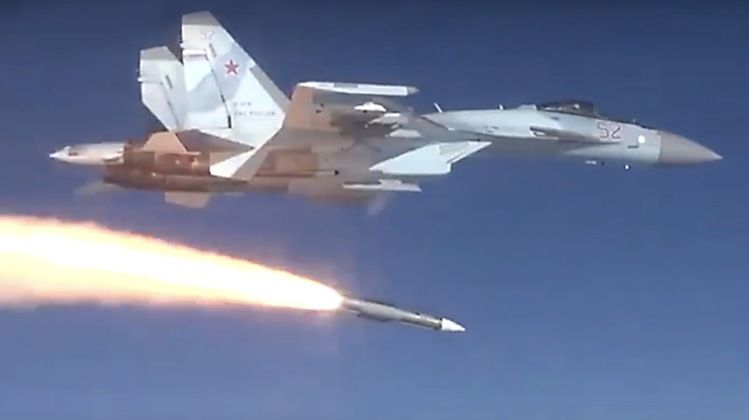
Su-35 Fires R-37M Missile
Russian state media has for the first time released an image of an R-37M long range air to air missile being launched from a Su-35 heavyweight fighter, with the missile previously having been shown attached to the fighter at various promotional events for Russian military hardware but never seen in flight with the aircraft. The R-37 has been deployed for several years from the Russian Air Force’s MiG-31 Foxhound heavyweight interceptors, and is considered one of the most capable air to air missiles in the world with an impressive 400km range, Mach 6 speed and massive 60kg payload. By contrast, the most capable long range air to air missile in U.S. service, the AIM-120D, has a 180km range, Mach 4.5 speed and a payload of around 20kg. The R-37’s very long range means it requires aircraft with very powerful sensors to deploy it, which previously meant that only the MiG-31, which carries by far the largest radar in the world for an aircraft designed for air to air combat, could employ it effectively. The Su-35’s introduction of the powerful Irbis-E radar, however, allows the newer aircraft to also make effective use of the R-37M - with the jet expected to gain even better situational awareness in future when it integrates an AESA radar derived from that currently deployed by the Su-57 fighter. The ability of multiple Su-35s to share targeting data, as well as the fighter’s ability to share data with ground based radars and airborne early warning aircraft such as the A-50U, allows them to make better use of the R-37’s long range.
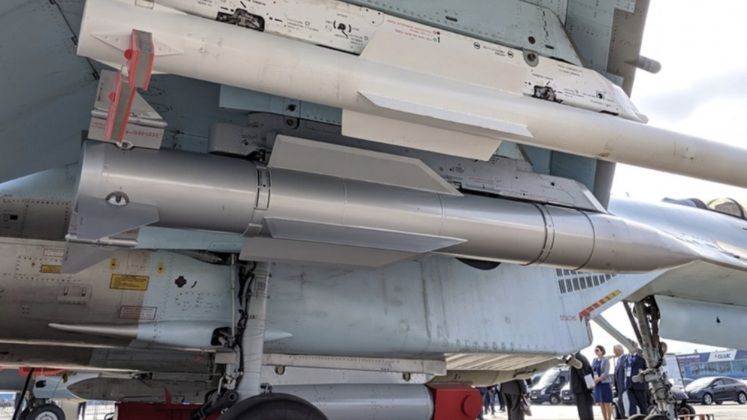
The R-37M is one of two new air to air missile classes to enter service in the Russian Air Force, the other being the K-77 which has a shorter range of approximately 193km but is more compact and has a sensor suite better suited to neutralising manoeuvrable targets. The K-77 may only be deployed by Russia’s new Su-57 fighters, however, and was designed specifically to be carried eight at a time from their internal weapons bays providing the largest long range missile payload of any fighter in the world in stealth configuration. The R-37M, however, is expected to be deployed by a wider range of aircraft including the Su-35, Su-30SM, Su-30SM2, MiG-35 and the Su-57 itself. It remains uncertain whether the Su-57 will be able to carry the R-37M, either in its current variant or in future modified variants, in its internal weapons bays, or whether the larger missiles must be carried externally which will compromise its stealth profile. The fact that the Su-57’s weapons bays are much deeper than those on other heavyweight stealth fighter such as the American F-22 or Chinese J-20 makes the possibly of internal carriage of the missiles high.
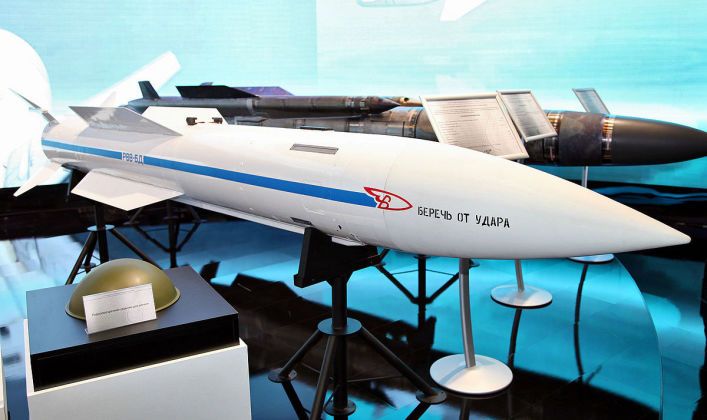
The R-37M is expected to be marketed for export, with Egypt and China both being leading potential clients given the types of potential adversaries both face and the fact that both were clients for the Su-35. The more recent announcement that advanced Su-30 variants can also deploy the missiles opens up considerably greater possibilities for export, with Belarus, Myanmar and Kazakhstan being likely clients. The Algerian Air Force, which is expected to receive its first Su-57 fighters by the mid-2020s and possibly to also upgrade its Su-30MKA jets to the Su-30SM2 standard, is also likely to purchase the new missiles alongside the K-77. Although the R-37 was originally designed to counter heavyweight targets such as bombers and airborne early warning aircraft, such missiles have shown a high potential against fighter-sized targets as well when operating at under 70% of their maximum range. The American AIM-54 Phoenix, which is conceptually in many ways similar to the R-37 but technologically approximately four decades older, proved very dangerous against manoeuvrable fighter sized targets at long ranges due to its endurance, high energy, high speed, powerful sensors and heavy warhead - at times neutralising multiple fighters in a single hit at extreme distances. The R-37 will be considerably more dangerous still, although its remains uncertain whether the R-37M variant built to be carried by smaller aircraft than the MiG-31 will still carry a heavy 60kg warhead, or whether this may have been reduced somewhat.
