
Russia Has Begun Flight Tests to Develop Su-57 Into Hypersonic Missile Armed Strike Fighter
Military Watch Magazine Editorial Staff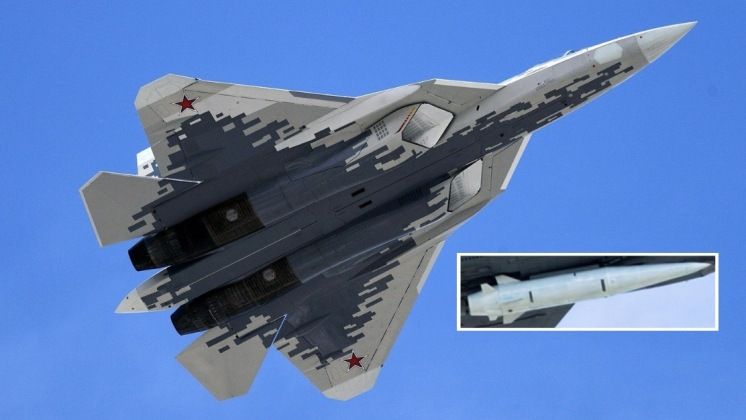
Su-57 Next Generation Fighter and Kh-47M2 Hypersonic Ballistic Missile
Following reports that Russia was developing a miniaturised variant of the Kh-47M2 hypersonic ballistic missile for deployment by the country’s new Su-57 fighter jets, and subsequent confirmation that a hypersonic missile for the Su-57 had reached a prototype stage of development, Russian military sources confirmed that the next generation fighter had begun test flights with the new missile. Although Russia has been testing armaments for integration onto its Su-57 fighters for over half a decade, including in combat conditions, these were all conducted from individually built prototype airframe until 2021. The Russian Air Force received its first serially produced Su-57 fighter in December 2020 however, with just one currently in service, and this has been assigned to the Southern Military District specifically for testing of new hypersonic weapons. It is likely that it is this serially produced fighter, which qualitatively is overall far superior to the prototypes and differs in a number of important aspects, has been used to test the new weapon.
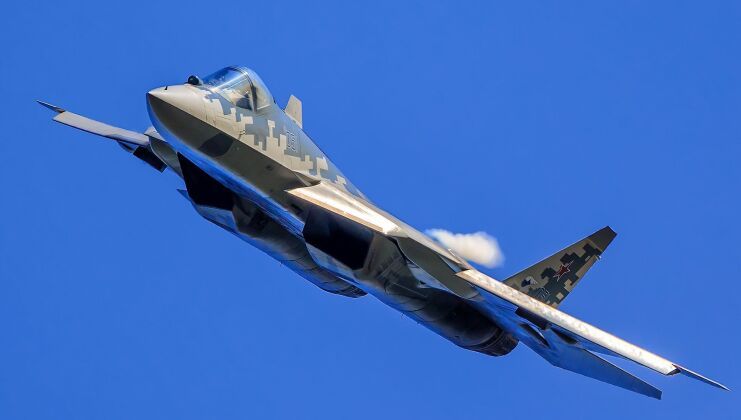
The Kh-47M2 is currently deployed by aircraft which are much larger than the Su-57, including the MiG-31K Foxhound heavy interceptor and Tu-22M bomber. Both of these aircraft carry weapons externally, while missiles being developed for the Su-57 will likely need to be deployed from internal weapons bays and will therefore be much more compact. It remains uncertain whether a smaller missile will be able to match the Kh-47M2’s performance, or whether it will compromise on range to meet the requirements for a design suitable for the Su-57. Unlike the American F-22 and Chinese J-20, the only other heavyweight next generation fighters in service, the Su-57’s weapons bays are deep and allow it not only to carry more air to air missiles, but also to deploy high diameter armaments such as large gravity bombs and cruise and ballistic missiles. This is a result of the Su-57 having been developed from the outset for both strike and air to air missions, where the F-22 and J-20 were developed purely for air superiority.
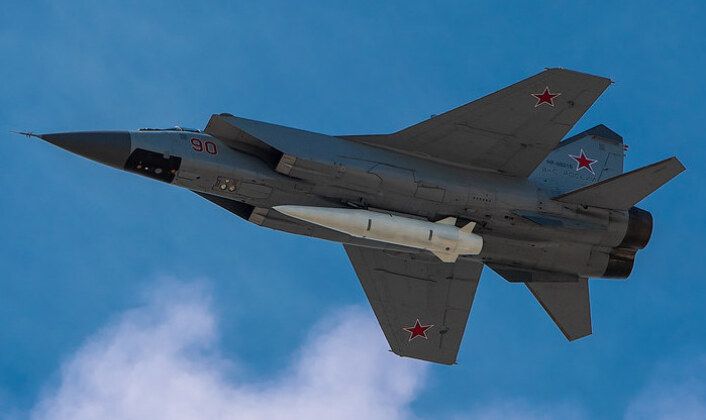
The original Kh-47M2 has a 2000km engagement range and Mach 10 speed, and benefits from high manoeuvrability and precision allowing it to threaten even well defend targets such as aircraft carriers, airfields and command centres. With the Russian Air Force expecting to be outnumbered in the event of a war with NATO, the missile has been highlighted as a means of blunting the Western advantage by allowing Russian forces to very quickly strike airfields and destroy fighter and bomber units on the ground. Deploying derivatives of these missiles from fighter jets will considerably increase offensive options and allow Su-57s to pose a major threat to enemy warships and far off ground targets. Pairing the missiles with fighters that benefit from advanced radar evading stealth capabilities — something the MiG-31K and Tu-22M lack — has the potential to make for a particularly dangerous combination. The Su-57 is currently in very low level initial production, but is set to be produced in much larger numbers from 2024 and see production rates again increase considerably after 2027. A number of advanced next generation technologies, including new Saturn 30 engines, artificial intelligence and laser weapons among others are currently under development for the fighter.
