
How Russia is Making Its Su-57 Fighter Much Stealthier: New Air Intakes, Coatings and Production Materials Lower Radar Cross Section
Military Watch Magazine Editorial Staff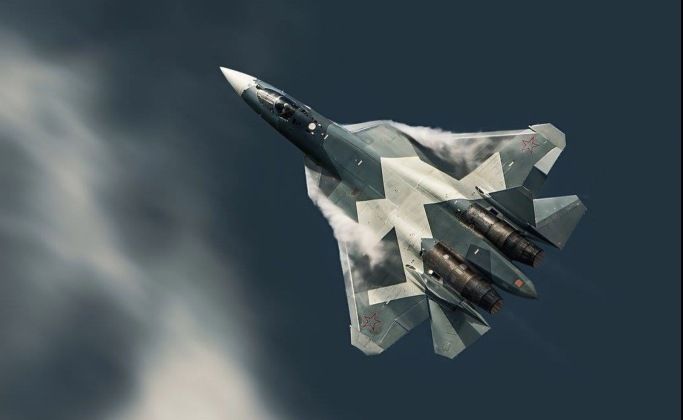
Su-57 Next Generation Fighter
Amid multiple reports on improvements to the Su-57 fighter’s design, and as the Russian Air Force prepares to receive its first operational squadron, information has emerged regarding efforts to reduce the aircraft’s radar cross section and improve its stealth capabilities. While the Su-57 has been designed with the goal of providing the Russian military with an advanced sixth generation fighter jet, initial production variants are considered fifth generation fighters and are the fourth fighters of their generation to enter service worldwide. Preceding the Su-57 were the American F-22 and the Chinese J-20 , which like the new Russian aircraft were also designed as heavyweight twin engine jets, as well as the American F-35 which was designed for large scale production and export and is much lighter and cheaper. Of these four, the Su-57 was long derided for its relative lack of stealth capabilities based on the high radar cross sections of its prototypes. As the first images of the fighter in serial production began to emerge however, a growing number of advanced stealth features of the Su-57 came to light.
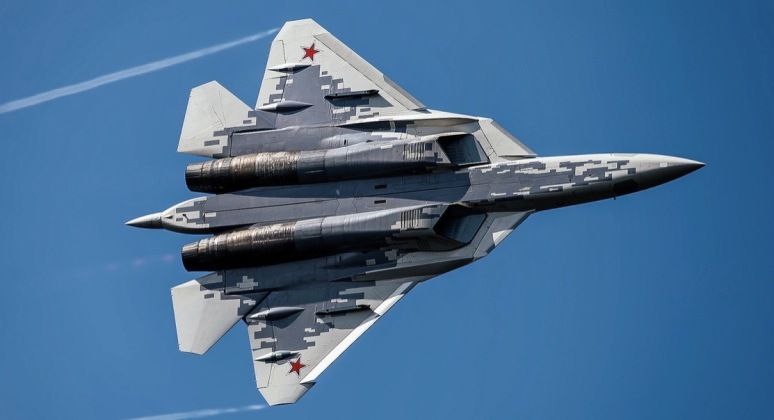
A report from Russian media outlets accompanied by photos on December 7th showed that a new grille had been added to Su-57’s the air intakes. Coaxial radial grating made of radar absorbent materials was fitted onto the air intakes, in some way comparable to the S-channel the intakes on the American F-22. Their effect would be to reduce the direct frontal transmission of radar by the engine compressor blades, which was particularly critical considering that the frontal radar cross section is by far the most important for a fighter's survivability. Platform edge alignment on the Su-57 more closely resembles features on the F-22 to reduce its radar cross-section, with control surfaces, the serrated edges of skin panels and the leading and trailing edges of the wings all angled to reduce the number of directions the radar waves could be reflected. Beyond this, a much higher manufacturing quality for fighters produced on a large scale allows for a much better finishing closer to the high standard set by Chinese and American stealth jets, which is vital to the Su-57’s stealth capabilities.
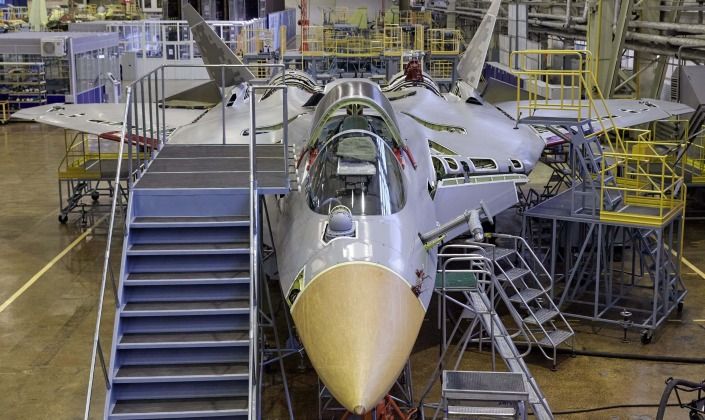
Western analysts previously highlighted on a number of occasions that the infrared search-and-track sensor on the nose of the Su-57 would seriously compromise its stealth capabilities and increase its frontal radar cross section. This issue appears to have been solved on serial production models, with the sensor designed to turn backwards when not in use. Its rear is treated with radar-absorbent material to reduce the Su-57’s frontal radar radar cross section. Using an infra red sensor notably allows the Su-57 to operate without any radar signature at medium and short ranges, which provides an advantage in survivability and situational awareness relative to the F-22 or J-20 which lack similar sensors. The Su-57’s airframe will benefit from new advances in radar absorbent materials, which according to Russian sources will reduce radar return by 30% and also protect pilots from ultraviolet or thermal radiation. The fighter’s stealth capabilities are expected to be further improved in future as more advanced radar absorbent materials are developed, and as the fighter begins to integrate Saturn 30 engines which are not only substantially more powerful but are also expected to reduce the rear radar cross section with a stealthier design. The Saturn 30 is speculated to also have a reduced infra red signature, although this remains unconfirmed.
