
Beyond Air Superiority: Russian Su-57 Fighter's ‘Aerial Sniper’ Capabilities Ideal for Blinding NATO Defences
Military Watch Magazine Editorial Staff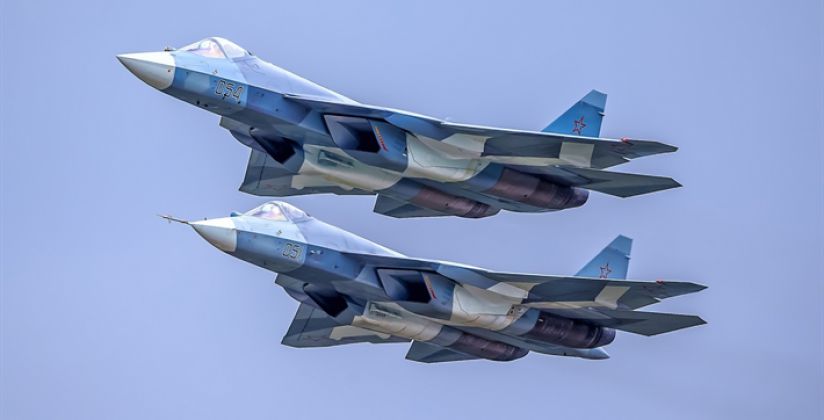
Russian Su-57 Next Generation Fighters
Although the large majority of published assessments of Russia’s Su-57 next generation fighter have focused on its capabilities as an air superiority fighter to engage other enemy aircraft such as American F-22s or F-15s, the aircraft also has a very formidable air to ground capability and places a much greater emphasis on such roles than its U.S. or Chinese rivals. Beyond its demonstrated capability to launch cruise missile strikes, and its capability currently in advanced development stages to launch hypersonic ballistic missiles, the aircraft’s powerful sensor suite allows it to function as an ‘aerial sniper’ - launching highly precise attacks on key enemy targets. The terms ‘aerial sniper’ was perhaps most famously applied to the U.S. Navy’s F-14D Tomcat fighter, which had the most capable sensor suite of any fighter in the Western world for over a decade after its introduction and was able to ‘fire a missile through a window several miles away’ due to the power of its massive radar. Similarly to the F-14D, the Su-57 carries a very large radar which was developed decades later and is considerably more powerful - allowing it to effectively map the battlefield not only in the air but also on the ground.
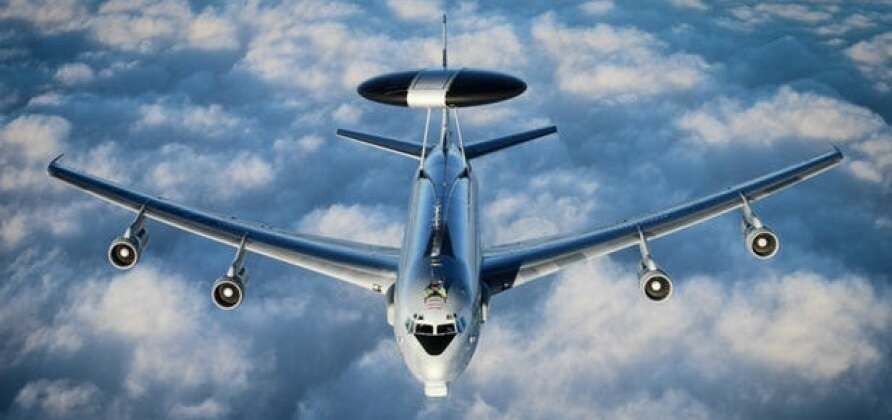
The Kh-58UShE anti radiation missile, at around five metres long and with a range of over 150km, is a potentially ideal weapon for a ‘sniper’ role. The missile homes in on enemy radar emissions which makes it ideal for breaking the back of an enemy air defence network and blinding the enemy’s ground control. Such attacks can effectively be complemented by the fighter's deployment of the R-37M - the world’s fastest and longest ranged air to air missile which is ideally suited to neutralising targets such as E-2 Hawkeye and E-3 Sentry ‘flying radar’ aircraft. The fighter’s heavyweight design and high endurance gives it an advantage over the F-35 - the only Western fifth generation fighter in production today - which is considerably smaller, carries less armaments and has a more limited range. The Su-57’s higher speed and altitude and reliance on frontal stealth allow it to potentially penetrate enemy defences head on to deliver strikes against key targets deep behind their lines. The fact that the fighter will be fielded only in limited numbers at least for the next 15 years means it will be well suited to an ‘aerial sniper’ role which do not necessarily require deployments in large numbers, while lower end fighters such as the Su-34 or Su-30SM tackle less sensitive targets in a complementary manner.
