
China’s Su-35 Fighters Continue to Fly with Air Superiority Loadouts: Are They Still Useful in Service?
Military Watch Magazine Editorial Staff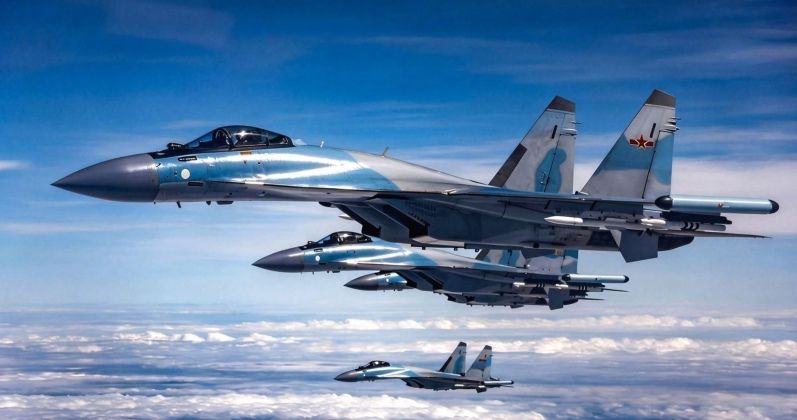
Chinse PLA Air Force Su-35 Fighters with R-77-1 and R-73/74 Missiles
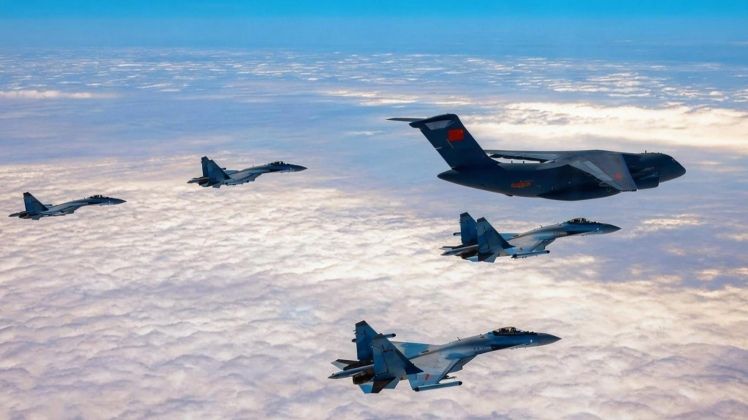
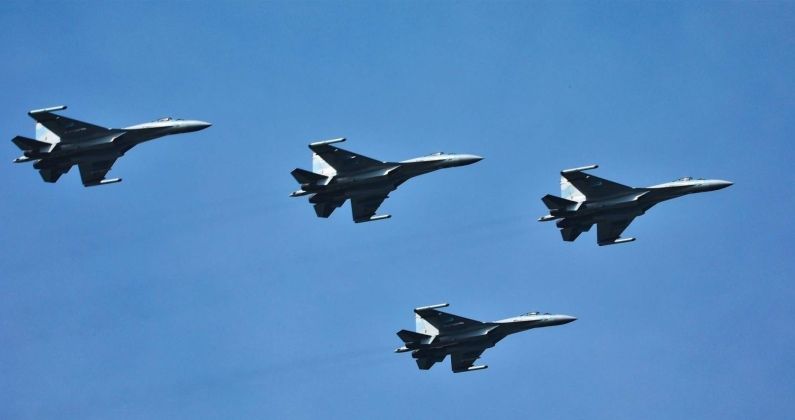
Images circulating on Chinese social media have provided a rare look at the rarest fighter type in Chinese People’s Liberation Army (PLA) Air Force service, the Su-35, flying in formation and equipped for air-to-air combat. One of the images showed Su-35s escorting a PLA Air Force Y-20 strategic transport, which is currently the largest military transport in production worldwide, while another showed the fighters equipped with R-77-1 active radar guided air-to-air missiles, R-73/74 infrared guided missiles built for visual range combat, and Khibiny electronic warfare pods. The Su-35 was the last Russian fighter type procured by the Chinese Defence Ministry, with a $2 billion order placed in 2015 reportedly having included technology transfers related to the aircraft’s three dimensional thrust vectoring capabilities, which it was the first fighter type in the world to operationalise.
Developed as an enhanced derivative of the Soviet Union’s top air superiority fighter the Su-27, the Su-35 integrates the Irbis-E X-waveband multi role passive electronically scanned array radar as its primary sensor, alongside a pair of N036B-1-01 L-band radars in its wing roots, while its airframe makes much higher use of composite materials and has a redesigned frontal profile that reduces its radar cross section. Its AL-41F-1S engines have comparable thrust levels and thrust/weight ratios to the F119 powering America’s first fifth generation fighter the F-22, facilitating a world leading flight performance and outstandingly long range. The Su-35 has gained far more air to air kills than any other post Cold War fighter type due to its central role in Russian operations in the Ukrainian theatre, including participating in major air battles with Ukrainian fourth generation fighter units where it has frequently achieved overwhelming victories. Despite its advanced capabilities, the Chinese PLA Air Force procured just a single regiments’ worth of the fighters with orders for just 24 having been made.
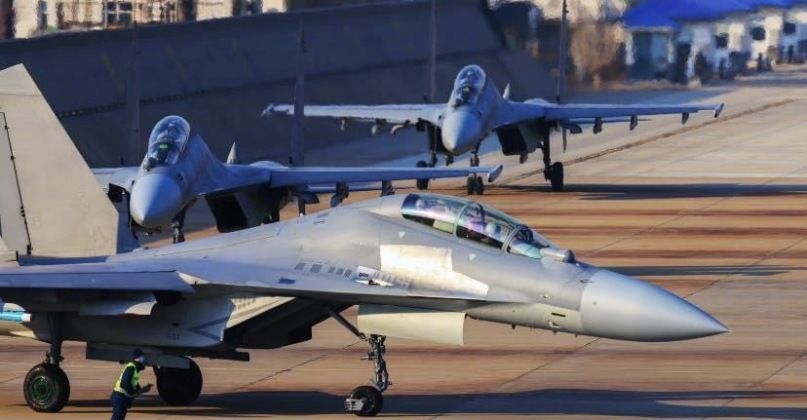
Preceding the Su-35, the Chinese PLA had procured over 100 Su-27 fighters from 1991, the majority of them under a license production deal, while also beginning to acquire the Su-30 from the year 2000 with 100 ordered. Advances in the local fighter aviation industry have significantly limited interest in procuring the newer Russian fighter type, and by the time it was ordered the country’s own indigenous ‘4+ generation’ derivative of the Su-27, the J-16, had already begun to be brought into service. The J-16 and its lighter counterpart the J-10C have proven capable of comfortably outperforming the Su-35 during exercises, while the entry into service of the J-20 fifth generation fighter from 2017 left the Su-35 significantly further behind. Chinese sources have been particularly critical of the Su-35’s data links and limited network-centric warfare capabilities, as well as the weakness of its radar compared to the similarly sized but more modern active electronically scanned array radar of the J-16, which is estimated to be the most powerful carried by any fighter type in the world.
The Su-35’s armaments significantly limit its viability as a high performing air superiority fighter in the fifth generation era, with the R-77-1 considered well behind the cutting edge, with comparable capabilities to the older Chinese PL-12 missile operationalised in the 2000s, far suppressed by the PL-15 that was brought into service in the mid-2010s. The American AIM-120D is also considered significantly superior, and entered service at around the same time that orders for the Su-35 were placed, while China has more recently operationalised the PL-16 and PL-17 with world leading capabilities. The Su-35’s visual range air-to-air performance is also particularly poor compared to its Chinese counterparts, with the R-73/74 missile, although having been world leading in the 1980s, today considered obsolete and at the opposite end of the spectrum of production missiles compared to the highly advanced Chinese PL-10.
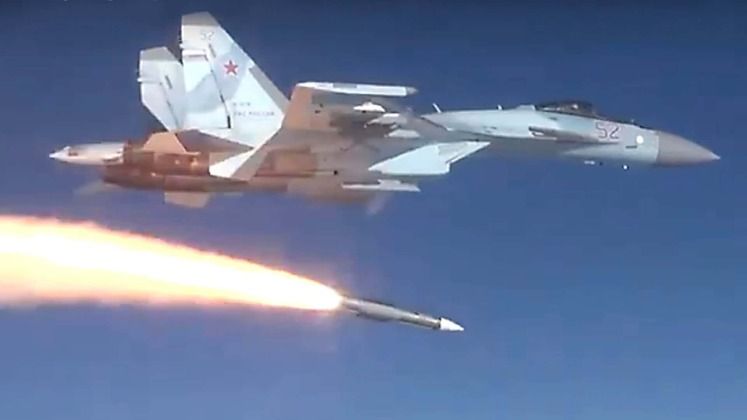
The Su-35’s role in Chinese service remains limited, with the procurement thought to have served to facilitate the transfer of a number of technologies where Russia still retained a lead. The aircraft likely allowed the Chinese aviation industry and the PLA Air Force to ensure that Russian industry’s conservative progress in the 15 years after the Su-30’s development did not have much to offer. Su-35s are likely to have been relied on for dissimilar combat training, and possibly to allow pilots to familiarise themselves with thrust vectoring before Chinese fighters with such capabilities began to enter service. The possibility has been raised that the fighters could be made more viable through procurement of new missile types, most notably the R-37M, which is one of the longest ranged missile types in the world and would allow them to pose an asymmetric threat to Western Bloc support aircraft such as tankers and AEW&C systems in the Pacific.
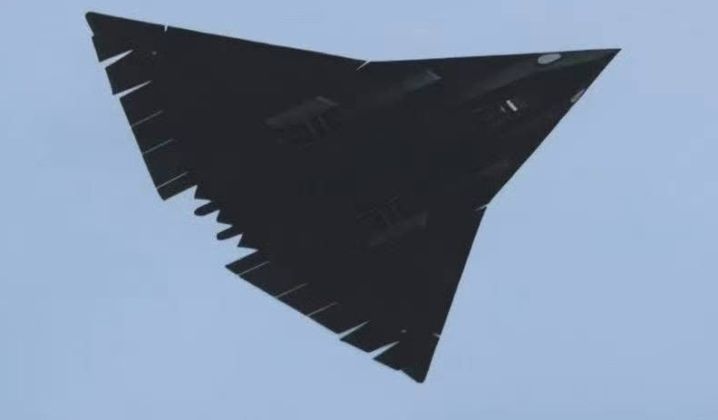
As China’s J-20 fleet has become the world’s fastest growing and in many respects the most advanced of the fifth generation, while the country is poised to lead the world by over half a decade in fielding sixth generation fighters, the Su-35’s role is expected to become increasingly peripheral. The continued growth of the J-16 fleet has further limited the significance of the Su-35. The fact that China has not offered the J-16 or any other heavyweight long range fighters for export has been a primary factor allowing Russia to continue exports of the Su-35 to other clients, although the aircraft’s estimated lower cost than its Chinese counterparts may have also been a factor. Russia has taken steps to modernise the aircraft, and in July 2025 they were confirmed to have belatedly integrated the R-77M air-to-air missile, providing a performance comparable to those of Chinese and American missiles from a decade prior, although these upgrades have been far from sufficient to reverse the trend towards a fast widening capability gap.
