
Why Russia’s Air Force Loves the Su-35’s Irbis-E Radar: A Detailed Look at the Sensor Suite Built to Hunt Stealth Fighters
Military Watch Magazine Editorial Staff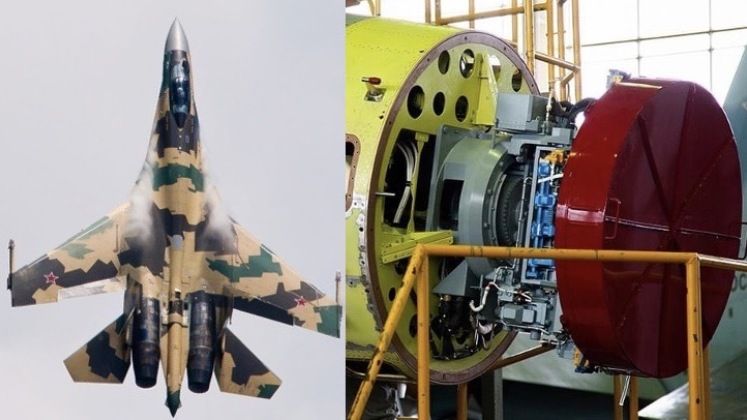
Su-35 Fighter and Irbis-E Radar
Entering service from 2014, Russia’s Su-35 heavyweight fighter was considered the world’s first combat jet of the ‘4++ generation' and boasted a range of new features which had not previously been seen in the Russian Air Force. These included the first operational three dimensional thrust vectoring engines and the first radar cross section reducing airframe on an operational heavyweight fourth generation fighter. The AL-41 engines on the fighter were the most powerful on any fourth generation heavyweight fighter built for air to air combat, and largely bridged the gap with the performance of fifth generation engines. They were less than 14kN weaker than the F119 powering the American F-22 fifth generation fighter despite the Su-35 being a much lighter design, thus providing a much higher thrust/weigh ratio. A notable feature of the new fighter was its deployment of the Irbis-E radar, which revolutionised its situational awareness relative to older generations of Russian heavyweight fighters and brought it closer to the high bar set by the American F-22 and Russia’s own MiG-31BSM interceptor - which had the most powerful sensor suites at the time.
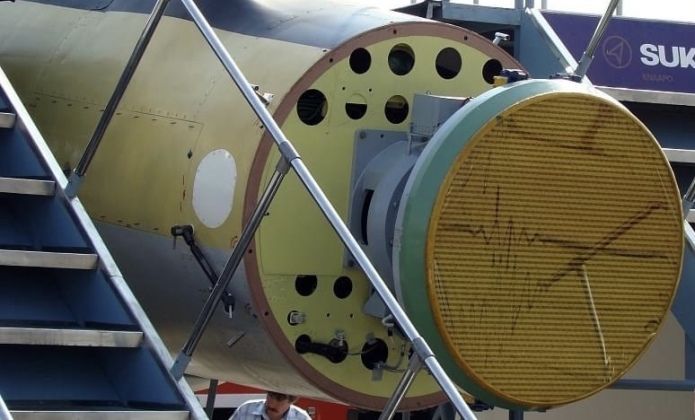
The Irbis-E was developed by the V V Tikhomirov Research Institute of Instrument Production as an X-waveband multi role radar with a passive phased antenna array (PAA) mounted on a two-step hydraulic drive unit. The two-step electro-hydraulic drive unit turns the antenna mechanically to 60° in azimuth and 120° in roll, while the the antenna device scans using an electronically controlled beam in azimuth and angle of elevation in sectors exceeding 60°. By using the electronic control and mechanical additional turn of the antenna, the maximum deflection angle of the beam reaches to 120° - a capability few fighters can boast. Compared to its predecessor the BARS radar used by the Su-27 and Su-30, the Irbis-E has four rather than three discrete channels and replaces and replaces the single 7 kiloWatt peak power rated Chelnok traveling-wave tube with a pair of 10 kiloWatt tubes which provide a total peak power rating of 20 kiloWatts. The new radar uses the Solo-35.01 digital signal processor hardware and Solo-35.02 data processor, but retains receiver hardware, the master oscillator and exciter of the older BARS design.
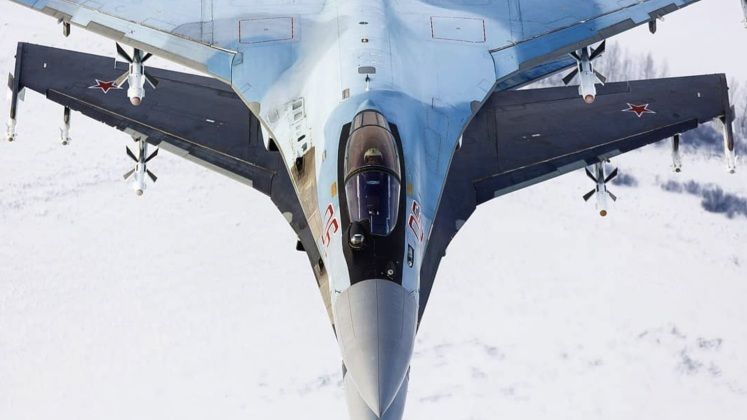
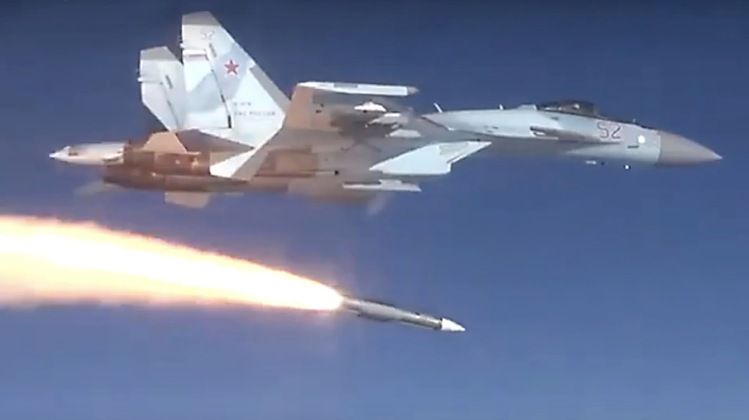
The Irbis-E for years had the longest detection range for a Russian aircraft developed for air to air combat other than the MiG-31BSM’s Zaslon-M, and could detect a target with a three square metre radar cross section 350-400 km away. Against stealth targets with a 0.01 square metre cross section, the range is 90 km. It remains uncertain whether these quoted ranges apply only when the radar is focused on a particular area, or when it is performing a wider scan over up to 120 degrees. With the Su-35 designed to operate in large squadrons and share target data through data links, the situational awareness for a full unit will be far greater than that for a single aircraft. In Track While Scan mode the Irbis-E can handle 30 targets simultaneously and provide guidance for the simultaneous firing of two semi-active rear guided missiles such as the R-27. These older missiles require guidance throughout their flight courses and lack ‘fire and forget’ capabilities, but are increasingly being phased out of service in favour of newer designs. If deploying missiles with active radar guidance such as the R-77 or R-37M, which most Su-35 units are thought to do, then the Irbis-E can guide up to eight missiles simultaneously.
While the Irbis-E can detect large aircraft at up to 400km away, against ground or naval targets the distance is somewhat shorter. An aircraft carrier sized target can be detected at 150-200km away, a railroad bridge sized target at 100-120km and a motorboat sized target at 60-70km. Unlike the original BARS radar, the Irbis-E has multiple ground mapping modes including a synthetic aperture mode, and on the Su-35 the radar is complemented by an OLS-35 optoelectronic targeting system that provides laser ranging, TV, and infra-red search and track capabilities. When deployed against surface targets, the radar can guide missiles to to attack up to four simultaneously with precision-guided weapons and can do so while still simultaneously scanning the horizon for new aerial targets. This means that situational awareness against airborne threats is not seriously compromised when operating in air to ground mode. Furthermore, it is able to track air and ground targets previously identified while simultaneously scanning for new targets.
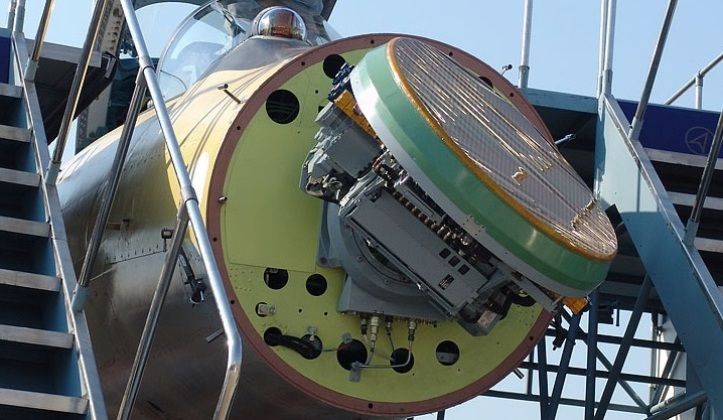
The Irbis-E is the considered world’s most powerful passive electronically scanned array radar deployed on a fighter-sized aircraft, and is challenged only by AESA radars such as those on American jets such as the F-22 or F-15EX or on Chinese fighters such as the J-16 or J-15B. The radar is today considered the third most powerful in the Russian inventory of those integrated onto aircraft built for air to air combat, with the Su-57 fighter’s AESA radar and the MiG-31 Foxhound’s much larger Zaslon-M phased array radar considered to be more powerful. The Irbis-E is thought to have been designed with combat against stealth aircraft in mind - much as the Su-35 was designed specifically to counter the American F-22 stealth fighter. The ability to track such aircraft at 90km ranges is a valuable asset, particularly if multiple aircraft are sharing targeting data which could extend this range considerably. Other than the Su-35, the Irbis-E has also been integrated onto the Russian Air Force’s Su-27SM2 and Su-27SM3 heavyweight fighters which share many characteristics with the newer aircraft. The radar is also thought to be intended for integration onto enhanced variants of the Su-30 in future, and has been offered for export as part of an upgrade package for Su-30 fighters which, particularly for older variants, could revolutionise their situational awareness. For the Su-35 itself, a number of reports indicate that the Irbis-E could eventually be replaced by an AESA radar based on the design currently being used by the Su-57 - which has been in service since December 2020.
