
U.S. Initiates Biggest Ever Shift in Apache Attack Helicopter Doctrine Adapting For Pacific Operations Against China
Military Watch Magazine Editorial Staff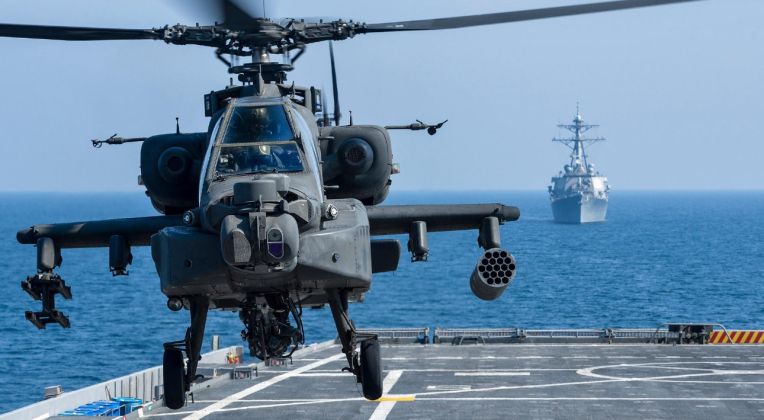
Apache Attack Helicopter During Pacific Operations
The U.S. Army is preparing a fundamental transformation in how it employs its AH-64 Apache attack helicopter fleet, with new concepts focusing on distributed maritime operations across the Pacific rather than traditional land-based warfare. During recent experimentation, the service demonstrated the ability to deploy Apaches from naval vessels and integrate them into dispersed strike networks, reflecting a broader effort to prepare for potential high-intensity conflict in the Pacific theatre. The concept represents one of the most significant changes to Apache doctrine since the helicopter first entered service, allowing the aircraft to operate from a wide range of temporary bases and ships rather than relying on established airfields. A leading constraint for shipboard, however, remains the aircraft’s lack of folding rotors, which makes them unsuitable for storage onboard, with this being a key feature of naval helicopters.
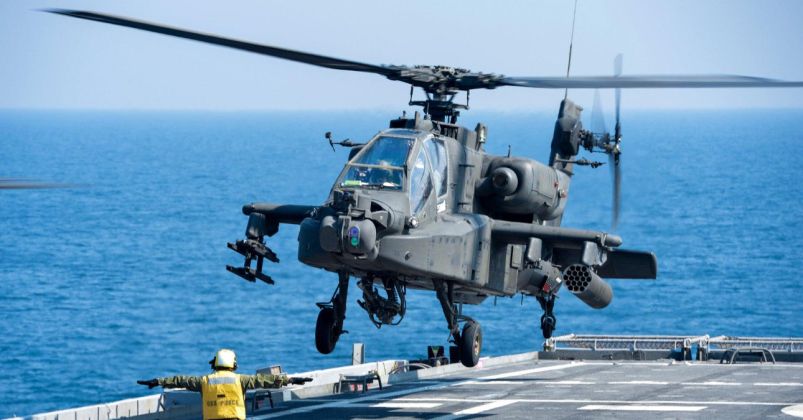
Central to the new concept is the creation of a sea-based distributed strike architecture in which AH-64s can rapidly reposition between islands, expeditionary landing zones, and naval platforms while remaining integrated into joint command-and-control networks. The approach aligns closely with the U.S. Army’s emerging Multi-Domain Operations doctrine and the U.S. Marine Corps’ Expeditionary Advanced Base Operations concept, both of which seek to complicate enemy targeting by dispersing forces across numerous smaller locations rather than concentrating them at a handful of large bases.
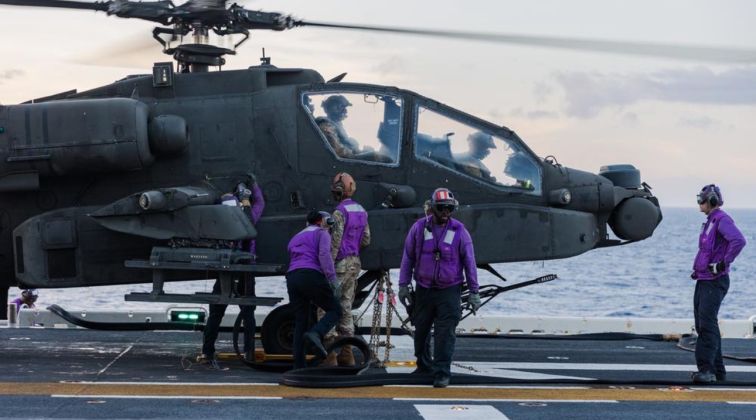
Operating from ships significantly expands the Apache’s operational reach across the Pacific, where vast distances between islands have traditionally limited helicopter employment. By embarking aboard amphibious ships or other suitable naval vessels, Apache units can be positioned much closer to potential operating areas while reducing dependence on vulnerable fixed infrastructure. The concept also enables helicopters to rapidly shift between operating locations, making them considerably harder to locate and target during wartime.
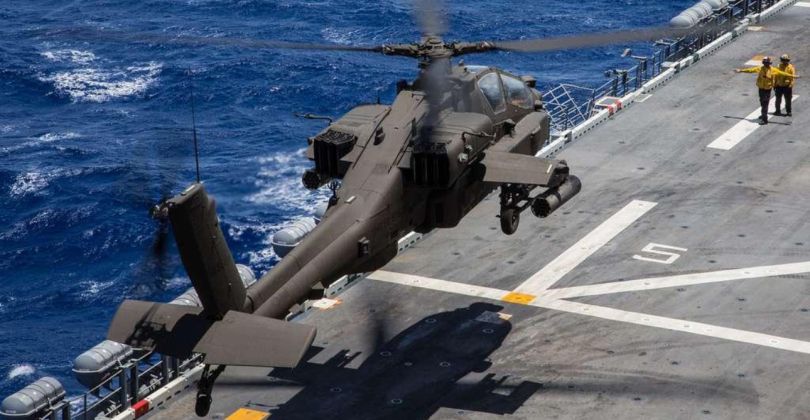
The architecture is intended to allow Apaches to conduct a wide range of missions in contested maritime environments. In addition to providing close air support for expeditionary ground forces, the helicopters could perform armed reconnaissance, maritime surveillance, long-range precision strike missions, and attacks against amphibious assault forces attempting to seize islands. The aircraft’s large sensor suite, including the Longbow fire-control radar, and its ability to operate in poor weather, provide capabilities that remain highly valuable even as unmanned systems become increasingly prominent. Operations in the Ukrainian theatre and the Middle East have indicated that attack helicopters can be particularly prized for air defence duties against low value drones.
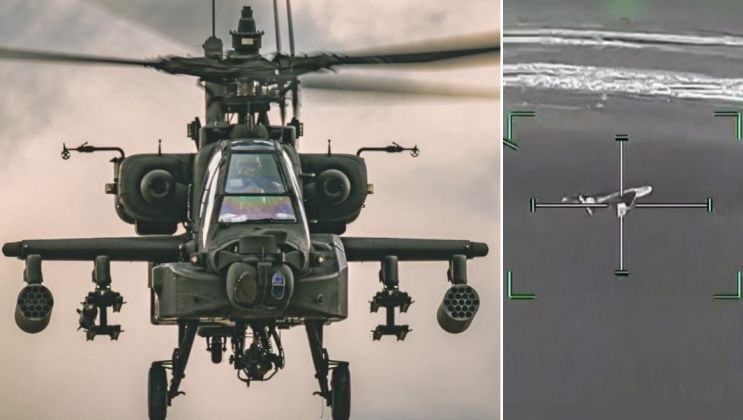
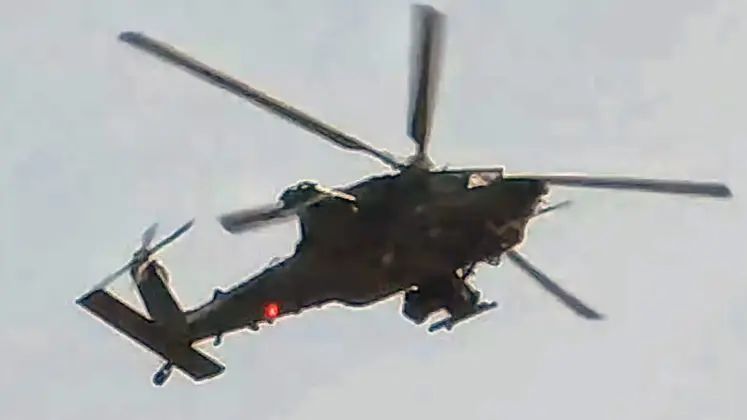
The Apache is the only heavyweight attack helicopter type in service in the Western world, with the aircraft developed during the Cold War as a direct counterpart to the Soviet Mi-24. Russia has developed two new heavyweight attack helicopter types, the Mi-28 and Ka-52, while China is currently flight testing its first helicopter from the heavy weight range the Z-21. Although constrained by the age of its design, the Apache’s 30mm M230 chain gun, and Hydra 70 rockets with Advanced Precision Kill Weapon System guidance kits, are relatively low cost armaments well suited to engaging lower cost drones. Engaging such targets has posed challenges for fighters due to the costs of their air-to-air missiles, which are more than an order of magnitude greater than the costs of the drones they are required to target, as well as the limited number of gun rounds they carry.
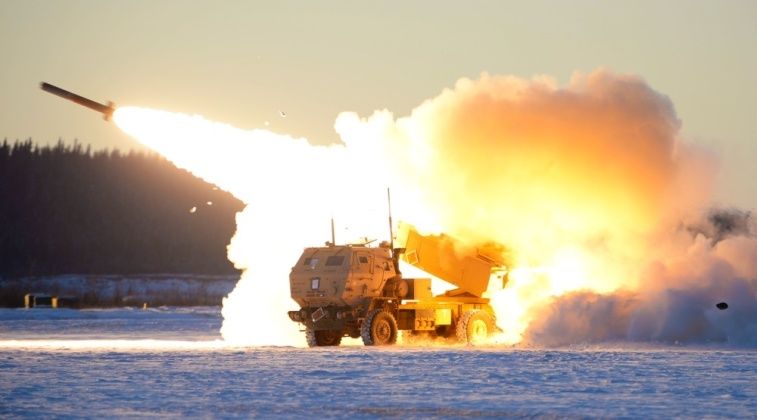
A particularly important aspect of the new doctrine is its emphasis on networked operations. Rather than functioning as isolated attack helicopters, Apaches are expected to share targeting information with ground forces, unmanned aerial vehicles, naval vessels, and long-range missile units through increasingly integrated battlefield networks. This allows helicopters to receive target information from other platforms while simultaneously providing reconnaissance data that can support strikes by HIMARS rocket artillery systems, Precision Strike Missiles (PrSM), naval cruise missiles, and combat aircraft.
The concept also reflects lessons drawn from recent conflicts, particularly the wars in Ukraine and the Middle East, where large concentrations of helicopters operating from fixed bases have proven increasingly vulnerable to long-range missiles, drones, and precision-guided weapons. Dispersing helicopters across multiple temporary operating sites and naval platforms significantly complicates enemy targeting while reducing the consequences of attacks against any single location. The initiative thus reflects the U.S. Army’s determination to ensure that the Apache remains relevant in future high-end warfare. Although the Apache was originally designed for large-scale armoured warfare in Europe during the Cold War, the service is adapting the platform for an environment dominated by dispersed operations across thousands of kilometres of ocean, which if successful could allow for much greater contributions to operations in the U.S. Armed Forces’ highest priority theatre of operations. Nevertheless, China’s growing advantage in the air-to-air domain, and significant lead in sixth generation fighter development, has raised the possibility that the United States’ ability to operate all types of high value aircraft in the region could become highly limited in future.
