
Russia Scrambles Su-27 Fighters to Intercept American B-52H Nuclear Capable Bombers
Military Watch Magazine Editorial Staff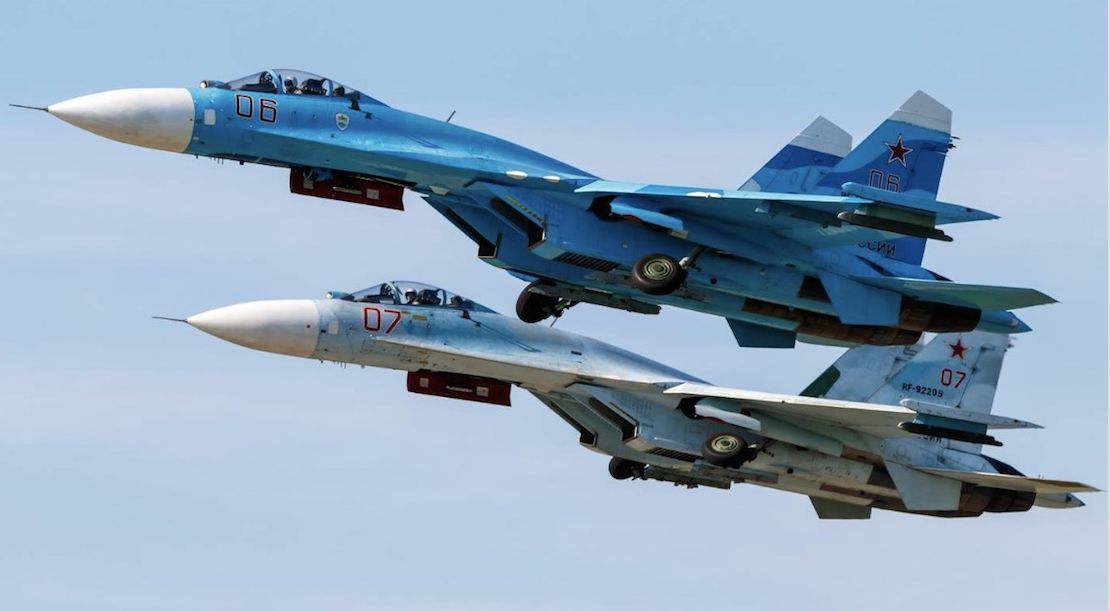
Russian Air Force Su-27 Air Superiority Fighters
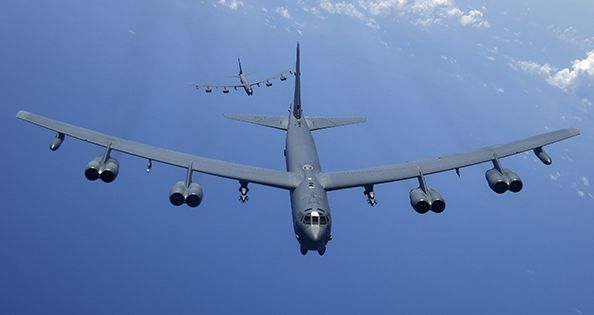
In response to two approaches by U.S. Air Force B-52H Stratofortress heavy bombers on June 16th, the Russian Air Force scrambled Su-27 Flanker air superiority fighters near its eastern and southern borders over the Baltic and Black seas. The exact number of aircraft involved on either side remains unknown, but the incident is the latest of many with U.S. bomber and reconnaissance aircraft approaching Russian borders with growing frequency. A statement by the Russian Defence Ministry regarding the operation stated: “The crews of Russian Su-27 fighter jets … have intercepted U.S. Air Force B-52H strategic bombers, that approached Russian state border from the Black and Baltic seas,” adding that Russian flights were conducted “in strict accordance with international rules.” The B-52H is considered the most valued bomber in the American inventory, and is prized for its versatility, range, high weapons payload, nuclear delivery capabilities and above all its reliability and low maintenance requirements. The bomber has repeatedly been flow near the airspace of U.S. adversaries at times of high tensions - from frequent overflights of the South China Sea since the mid 2010s to deployments to the Middle East in May 2019 intended to target China and Iran respectively. The bombers can carry payloads of up to 20 AGM-86 radar evading long range cruise missiles, and are currently being prepared to integrate a number of new munition types including ballistic missiles and hypersonic missiles.
The Su-27 Flanker currently comprises the mainstay of the Russian air fleet, with over 300 in service. The platform was designed to counter the American F-15C Eagle, which it outperforms in most parameters, and has since been modernised extensively to produce advanced variants such as the Su-27SM3. The heavyweight twin engine aircraft is heavily specialised in high end air to air combat, though its capabilities have since been surpassed by its close derivative the Su-35 and its next generation analogue the Su-57. The fighter is particularly prized for its high operational altitude, powerful sensors, high weapons payload, high speed and very high manoeuvrability - and upgraded variants such as the Su-27SM2 are considered capable of overcoming anything in the Western air fleets with the exception of the U.S. Air Force’s F-22 Raptors. The fighter is set to form the mainstay of the Russian Air Force until the late 2020s - possibly longer - but this will depend on the rate at which newer Su-35 and Su-57 jets will be inducted into service.
