
Why Russia’s Air Force Will Continue Su-35 Acquisitions Alongside the Next Generation Su-57
Military Watch Magazine Editorial Staff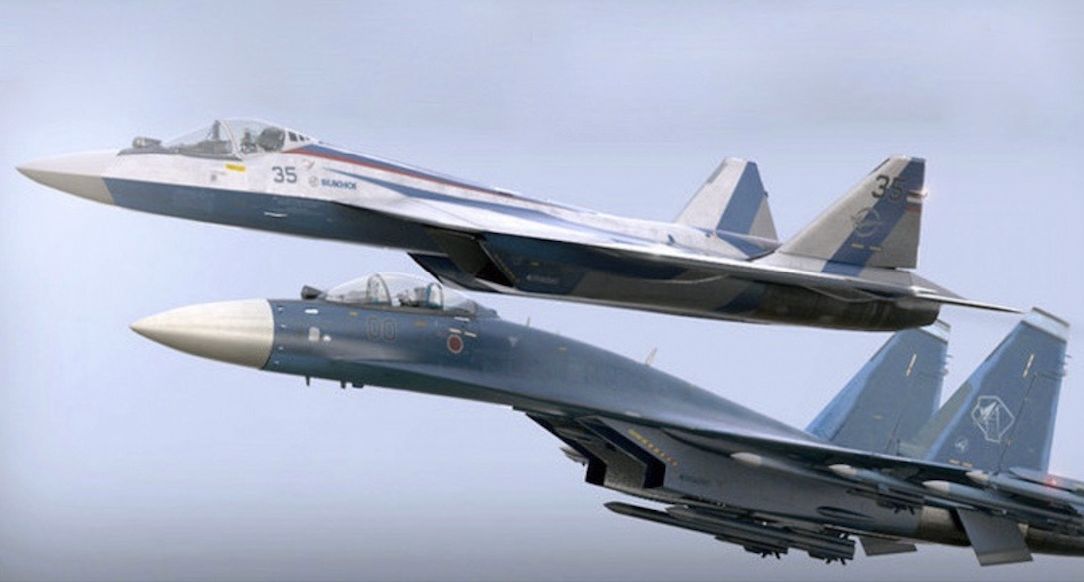
Russian Air Force Su-57 and Su-35 - artwork
FIGHTERMAN
The Russian Air Force inducted its first Su-35 ‘4++ generation’ air superiority fighters into service in 2014, with the 100th aircraft reportedly leaving production lines in mid-December 2018 and over 80 of the aircraft in Russian service today. The fighter program has been the post prolific success in Russian military aviation since the Soviet collapse, with the Su-35 representing an extensive enhancement of the original Soviet Su-27 air superiority platform integrating a reduced radar cross section, a stronger but lighter airframe making greater use of composite materials, new more powerful engines with three dimensional thrust vectoring capabilities for unrivalled manoeuvrability, new electronic warfare systems, compatibility with the latest munitions such as the R-77 and R-37M air to air missiles, a large 14 missile payload, and advanced sensors including an Irbis-E radar. The platform not only considerably surpasses the capabilities of Western fourth generation combat jets such as the F-15C and Eurofighter Typhoon, but it is also considered by the Russian military to be capable of engaging the most advanced American air superiority fighter the fifth generation F-22 Raptor and its lighter less specialised counterpart the F-35. Given the performance of the Su-35 during recent deployments in close proximity to the F-22 in Syria, where the American jet failed to detect the Russian platform and the Su-35 itself managed to gain a lock onto the Raptor, this remains somewhat plausible.
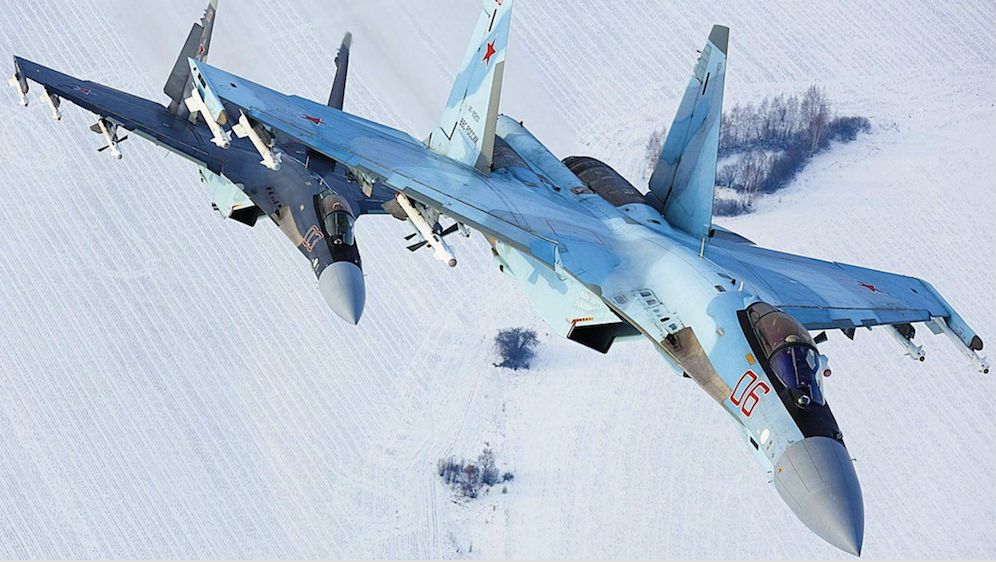
The Su-35 has received considerable interest from abroad, with two dozen fighters deployed by the Chinese People’s Liberation Army alongside the fifth generation Chengdu J-20, 11 fighters on order in Indonesia, and reported but unconfirmed orders placed by Algeria and Egypt. Su-35 technologies including the Irbis-E radar have also been integrated onto the less costly Su-27SM2 and Su-37SM3 air superiority fighters, and the next generation design has also reportedly influenced China’s own development of an enhanced Flanker derivative the J-11D. The Russian Air Force’s decision to keep the Su-35 in production is likely influenced by multiple factors. These include the need to keep production lines open as foreign interest continues to grow, with foreign sales heavily subsidising production of the aircraft, as well as the lower cost of the fighter relative to the Su-57 and the complementary roles the two can play. The Su-57 for its part remains a work in progress, as while an advanced fifth generation design has been completed future variants of the aircraft are set to integrate a number of sixth generation technologies including laser weapons, hypersonic weapons and artificial intelligence. The greater operational cost of the Su-57, and the relatively small production run planned for the coming decade of little under 80 fighters, means that a large fleet of Su-35 remains a valuable asset for the Russian Air Force - particularly as United States inducts more F-15EX and F-35 fighters into service. Similar parallel manufacture of fifth generation and ‘4++ generation' air superiority aircraft can be seen in China and the United States - the former with the J-20 and J-11D and the latter with the F-22 and F-15EX.
