
Republic of China Defence Researcher Highlights Measures to Adapt to Growing Air Domain Disadvantage
Military Watch Magazine Editorial Staff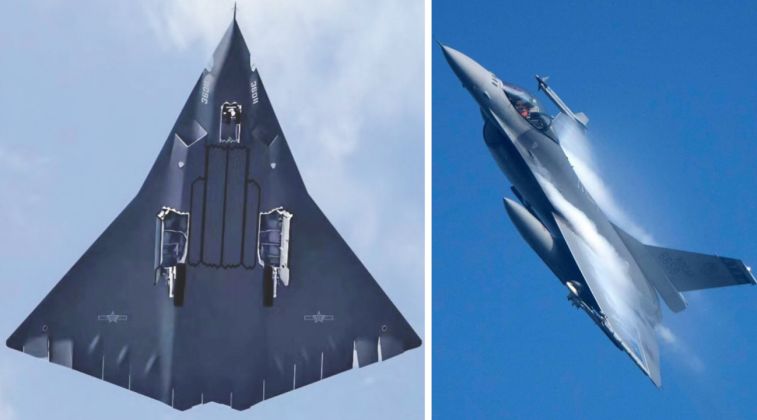
Chinese Mainland Sixth Generation Fighter Prototype (left) and ROCAF F-16
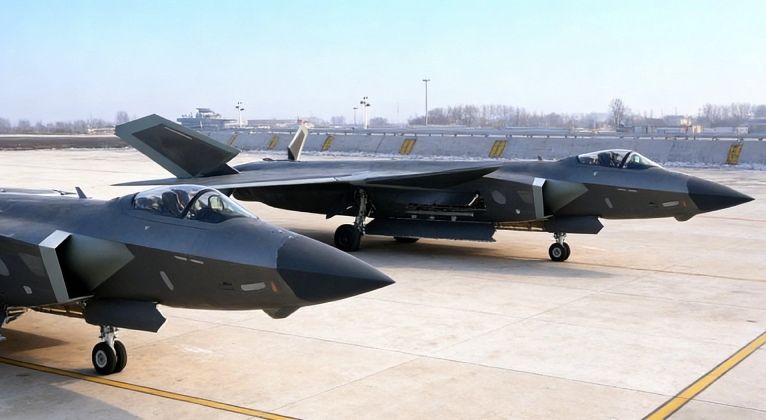
Associate researcher at the Republic of China Institute for National Defense and Security Research Shu Hsiao-huang has assessed that the Republic of China Armed Forces can take a range of measures to compensate for an inability to procure fifth generation fighter aircraft. His assessment was made at a time when an increasingly wide technological disadvantage in the air domain is perceived to have placed security increasingly under threat. Shu assessed that a fifth generation fighter is unlikely to be procured within the next decade, as efforts by the Republic of China Ministry of National Defense to procure the only NATO standard fighter of this generation, the F-35, have consistently been rebuffed by the United States. The Chinese People’s Liberation Army Air Force, with which the Republic of China remains in a state of civli war, has fielded advanced fifth generation fighters for over nine years, and has rapidly expanded its fleet and incrementally improved its aircraft’s capabilities.
Shu assessed that in the absence of near or medium term options to procure fifth generation fighters, the procurement of ‘4+ generation’ fighters can meet air defence requirements to a limited extent. The Republic of China Air Force operationalised its first fourth generation fighters in November 2021, after 64 obsolete F-16A/B Block 20 fighters procured in the 1990s were modernised to the F-16V standard with similar avionics to the modern F-16C/D Block 70/72 variant, and brought back into service. While continuing to receive more of these modernised aircraft, the Air Force is also expected to operationalise 66 new F-16 Block 70/72 fighters, which the U.S. agreed to export despite refusing to supply the higher end F-35. Local industry is meanwhile developing an upgrade package to modernise the indigenous F-CK Ching-kuo fighter to a ‘4+ generation’ standard, while also producing the Brave Eagle ‘4+ generation’ fighter to equip a single squadron.
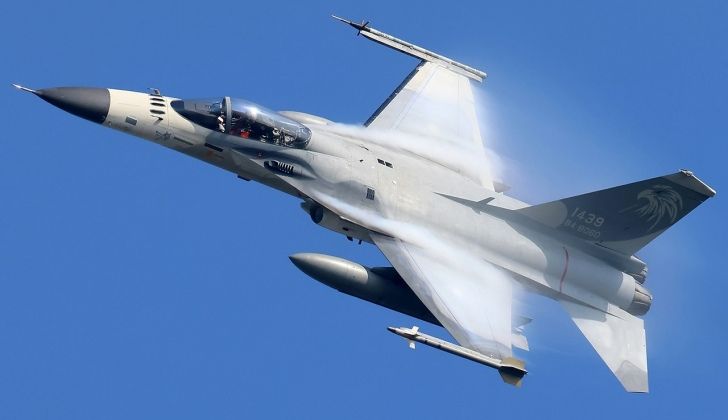
Shu observed that in addition to long-range air-to-air and air-to-ground weapons, electronic warfare capabilities will be key to the future enhancement of the Ching-kuo fighter fleet, while highlighting the value of gallium nitride-based radar technologies. The Republic of China Air Force is expected to fall two generations behind the People’s Liberation Army, as the latter is expected to become the first in the world to operationalise sixth generation fighters in the early 2030s. The United States Air Force is not expected to field sixth generation fighters until the 2040s. As the balance of power in the air has become increasingly overwhelmingly unfavourable for Taipei, it is expected that the Republic of China Armed Forces will increasingly emphasise the fielding of asymmetric assets including ground-based air defences, as well as ballistic and cruise missiles capable of striking airfields hosting advanced adversary fighters.
