
French Rafales Engage Russian Su-30SM Long Range Fighters on Tense European Frontlines
Military Watch Magazine Editorial Staff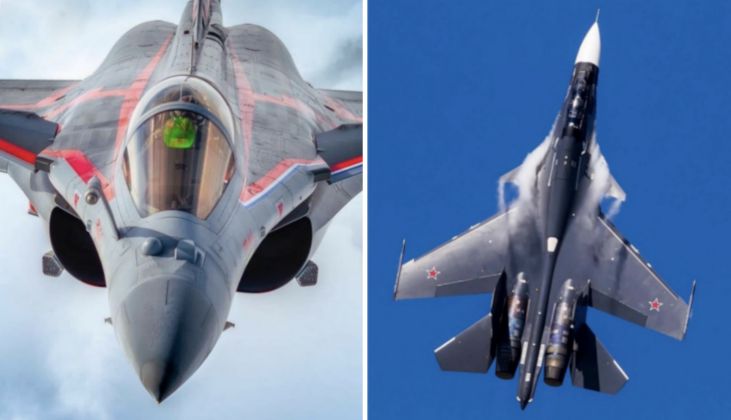
Rafale (left) and Su-30 Fighters
The French Air Force has scrambled Rafale fighters scrambled from Siauliai Air Base in Lithuania to intercept two Russian Navy Su-30SM2 long range fighters over the Baltic Sea, with the French Armed Forces Armed Forces General Staff publishing images of the interception. The Rafales assumed a new rotation for Baltic Air Policing in the first week of April, arriving at Siauliai Air Base which is located just 130 kilometres from Russian territory. The fighters’ arrival closely coincided with the French Army’s deployment of Leclerc main battle tanks for live fire exercises in Romania, across the border from Ukraine. In mid-April the aircraft engaged Russian Su-30SM fighters, as well as an accompanying Il-20M electronic intelligence aircraft. Subsequently in early May they intercepted to Russian Aerospace Forces Su-24M strike fighters over the Baltic Sea.
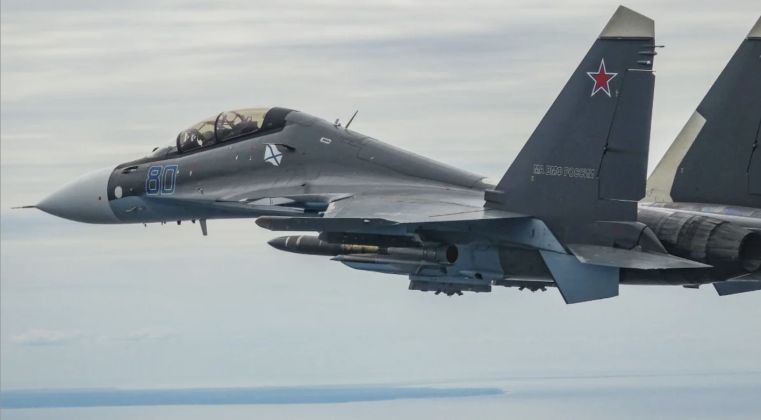
Siauliai Air Base has served as the primary hub for hosting fighter aircraft from other NATO member states, with Spanish Air Force F-18 fighters having directly preceded the French Rafales on rotation at the facility. Shortly before being withdrawn, the F-18s intercepted Su-30SM fighters over the Baltic Sea in late January. Spanish variants of both the F-18 and the Eurofighter have long since been considered obsolete, and are significantly outmatched across the large majority of performance parameters by the Su-30SM. The deployment of Rafales in Lithuania has been supported by over 100 French military personnel. The aircraft have used the Thales TALIOS targeting pod in the past to achieve visual identification of unknown aircraft at long ranges, and in April used these to identify Su-30SMs carrying Kh-31 anti-radiation missiles which were specifically designed to destroy NATO radar systems. This weapons payload suggested a mission profile linked to suppression of enemy air defences that was not a regular show-of-force operation.
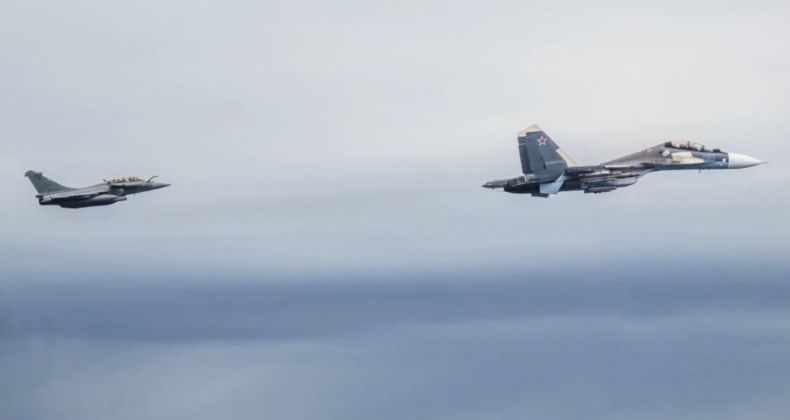
The Su-30SM/SM2 is one of four fighter types currently being produced to equip the Russian Armed Forces, alongside the similarly priced Su-34M strike fighter, the Su-35S air superiority fighter which is close to 60 percent more costly, and the Su-57 fifth generation fighter which is estimated to cost well over twice as much to procure. The enhanced Su-30SM2 variant first entered service in early 2022, and integrates twin AL-41F-1S engines to achieve a much improved flight performance and reduced maintenance needs. The more modern engine uses a wide range of technologies from the much more ambitious Soviet AL-41F fifth generation engine design, which saw plans for production cancelled after the state disintegration. While the Su-30SM2 is powered by the most powerful engine ever integrated on an operational fourth generation fighter, the Rafale’s M88 is by far the weakest fighter engine currently in production worldwide, reflecting both the vast discrepancy in size between the Rafale and Su-30, and the fact that the French aircraft places a much lower emphasis on flight performance than the Russian one.
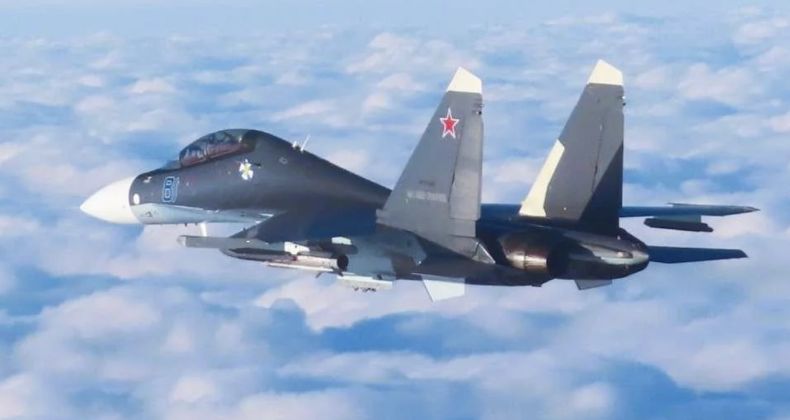
The Rafale is a lightweight ‘4+ generation’ fighter constrained by a very small radar, around one quarter the size of those of Russian Su-30 and Su-35 fighters, and by its limited flight performance. The aircraft has been widely assessed to be far outmatched not only by advanced fifth generation fighters such as the U.S. F-35 and Chinese J-20, but also by higher end fourth generation fighters like the U.S. F-15EX and Russian Su-30SM. The Rafale competed against the Su-30 for orders on three known occasions, namely in Algeria, Ethiopia and Kazakhstan, and notably lost in all three cases, with the Russian fighter having a radar over three times as powerful, and having vast advantages in range, weapons payload capacity, and almost all aspects of flight performance.
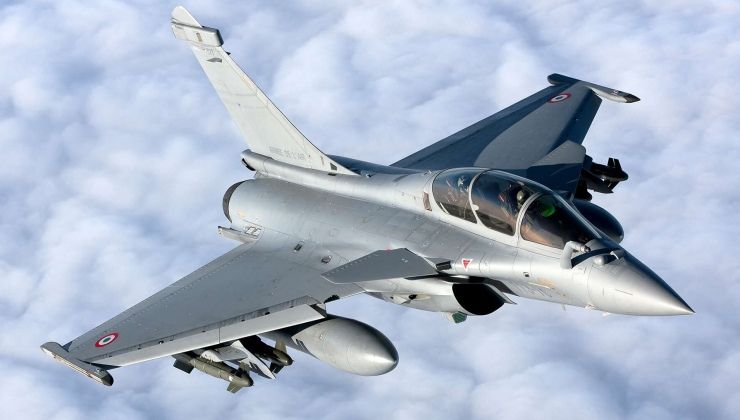
The Rafale saw its first deployment for intensity combat in May 2025, during which between one and four of the aircraft flown by the Indian Air Force were neutralised during engagements with Pakistan Air Force’s Chinese-supplied J-10C ‘4+ generation’ fighters - the lowest end fighter type being procured by China’s air force. This followed years of assessments pointing to its the fighter type’s limitations not only compared to U.S. and Chinese fighters, which currently lead the world in performance, but also compared to Russian fighter types like the Su-30SM. Like many European states, France has faced a dilemma between supporting local industry to produce less capable fighters, or making sacrifices to procure much more capable F-35 fighters from the Untied States. The United Kingdom has selected the latter option, ending Europfighter procurements and investing heavily in the F-35 program, while Germany has hedged between the two and expanded orders for both the F-35 and the Eurofighter. Major delays to the development of France’s first post-fourth generation fighter are projected to result in a continued reliance on the Rafale as the country’s most capable fighter type into the 2050s.
