
Russian Su-30SM and Spanish F-18 Fighters Engage Over the Baltic Sea
Military Watch Magazine Editorial Staff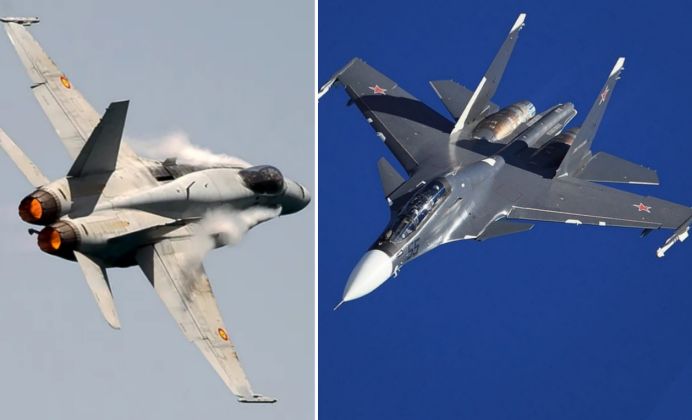
Spanish F-18 and Russian Su-30SM Fighters
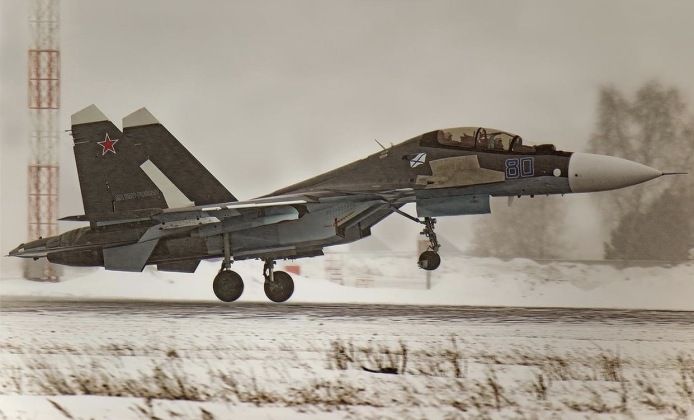
Spanish Air Force F-18M fighter jets intercepted Russian Su-30SM/SM2 fighters over the Baltic region, with the F-18 having operated from Siauliai Air Base in northern Lithuania as part of NATO’s Baltic Air Policing operations. The Spanish fighters reportedly identified the Russian aircraft flying in international airspace close to NATO borders. The Su-30SM fighters were reportedly armed with live air-to-air missiles and cluster munitions, highlighting the operational nature of their patrols and the high readiness posture which Russian air units in the region have maintained in recent years. The Spanish Defence Staff released images of one of the intercepted aircraft, confirming that it was operated by the Russian Navy rather than the Aerospace Forces. The Su-30SM is the most capable fighter in Navy service, with the fleet having gradually been updated to the Su-30SM2 standard integrating updated avionics and the much improved AL-41F-1S engines.
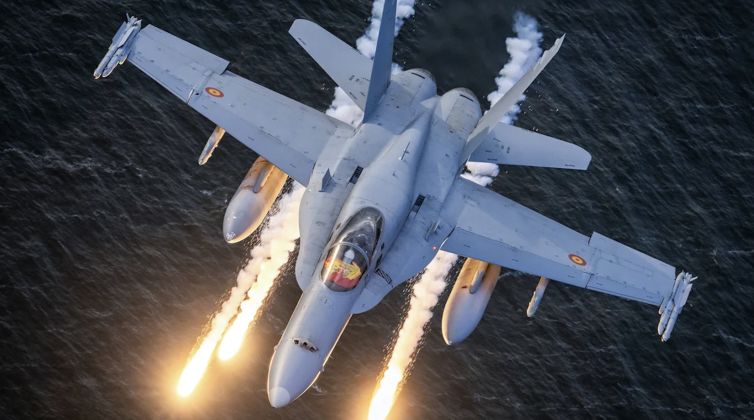
The engagement between F-18s and Su-30s occurred shortly after the former aircraft assumed a new rotation in the Baltic Air Policing mission, with ten F-18s having arrived at Siauliai Air Base in late November, replacing Spanish Eurofighters that were previously on rotation at the facility. Spanish variants of both the F-18 and the Eurofighter have long since been considered obsolete, and are significantly outmatched across the large majority of performance parameters by the Su-30SM, and moreso by the F-35A fifth generation fighter that is gradually proliferating across European air forces. Both fighters in Spanish service are limited by their short ranges, ageing avionics, and carriage of radars which are both small, and decades behind the cutting edge due to their use of mechanically scanned arrays.
The Su-30SM2 is one of four fighter types currently being produced to equip the Russian Armed Forces, alongside the similarly priced Su-34M strike fighter, the Su-35S air superiority fighter which is close to 60 percent more costly, and the Su-57 fifth generation fighter which costs well over twice as much to procure. The Su-30, Su-34 and Su-35 are all derivatives of the Soviet Su-27 air superiority fighter, and have longer ranges and carry far larger sensor suites than any Western fighter types. The AL-41F-1S engine powering the Su-30SM2 and Su-35 has a thrust output level and fuel efficiency more comparable to early fifth generation engines such as the American F119 powering the F-22 fighter, and was the first engine introduced into service anywhere in the world with three dimensional thrust vectoring capabilities. The Su-30SM’s advantage in air-to-air combat potential over the F-18C/D and Eurofighter has reportedly recently widened due to the integration of R-77M air-to-air missiles.
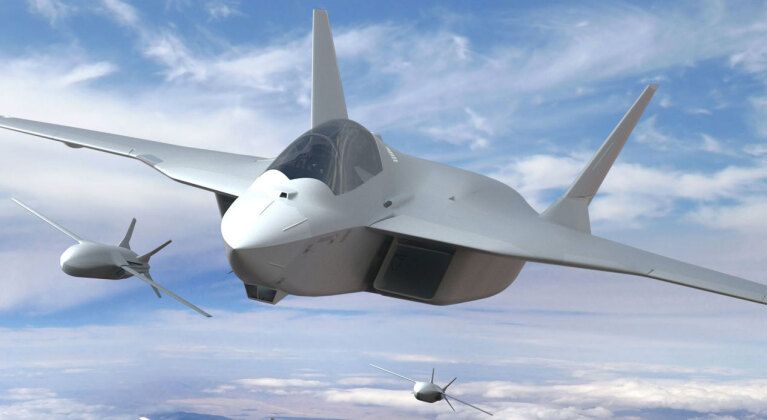
While the Russian Defence Ministry is heavily invested in the Su-57 fifth generation fighter program, the future of the Spanish fighter fleet appears far less certain. The troubled state of the joint Franco-German-Spanish Future Combat Air System (FCAS) stealth fighter program has further increased interest across Europe in procuring the F-35, with Spain reported in 2022 to be considering procuring 50 F-35A fighters to replace 25 Spanish Air Force F-18 Hornets and 25 Spanish Navy AV-8B+ Harrier IIs. CEO of French aerospace firm Dassault Eric Trappier in June 2022 revealed regarding the state of the FCAS program that “[The target of] 2040 is already missed, because we already stall, and the discussions of the next phase will surely also be long,” noting that the aircraft was intended to enter service in 2050, by which time the United States and China are expected to have been fielding sixth generation fighters for around 15 and 20 years respectively. Although the Spanish Defence Ministry has for political reasons remained one of Europe’s last holdouts against ordering F-35s, the likelihood of an order being placed has continued to grow.
