
Can Taiwan’s Air Force Operate Without its Airfields? Freeway Takeoffs Demonstrated in the Han Kuang Military Drills
Military Watch Magazine Editorial Staff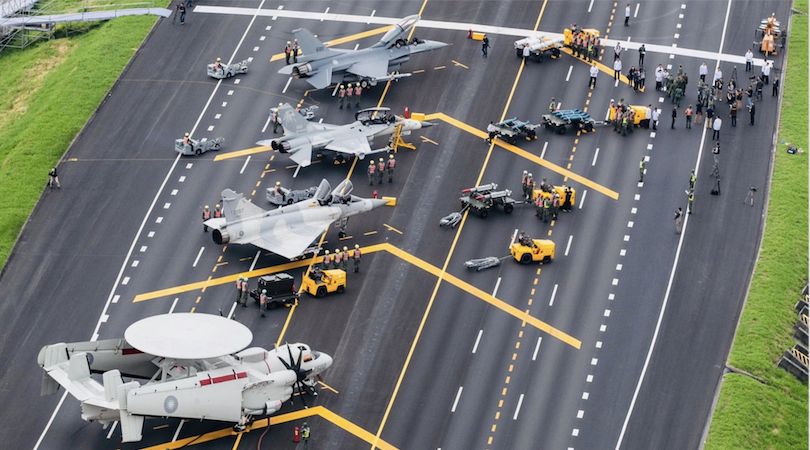
Taiwanese F-16V, Ching Kuo, Mirage 2000 and E-2 on Sun Yat Sen Freeway
Taiwan’s Air Force has demonstrated the ability of its combat jets to operate away from its airfields in the recent Han Kuang military exercises, with the Huatan section of the Sun Yat Sen Freeway cleared to allow fighters to deploy from the civilian road network as it is expected to in the event of a major war. Taiwan’s Air Force currently fields four fighter types in six squadrons, including the F-16V Fighting Falcon, F-CK Ching Kuo, Mirage 2000 and F-5E Tiger II, all lightweight platforms designed for operations near a conflict’s frontlines and capable of taking off from relatively short runways. The service also relies heavily on the E-2 Hawkeye airborne early warning and control system (AWACS) to provide critical support to its fighter squadrons, and these propeller driven aircraft are designed specifically for short takeoff and originally intended for deployment from American aircraft carriers. Given the light weight of Taiwanese fighters and their resulting small radars, the E-2 is essential to providing the Air Force with a high level of situational awareness in the event of a potential conflict.
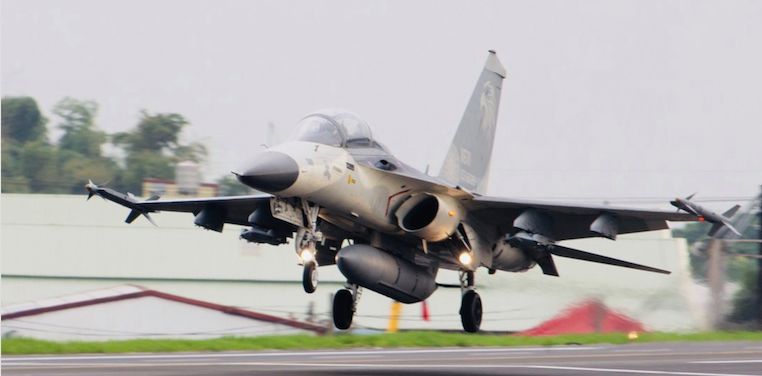
Approximately 1,600 servicemen participated in the Air Force’s combat readiness drills, which also reportedly included F-16V fighters of which less than a dozen are currently in service. Taiwan’s Aerospace Industrial Development Corporation has indigenously modernised a portion of the Air Force’s F-16A Fighting Flacons to this standard, which includes integration of an active electronically scanned array radar and new electronic warfare systems and avionics. The importance of deploying jets away from airfields is considered particularly vital in the event of a cross straits war, with Taiwan’s airfields expected to be neutralised within hours by ballistic and cruise missile strikes from the Chinese mainland’s People’s Liberation Army (PLA). Aircraft such as the H-6K, JH-7 and J-16 are all highly capable of launching precision strikes to cripple Taiwanese airbases in this regard, among other assets including ground, submarine and destroyer based missiles. Air Force Colonel Shu Kuo Mao thus told reporters: "There are only a few military air bases [in Taiwan], which would become prime targets in the event of an attack. The highway drill is necessary, as highway strips would be our priority choice if the runways are damaged during a war."
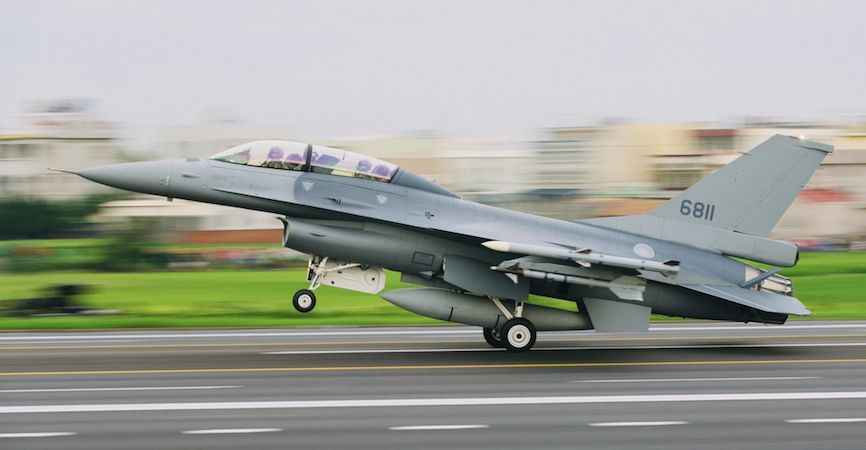
Four sections of Taiwan’s Sun Yat Sen Freeway were designed specifically for use as emergency runways in the event fo war, but the vast majority of roads are considered unable to accommodate combat jets. The F-16, Mirage 2000 and F-5 were never built to make use of makeshift runways when they were designed during the Cold War, lacking sufficient mudguards and protection for their engines meaning they are prone to malfunction on anything less than a fully immaculate runway. This was not the case for Soviet jets such as the MiG-29 and Su-27, and the many PLA aircraft such as the J-11 have inherited this hardiness from the Soviet platforms form which they are derived. Taiwan had sought to acquire the Lockheed Martin F-35B from the United States, the most costly combat fighter jet in production anywhere in the world today, which retains specialised short takeoff and vertical landing capabilities allowing it to deploy from makeshift runways both on the Taiwanese mainland and from outlying islets controlled by Taipei. With the United States having denied this request, and Taiwan instead set to acquire further F-16V squadrons, the runways from which the Air Force will be able launch operations will remain limited.
