
U.S. Withholds F-35B Stealth Fighters From Taipei - Fears Taiwan's Armed Forces are Compromised by Chinese Agents
Military Watch Magazine Editorial Staff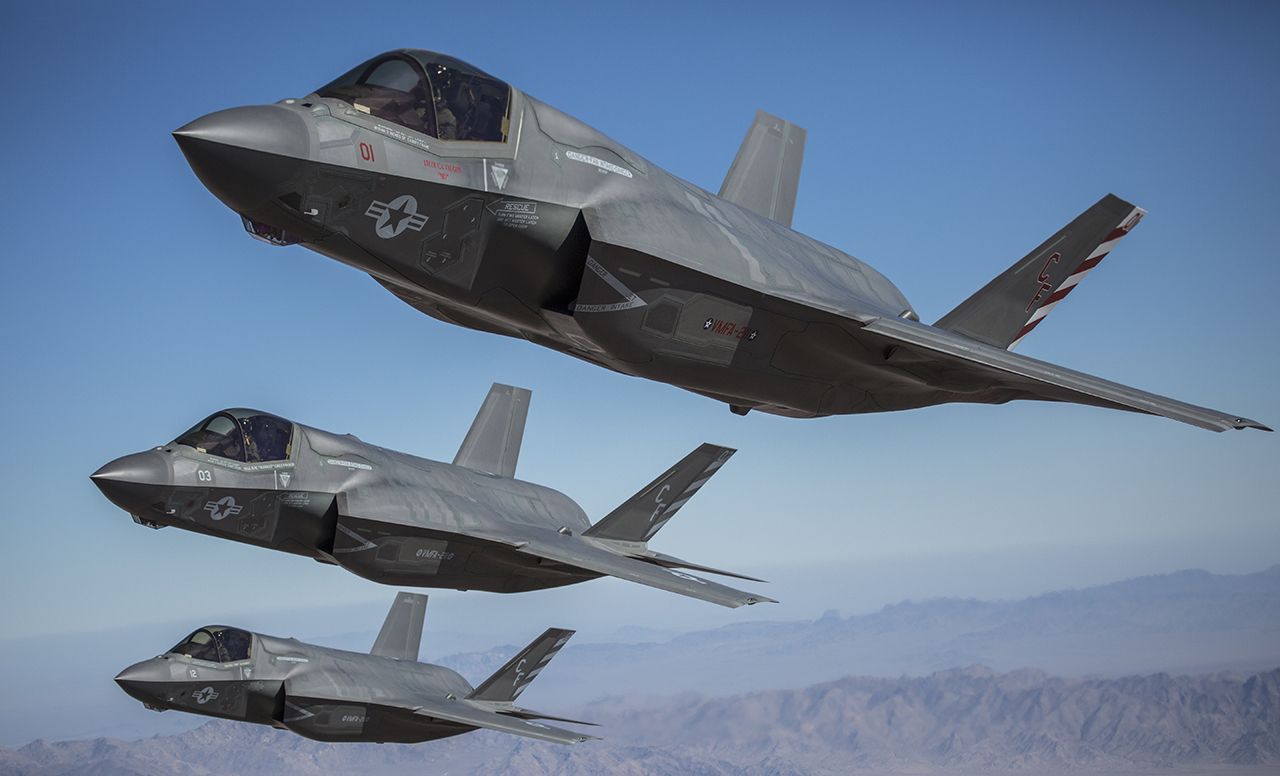
F-35B Light Stealth Fighters
The Aviationist
In an effort to modernise its increasingly antiquated aerial warfare capabilities, Taiwan has reportedly sought to acquire F-35B light stealth fighters from the United States at a time of growing tensions with across the Taiwan straits. While designed with short takeoff and vertical landing capabilities (STOVL) primarily to deploy from aircraft carriers such as the U.S. Wasp Class, Japanese Izumo Class and British Queen Elizabeth Class, which lack the ability to accommodate conventional carrier based aircraft such as the F-18E and F-35C, the F-35B is also prized for its ability to operate from extremely short makeshift runways. This had led the U.S. Marine Corps and the armed forces of Japan and Israel to consider operating the fighter for operations without carriers, the former two to deploy from remote Island outposts in the Pacific while the Israeli Air Force has considered deploying them to short landing strips near the frontlines of potential combat zones.
With Taiwan today deploying the much of its active forces to outlying Island outposts in the South China Sea, Taipei continues to prioritise the fortification of these strategic positions against a potential attack from the Chinese mainland. Taiwan’s Air Force technology mostly dates back to the 1980s or earlier, and lacks the technological capabilities to match platforms fielded by Beijing such as the J-10C. Taiwan’s fleet is comprised entirely of light fighters such as the F-16 and Ching Kuo, which are overwhelmingly outmatched by Chinese long range heavy air superiority fighters such as the J-11 and Su-35, which have actively trained for a campaign against Taipei should the need arise. With Taiwan’s Air Force lacking either long range heavy fighters such as the F-15 or interceptors such as the MiG-31, the short range of its fighters seriously restricts its ability to respond to threats in far off outposts. The state of Taiwan's missile defences similarly leave much to be desired, particularly when considering the sophistication of Beijing's combat aircraft and the number in which they are fielded. Taipei has recently sought to fortify these outposts against air attacks by deploying MIM-23 Hawk surface to air missiles, U.S. made platforms dating back to the late 1950s which have since been extensively upgraded, and remain somewhat viable in defending against air attacks. The STOVL capabilities of the F-35B could prove an invaluable asset to alleviate Taiwan’s pressing situation, with the fighters able to deploy from short runways and thus provide much needed air support beyond the reach of Taipei’s other aerial assets.
As a result of the potential usefulness of the F-35B in defending its outlying islands, Taiwan has become the first non carrier power to show significant interest in acquiring the specialised variant of the stealth fighter. The Air Force has reportedly sought to commission the U.S. made platforms from Lockheed Martin, in a deal estimated to be worth approximately $3 billion - or 30% of Taipei’s annual defence expenditure. The United States government however has on its part proven unwilling to provide the fighters to Taiwan, namely due to concerns that Taipei’s acquisition could facilitate the loss of valuable American technological secrets. With production of the British Harrier Jet and the Soviet Yak-38 long since terminated, the United States remains the only producer of STOVL capable aircraft in the world and retains a monopoly on modern STOVL technologies. For these to fall into the hands of a rival power could have disastrous effects for the United SWith production of the British Harrier Jet and the Soviet Yak-38 long since terminated, the United States remains the only producer of STOVL capable aircraft in the world and retains a monopoly on modern STOVL technologies. For these to fall into the hands of a rival power could have disastrous effects for the United States military, and lead to the production of competing STOVL combat aircraft on already highly contentious export markets and the deployment of far more effective air support by amphibious contingents fielded by America's potential adversaries. The F-35B’s stealth technologies and state of the art radar, engine and avionics, while lacking the sophistication of the F-22 Raptor, are still valuable and could also be put to much use in Beijing's hands.
U.S. apprehension regarding the sale of the F-35B to Taipei has come as a result of a perception that Taiwan’s military is to some degree compromised by agents from the Chinese mainland, which could potentially acquire secrets from the new platforms and pass these on to Beijing both to aid in the development of China's own fighters and to develop effective countermeasures to the American platform. While former U.S. National Security Agency (NSA) contractor turned whistleblower Edward Snowden revealed that China had already gained access to "many terabytes of data" on the United States’ fifth generation fighter programs, the F-35B’s particularly sensitive STOVL systems could still very likely hold some secrets which Beijing lacks.
In Taiwan a number of legislators from the ruling Democratic Progressive Party (DPP) have recently called on President Tsai Ing Wen to strengthen precautions within the government to prevent Chinese agents from acquiring state secrets, indicating that Taipei itself is not overly confident in its proneness to infiltration and espionage by Beijing’s agents. Lawmakers have indicated that only when President Tsai has carried out a satisfactory ‘house cleaning’ operation will the United States consent to a resumption of talks for acquiring the costly next generation fighters. The F-35B is notably the least combat capable of all the fighter’s variants, and by far the most costly to operate and maintain. The platform lacks the firepower, range, speed and altitude to contend with modern Chinese air superiority fighters, and was designed as a light multirole platform primarily for a strike rather than an aerial combat role. The F-35B is currently by far the most expensive fighter on sale anywhere in the world, and even the United States military has struggled to service them due to their phenomenal operational costs. Given the shortcomings in its performance and the United States’ unwillingness to sell the platform without a number of preconditions, Taiwan’s armed forces may well be better served by looking elsewhere to enhance their aerial warfare capabilities.
