
Bringing Chinese Carrier Based Fighters into the Next Generation; Advanced New Engines for J-15 Fighters An Important Step Towards Fielding Some of the World’s Finest Carrier Strike Groups
Military Watch Magazine Editorial Staff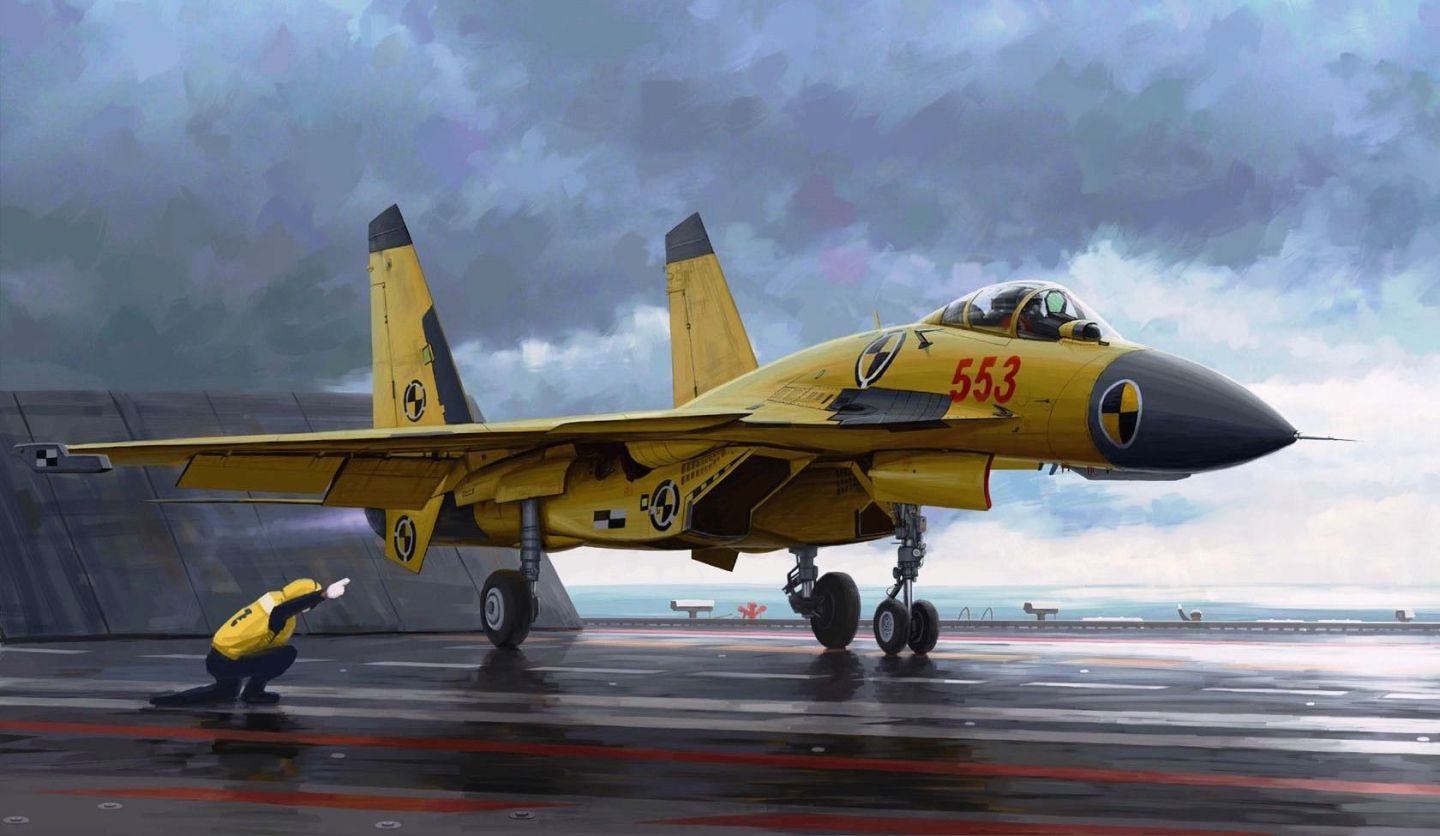
Chinese J-15 Flying Shark Carrier Based Air Superiority Fighter - artwork
As part of a wider program to develop new more advanced combat aircraft with next generation capabilities based on tried and tested fourth generation designs, China’s People’s Liberation Army (PLA) has sought to integrate a number of cutting edge new technologies onto its J-10, J-11 and J-15 fighters. With the country’s air fleet moving into the fifth generation, inducting a number of cutting edge platforms such as the J-20 air superiority fighter and the upcoming H-20 stealth bomber and J-31 twin engine jet, manufacturing heavily modernised new variants of the older fighters gives the military a way of ensuring the older airframes’ continued viability while modernising its fleet at a far lower cost than manufacturing fifth generation stealth aircraft. With lower maintenance requirements and the ability to carry more munitions and external fuel than their fifth generation counterparts, upgraded fourth generation airframes retain a number of advantages over and can play a highly complementary role to fifth generation aircraft, and they are set to continue to play a key role in the PLA for decades to come. Russia for its part has made similar investments, developing a number of ‘4++ generation’ jets such as the Su-35, while the United States is actively considering such a option with the F-15X and F-18E Block 3 to support its F-22 and F-35 stealth jets.
While China’s PLA Navy inducted the J-15 Flying Shark in to service in 2012 as a relatively basic fourth generation carrier based air superiority fighter, with capabilities analogous to the Air Force’s J-11B, as the country’s carrier program has expanded rapidly considerable investments have been made to enhance the capabilities of the air superiority jet's airframe. A new aircraft, speculated to be designated J-15B, is expected to follow a similar development path to the J-10 and J-11 in its development into a next generation fighter - with both of these jets as the enhanced J-10C and J-11D variants integrating advanced thrust vectoring technologies for supermanoeuvrability, stealth coatings for a reduced radar cross section, powerful AESA radars and infra red search and track systems for a reduced radar signature and formidable detection range. These next generation derivatives of the older fourth generation jets also make use of powerful derivatives of the WS-10 engine - a single one for the J-10C and in twin configuration on the J-11D - alongside advanced new munitions such as the PL-15 and PL-12D air to air missiles which will give them among the longest engagement ranges of any fighters in the world.
New variants of the J-15 are set to be considerably more formidable than their predecessors, and reports that the WS-10H engine which will power them is nearing mass production indicates that new batches of the fighters could well enter service in the near future. The WS-10 reportedly has 52% more dry thrust than the F404 used by the U.S. Navy’s own F-18 carrier based fighters, and 59% greater thrust when using afterburners, and the new engine will have a longer lifespan considerable greater thrust than older variants of the WS-10. Thrust vectoring nozzles are likely to also be integrated onto the engines of new Flying Shark variants. While the J-15 airframe has considerable potential, with a higher speed, payload and operational altitude and greater manoeuvrability than any Western carrier based fighter currently in service due to its advanced air superiority airframe, the fighter has been seriously constrained by its extremely low takeoff weight - a result of the shortcomings of the ski jump system on China’s two commissioned carriers. Though the induction of the WS-10H is set to somewhat compensate for this, the Flying Shark is set to approach its full potential when deployed from the upcoming Type 002 and Type 003 carriers - which will integrate advanced electromagnetic launch systems allowing the fighters to deploy with a full fuel supply and several times the missile payload of those currently deployed from the carrier Liaoning.
While China’s carrier capabilities currently appear mediocre at best, the combination of the J-15’s potentially highly formidable air superiority airframe, next generation technologies such as PL-15 missiles and three dimensional thrust vectoring systems, and the use of an electromagnetic launch system on future carriers, is likely to provide the PLA Navy with some of the most formidable carrier air wings in the world by 2025. Combined with investments in KJ-600 AWACS platforms, a force multiplying asset analogous to the U.S. Navy’s E-2 Hawkeye, Chinese carrier strike groups will be well above and beyond all rivals other than the U.S. Navy in their capabilities - with the United States’ post Cold War retirement of its costly carrier based air superiority fighters and cancelation of plans to develop suitable replacements somewhat compensating for its far greater experience operating carrier strike groups.
