
China Developing Elite New Variants of the J-15 Flying Shark to Deploy from EMALS Equipped Future Carriers; Implications for the Balance of Power at Sea
Military Watch Magazine Editorial Staff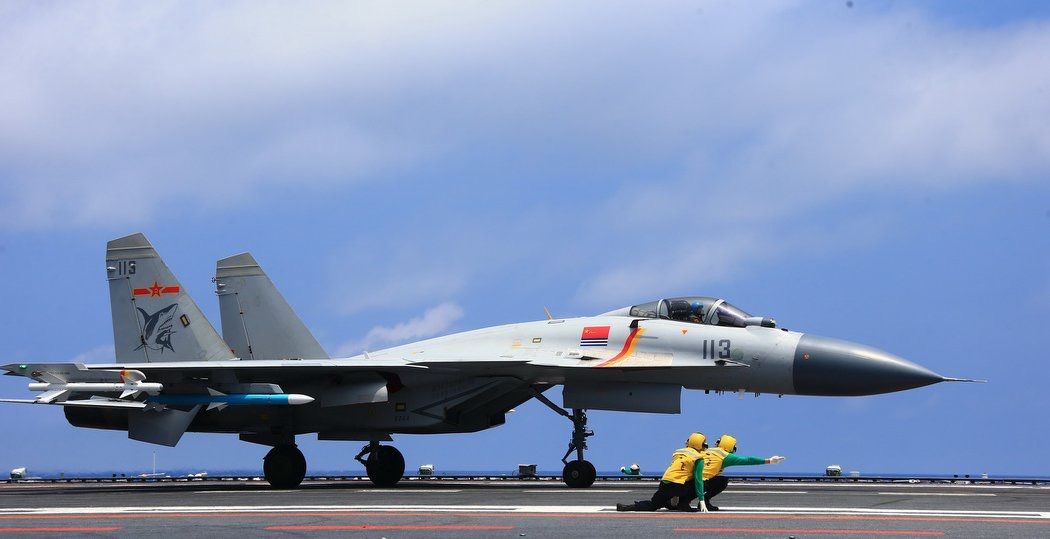
Entering service with China's People's Liberation Army Navy in 2012, the J-15 Flying Shark twin engine air superiority fighter today represents the service’s only carrier based combat jet. Deploying from China’s sole commissioned aircraft carrier the Liaoling - a close derivative of the Soviet Kuznetsov Class warship, and using an airframe based on a prototype of the Russian Su-33, the J-15 makes use of a number of cutting edge indigenous technologies which combined with an abundance of funds for modernisation have made it a considerably superior platform - one of the most capable carrier based fighters in the world today. Fielding the J-15, China's Navy is the only one in the world today to deploy a large number of carrier based air superiority fighters, with the Flying Shark heavily specialised in air to air and anti shipping roles needed for war at sea rather than a strike role against enemy ground targets. This closely reflects the highly defensive orientation of the PLA’s carrier program at present, which has not invested in long range power projection capabilities suited to operations far from the country’s coastal waters such as air to ground strike optimised fighter jets, and the carrier fleet much like the J-15 appears instead to be heavily tailored towards protecting China's maritime claims at sea.
While the original J-15 fighter, much like the Su-33, was designed to operate without a catapult system and instead makes use of a ski jump to take off from a short carrier runway, with China's two upcoming carriers the Type 002 and Type 003 set to deploy advanced electromagnetic catapults (EMALS) future carrier based fighters will need to be compatible with such launch systems. Deploying combat aircraft using EMALS not only reduces the strain on their airframes, thus increasing their service lives and reducing maintenance requirements, but the launch system also provides the aircraft with considerably more energy upon launch which allows them to take off with more fuel and munitions than their counterparts using either ski jumps like the Kuznetsov Class or steam catapults like America’s Nimitz Class supercarriers. For the J-15, a heavy, high altitude and long ranged fighter with a considerable payload relegated to operating at just a fraction of its potential from carriers such as the Liaoling due to the limitations imposed on its takeoff weight by the ski jump system, the introduction of carriers with EMALS to the PLA Navy has considerable implications for the fighter's combat capabilities. With Russia’s Su-33 facing imminent retirement, and the United States Navy for having retired its own elite carrier based air superiority fighter the F-14D in 2006 and cancelled the planned fifth generation replacement, a carrier based variant of the F-22 Raptor, due to budgetary constraints and the lack of near peer threats in the Cold War’s aftermath, the J-15 will soon be the world’s only carrier based air superiority fighter in service. When deployed using a new launch system, this will make the Chinese Flying Shark by far the longest ranged, highest flying and most heavily armed jet at sea - operating at speeds far surpassing the lighter F-18E and F-35C deployed by U.S. carriers.
A number of reports have indicated that the first of a new generation of Flying Sharks have already been manufactured and are currently being used to train pilots to operate using catapult launch systems at the Huangdicun training facility - where the navy previously trained its carrier pilots in the years leading up to the Liaoling's entry into service. According to analyses of recent satellite photos of Huangdicun, mock runways with jet blast deflectors and catapult launch systems have been in active since at least 2016 - almost certainly for the testing of a new generation of carrier based aircraft. While the J-15 fighters in service onboard the Liaoling are incompatible with EMALS, leading to some speculation that the PLA would prefer an entirely new stealth fighter for its upcoming carriers, recent satellite images of Huangdicun indicate that new production variants of the Flying Shark have been designed to operate using electromagnetic launch systems and have been in testing for over a year. Separate testing of what appears to be an electronic warfare variant of the J-15, a similar concept to the U.S. E/A-18G Growler, has also been observed. While the development of a catapult compatible variant of the J-15 has been widely speculated since the fighter first entered service in 2012, its confirmation raises a number of questions regarding what other modifications the new carrier based air superiority fighter will field.
With the J-15 at the time of its first induction having represented the pinnacle of Chinese military aviation, with capabilities similar to those of its land based counterpart the J-11B, the country's capabilities in the field have advanced considerably since with the induction of fifth generation and '4++ generation' platforms fielding technologies far in advanced of the original J-15. It remains highly likely therefore that the new Flying Shark, possibly under a new designation - J-15B perhaps - will field a number of next generation technologies significantly superior to those of the original fighter. Based on the next generation technologies integrated onto the J-10C and J-11D, next generation modernisations of older airframe designs, the new J-15 could well expect thrust vectoring, AESA radars, stealth coatings, extensive use of composite materials and the latest PL-15 air to air missiles to be among the upgrades implemented. Combined with the use of a new electromagnetic launch system, an effective force multiplier for the Flying Sharks relative to operating with a ski jump, this will make China's future carrier air wings considerably more capable than those currently in service - better exploiting the high potential of the J-15 airframe and posing a far greater challenge to the country’s near peer potential adversaries at sea.
