
Chinese State Media Confirms J-20’s Role as an Air Superiority Fighter: Stealth Aircraft a Direct Competitor to America's F-22
Military Watch Magazine Editorial Staff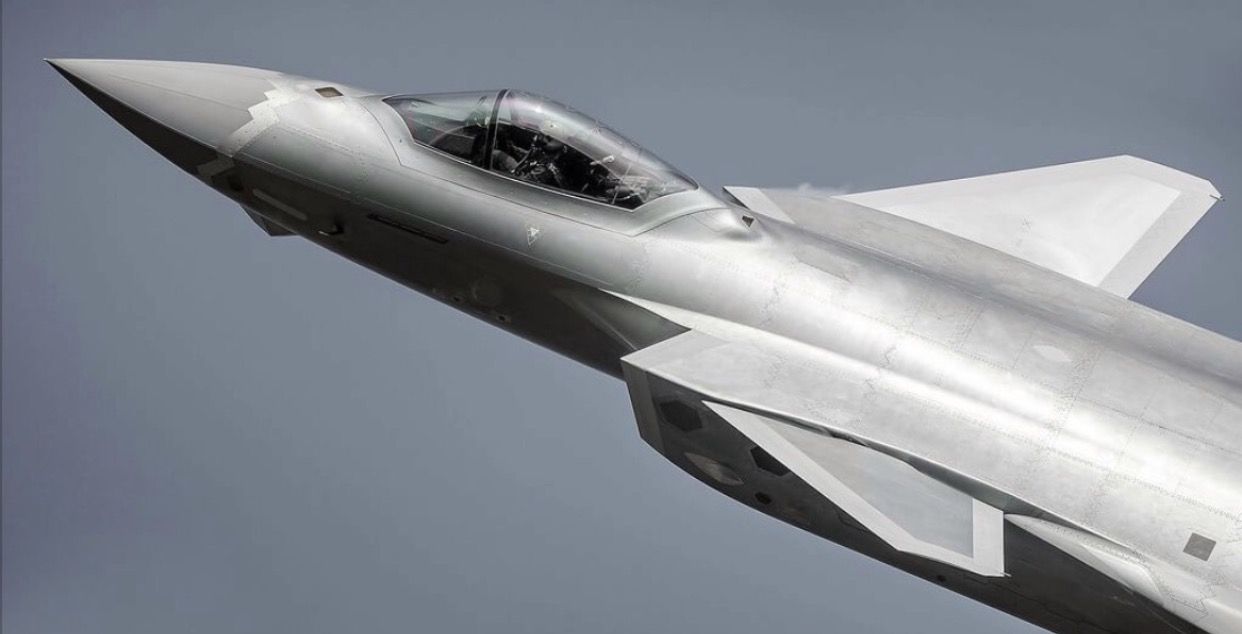
J-20 Stealth Fighter
Since China’s J-20 fifth generation heavyweight fighter first flew 2011 there has been significant speculation from a wide range of sources as to its purpose and what primary role it was intended to fulfil. The aircraft’s size, twin engines, stealth profile and airframe all indicated an air superiority role similar to that of the American F-22 Raptor, which entered service in 2005, although a number of alternative theories have also prevailed. While a large airframe, high thrust, operational altitude and speed, long range and sizeable missile payload are all key to the performance of air superiority platforms, a number of other combat roles also require such specifications.
A number of analysts thus speculated that the J-20 was designed as an interceptor similar to the Russian MiG-31 Foxhound, which was designed with a massive carrying capacity for oversized air to air missiles and an oversized sensor suite to engage high value support aircraft and bombers at extreme ranges. While the J-20 is heavy by the standards of fighters, however, it remains significantly lighter than the MiG-31 and cannot carry comparably large missiles while in stealth configurations. The Chinese fighter’s high manoeuvrability, which is set to improve markedly with the integration of WS-15 engines and incorporation of thrust vectoring technologies, also strongly indicate it is an air superiority fighter and not a dedicatd interceptor. As more details regarding the J-20’s capabilities have been revealed, it has become clearer that its capabilities did not match those of a dedicated interceptor - which are the least manoeuvrable of all aircraft types deigned for air to air combat.
Another role considered a possibility for the J-20 was that of an interdictor or strike fighter, similar to the proposed FB-22 strike variant of the F-22 Raptor. Such a fighter would require a longer range than even air superiority fighters, and their primary task would be offensives to destroy enemy infrastructure and supplies as an interdictor or to target enemy ground and possibly naval surface platforms at long ranges as a strike fighter. The J-20’s stealth capabilities and high operational altitudes could well have made it an effective platform in such roles, but the fighter’s airframe appeared to more closely reflect an intended air superiority role. The fact that the fighter has not been seen with air to ground weapons, but exclusively with air to air missiles, was the clearest indicator of this. The vast maritime distances separating China from its major potential adversaries, and Beijing’s already formidable and ever expanding maritime strike capabilities, also indicate that Beijing needs to modernise its air superiority capabilities far more than it does its strike capabilities. Controlling the skies above the South and East China Seas, or at least denying control to potential Western adversaries, is expected to be key to determining the outcome of a potential future conflict should Chinese interests in these regions come under attack by the United State and its allies.
Speculation regarding the J-20’s purpose has likely finally been put to rest due to a recent report by the Chinese state media outlet People’s Daily, an official newspaper of the Communist Party of China. The report released on June 2nd 2018, covering recent exercises carried out by China's new generation of fighters including the J-20, the J-10C light fighter and J-16 multirole jet, elaborated as follows on the roles assigned to each of these: “During the exercise, the J-20 pilots used their aircraft's advantages in terms of situational awareness and stealth to gain air superiority, while the J-16 and J-10c fighters carried out precision strikes on ground targets. The training sought to take full advantage of the different capabilities of the fighter jets.”
With the J-20 confirmed to be used in an air superiority role, complementary to those of China’s other new combat aircraft, the aircraft is a direct competitor to the Untied States Air Force’s F-22 Raptor -a fighter which the J-20 is expected to surpass in its capabilities due to the far greater pace at which it is being enhanced and the stagnation in the Raptor program since the termination of production in 2011. While the J-20 will fulfil an air superiority role, remaining outstanding questions regarding China’s fifth generation fighter programs include the role of the upcoming lighter FC-31 stealth jet, the potential existence of further unannounced fifth generation programs, and the future of the J-20 as a potential carrier based fighter. With defensive air superiority having long been a priority for the Chinese fleet, and China being one of just three countries alongside Russia and the United States capable of producing any kind of heavyweight fighters, the J-20 remains a key asset.
