
U.S. Air Force’s Newest Fighter Demonstrates Airborne Command and Control Capability For Unmanned Stealth Jets
Military Watch Magazine Editorial Staff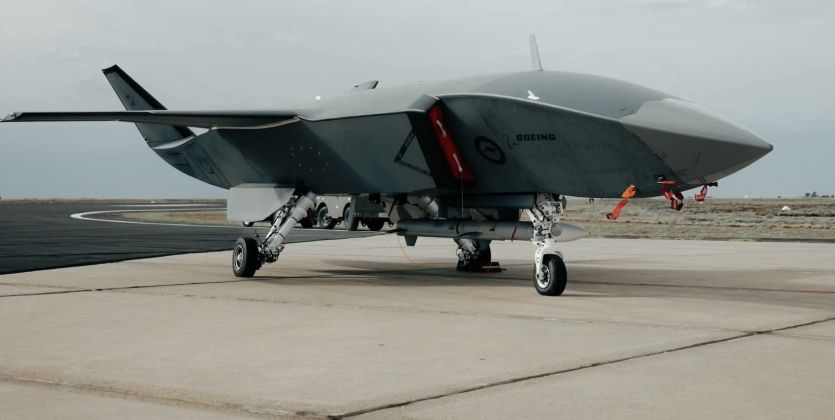
MQ-28 Ghost Bat Unmanned Fighter
The U.S. Air Force has demonstrated a significant advance in human-machine teaming by showcasing its newest fighter type’s ability to operate alongside and control autonomous unmanned aircraft during Exercise Valiant Shield 2026 over the Philippine Sea. This followed the deployment of F-15EX fighters to Kadena Air Base in Okinawa for testing and training purposes, and highlighted the growing role of manned fighters as airborne command nodes for future unmanned formations. The demonstration reflects a broader shift in U.S. air combat doctrine, as fighters are increasingly expected to direct collaborative combat aircraft rather than relying solely on their own weapons and sensors. The unmanned aircraft in question was an MQ-28 Ghost Bat stealth fighter, which has yet to be brought into active service.
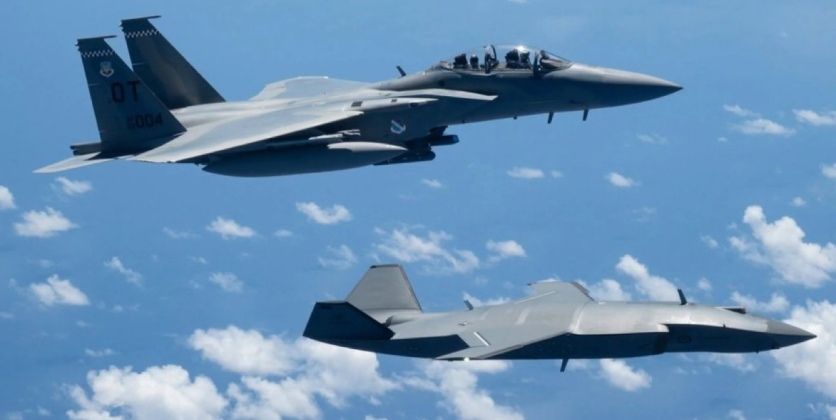
The F-15EX is particularly well suited to service as an airborne command post, as not only is its radar the largest and by far the most powerful carried by a Western fighter type, but it also has by far the longest range of any Western fighter, and has a twin seat configuration allowing an officer in the second seat to focus on command and control functions. The fighter has far greater computing resources than prior F-15 variants, while its Open Mission Systems architecture allows new software and autonomous control functions to be integrated much more rapidly than on older aircraft. In April the U.S. Air Force’s budget for the Fiscal Year 2027 was revealed to have increased planned procurements of F-15EX fighters to 267 aircraft, up from a previously planned 129, reflecting a longstanding demand for an expanded scale of deliveries.
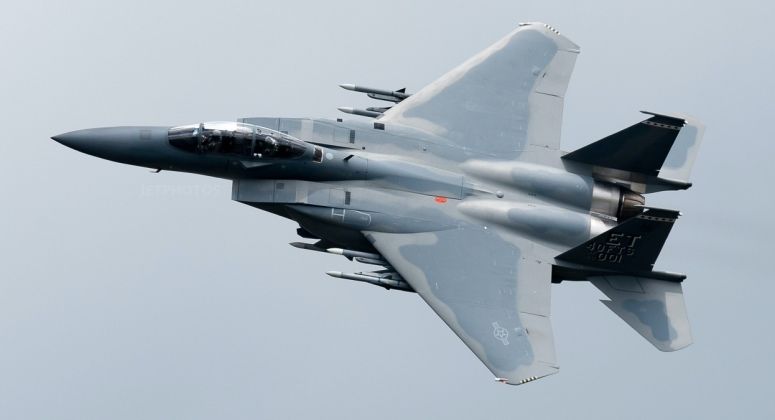
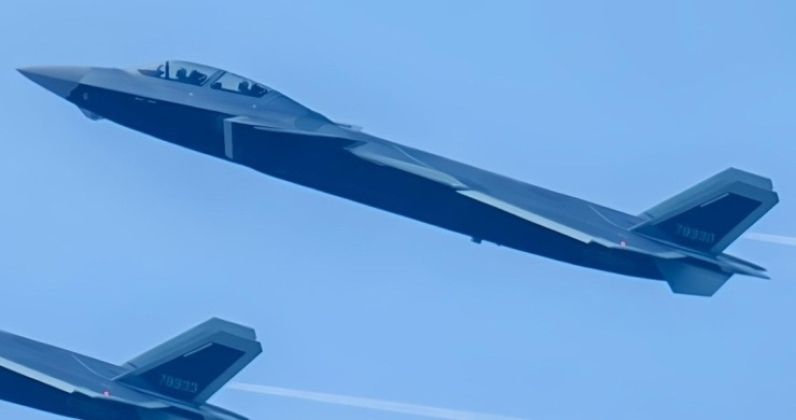
The pairing of manned fighters with unmanned support aircraft is a central capability under development for sixth generation combat aircraft, and is also expected to strengthen the capabilities of fifth generation designs. The United States notably has not developed a twin seat fighter with stealth capabilities, however, with the single seat configuration of its F-35 fifth generation fighter limiting its ability to command and control supporting unmanned aircraft. This leaves the United States significantly behind China in this regard, and may potentially leave future formations built around manned-unmanned teaming vulnerable to the destruction of non-stealth manned fighters such as F-15s at long ranges. The Chinese People’s Liberation Army Air Force was confirmed in July 2025 to have brought the world’s first twin seat fight generation fighter, the J-20S, into service. While the U.S. F-47 sixth generation fighter is expected to also be a twin seater, it is projected to enter service only in the early 2040s, around a decade behind China’s own sixth generation fighters which are also twin seaters.
The MQ-28 Ghost Bat was specifically designed to operate alongside manned fighters, and rather than replacing them, and is intended to multiply their combat effectiveness while reducing risk to pilots. Its principal strength is autonomous teaming. The unmanned stealth fighter can fly semi-autonomously under the supervision of a crewed aircraft or operate independently on pre-planned missions. It also can scout ahead of the formation, identify threats, conduct electronic warfare, act as a decoy, or carry additional weapons, allowing manned fighters to remain farther from enemy air defences. The MQ-28 has a heavily reduced radar cross section, making it considerably more survivable than conventional drones in contested airspace. Combined with a combat radius exceeding 3,700 kilometres, which is over double that of the F-15EX and close to quadruple that of the F-35, this allows it to accompany long-range strike packages across the vast distances of the Pacific.
