
Russia and India Negotiating Contract for Elite New MiG-35 Fighters
Military Watch Magazine Editorial Staff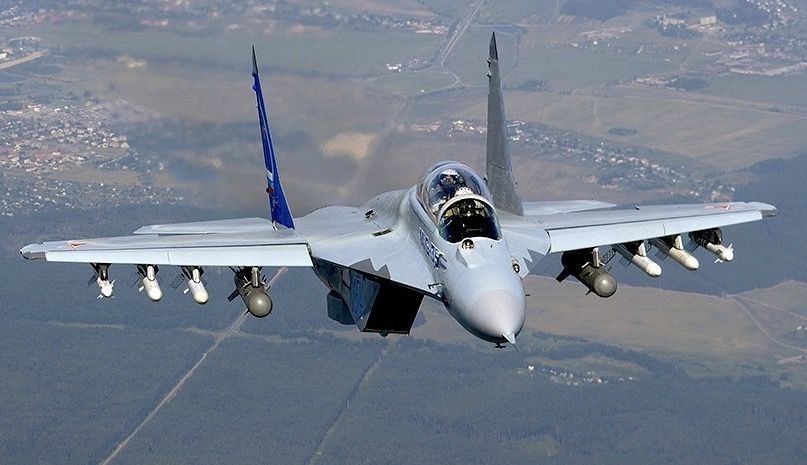
MiG-35 Next Generation Fighter
In the aftermath of the signing of a landmark deal under which Russia is to provide India's armed forces with several units of the S-400 surface to air missile system, the two longstanding partners are reportedly negotiating a number of other weapons contracts - with India showing interest in several next generation Russian systems including Su-57 stealth fighters, T-14 Armata tanks, T-15 APCs and possibly A-100 AWACS platforms. While negotiations for the HAL FGFA program are still ongoing, under which India is to jointly manufacture a fifth generation air superiority aircraft closely based on the Russian Su-57 for its own Air Force, Delhi has also shown interest in acquiring lighter MiG-35 next generation twin engine combat jets. Much as the Su-57 can be considered a next generation analogue to the Su-30MKI, approximately 300 of which are currently fielded by the Indian Air Force as the backbone of its fighter fleet, so is the MiG-35 a next generation analogue to the MiG-29 - a lighter aircraft also deployed by India which was formerly its most capable combat jet.
With European fighters having proven far more costly than their Russian or U.S. made analogues and in many ways far less effective, India abandoned plans to acquire a large contingent of French Dassault Rafale fighters to serve in a lighter complementary role to the Su-30 - reducing the size of its order substantially and instead looking to alternative sources for a new light fighter. While the United States has repeatedly indicated its willingness to sell India the F-35 single engine stealth fighter, Delhi has shown little interest in acquiring the platform and instead appears to be turning to its Russian analogue the MiG-35 to modernise its fleet. Other than its radar evading capabilities, the MiG-35 appears to outperform the F-35 across the spectrum with considerable advantages in speed (38% greater), air to air missile payload (100% greater), a longer engagement range, superior manoeuvrability, a higher flight ceiling and lower maintenance requirements. Deployed alongside the Su-57, the fighter will contribute to providing India's Air Force with one of the most advanced fighter fleets in the world.
Speaking regarding the MiG-35's capabilities and its potential for export, Director General of Russian Aircraft Corporation MiG Ilya Tarasenko noted the fighter's considerable superiority across the spectrum to the F-35 - an advantage even more pronounced when compared to the French Rafale jet India formerly sought to acquire. Regarding negotiations with India for sales of the MiG-35, the Director General noted that Russia sought to supply training and after sales servicing for the fighters to cover a 40 year service life. He stated: "We are in the negotiation stage where talks on technical and technological specifications that MiG can present to India and the requirements that India has for this aircraft were taking place... Since this is a very new plane, it will still take some time to negotiate on exactly what India needs and adjust the product to it." Joint production of the fighter remains a likely prospect, and India may seek to arm the MiG-35 with its own indigenous munitions - with the country's Ramjet powered Astra air to air missile having been developed with Russian assistance for full compatibility with Russian combat jets and repeatedly successfully tested in 2018. Should India contract the MiG-35 in considerable numbers, it will represent a significant boost to the fighter program - lowering the platform's unitary cost, facilitating an expansion of production facilities and very likely leading to more export orders for the next generation jet.
