
India Places Long Anticipated Order for S-400 Missile System; Should Pakistan be Concerned?
Military Watch Magazine Editorial Staff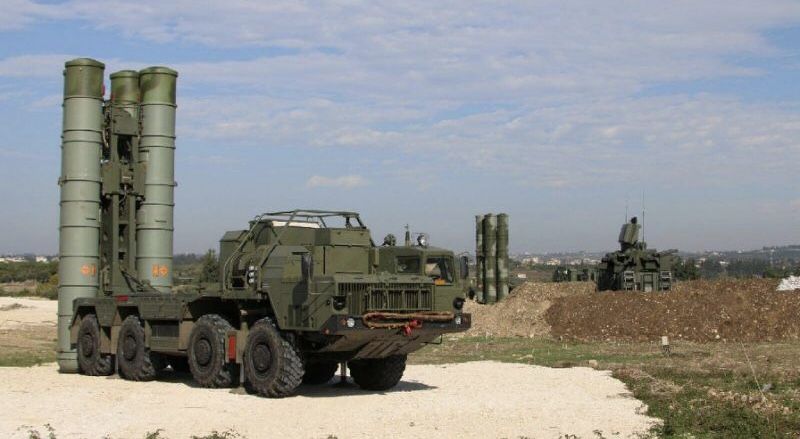
S-400 Surface to Air Missile Batteries
During a visit by Russian President Vladimir Putin to Delhi, India inked inked a $5.43 billion contract to purchase five units of S-400 Triumf surface to air missile systems from Russia on October 5th. The signing followed an high profile summit between Prime Minister Narendra Modi and President Putin, and proceeded despite much speculation regarding its potential cancellation given the considerable pressure applied by the United States for India to cancel the acquisition. The United States Treasury had previously imposed economic sanctions in countries purchasing arms from Russia, and sanctions placed on Chinese entities involved in the acquisition of the S-400 in September were widely perceived as a warning to Delhi of the potential consequences it would face should it defy Washington’s demands.
The S-400 is one of the most capable weapons platforms of its kind, and can reliably engage up to 80 aircraft, ballistic missiles or cruise missiles simultaneously with up to 160 interceptor missiles. The platform is particularly renowned for its ability to deploy the 40N6 missile, a hypersonic missile travelling at Mach 14 with the ability to strike targets with precision up to 400km away. The missile system is thus capable of striking hostile aircraft, particularly high value support targets such as AWACS, deep into enemy territory - a potent asset in the event of war with either Pakistan or China. Designed largely with the elite American F-22 Raptor in mind, S-400’s ability to target stealth aircraft such as China’s Chengdu J-20 makes it a particularly valued asset in Indian hands, with the country’s induction of its own stealth fighters under the FGFA program having stalled considerably.
India’s S-400 acquisition is likely to be met with considerable apprehension in Islamabad in particular, with tensions continuing to simmer between the two longstanding adversaries. If deployed to Himachal Pradesh in West India, the S-400 will provide Indian forces with coverage over almost all of Kashmir, while if deployed to Jalandhar it would allow the Indian military to shoot down Pakistani jets over Islamabad itself. The ability to impose an effective no fly zone over Pakistani territory, with multiple battalions working simultaneously able to destroy hundreds of Pakistani fighter jets within minutes, compounds the already considerable qualitative advantage the Indian Air Force possesses due to its deployment of elite Su-30MKI air superiority platforms - aircraft unrivalled by anything in the Pakistani arsenal at present. Pakistani territory is long, but not deep, and this plays into Indian hands. Should India choose to deploy the S-400 as far west as Amritsar, the missile system will be able to threaten Pakistani aircraft over Peshwar. Whether Pakistan will respond by acquiring more advanced air defence systems of its own from China, developing more capable ballistic missiles, or whether the two South Asian powers will be able to reach an understanding to deploy the S-400 some distance from the Pakistani border to avoid an escalation of tensions, remains to be seen.
