
Armata Tank Coming to India? Military Leadership Show Interest in Acquiring Elite Russian T-14 Tanks
Military Watch Magazine Editorial Staff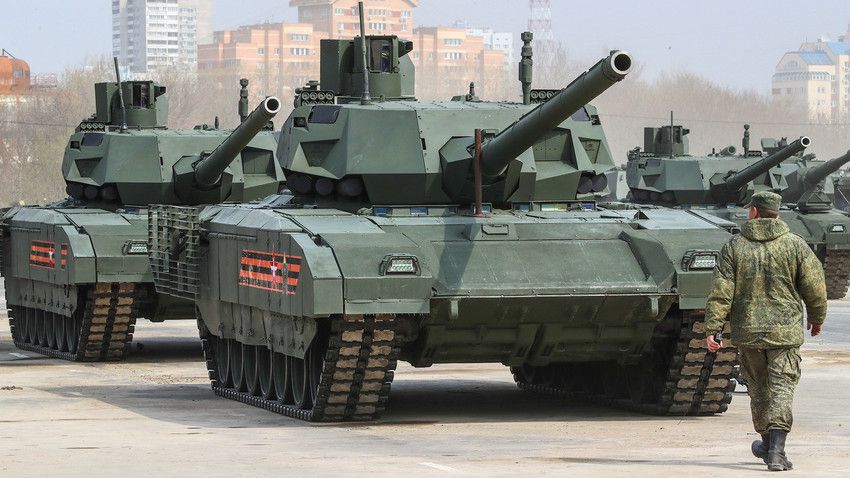
T-14 Armata Battle Tanks
Amid growing defence ties between Moscow and Delhi, Indian Army Chief of Staff General Bipin Rawat has begun a six day visit to Russia. The visit comes shortly before a trip by Russian President Vladimir Putin to Delhi, and is widely seen as a way of cementing the strategic partnership between the two states. With India having flatly rebutted U.S. threats to impose economic sanctions should the country fail to halt its defence cooperation with Moscow, while showing little interest in a number of weapons systems offered as alternatives to their Russian counterparts such as the THAAD missile defence system and F-35 stealth fighter, cooperation between the two states appears to be improving. Defence contracts worth over $10 billion are expected to be signed during a bilateral annual summit on October 5th, with Russia continuing to serve as the prime supplier of arms to the Indian armed forces.
While India already plans to acquire a number of high end Russian weapons systems, including S-400 missile systems and possibly Su-57 air superiority fighters, the country has shown interest in a number of new platforms to aid in its modernisation efforts. The Indian military delegation led by General Rawat is reportedly set to discuss potential acquisitions of Russian T-14 Armata battle tanks - one of just three fourth generation tanks currently in production alongside South Korean and Japanese designs, which will if acquired provide India’s armoured units with a considerable edge over all neighbouring states. With India having recently made sizeable orders for T-90 battle tanks, the new T-14 could potentially form the elite of the country’s armoured units - an invaluable spearhead in a potential ground war against either China or Pakistan. With China itself fielding the advanced Type 099A, and Pakistan reportedly considering itself acquiring the T-90, the T-14 is an invaluable means of retaining an edge over these two powers.
Russia’s own armed forces, placing considerable faith in older and less costly designs such as the T-90 and T-73B3, have notably placed only limited orders for the T-14 - which has yet to enter mass production. An Indian order however could well see mass production of the platform begin sooner, and lower the unitary cost of the battle tank considerably to make it more attractive to other potential export customers. Algeria, Iraq, Egypt and Vietnam are all leading potential clients for the system alongside India, and Delhi has much to gain from jointly manufacturing the platform not only for its own armed forces - but also for export to third parties. Whether India will choose to acquire the T-14 for its ground forces, and possibly its sister platform the T-15 personnel carrier, or whether it will instead opt for an alternative elite battle tank such as the South Korean K2 Black Panther, remains to be seen - but given the T-14’s cost effectiveness relative to rival platforms and India’s familiarity with operating Russian armoured vehicles it remains a considerable possibility.
