
Is the Indian Air Force Considering Acquiring America's F-35? What the United States has to Gain from Selling the Joint Strike Fighter to Delhi
Military Watch Magazine Editorial Staff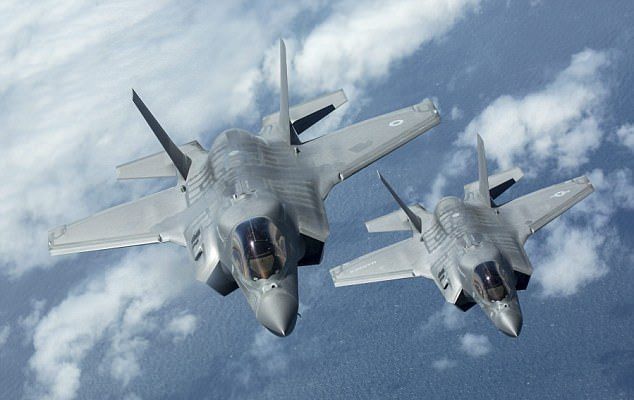
F-35 Multirole Fighters
Amid a large scale modernisation program and growing ties to the U.S. military, the Indian Air Force has shown interest in acquiring America’s F-35A Joint Strike Fighter (JSF) for its fleet. The Air Force has formally requested a classified briefing by U.S. defence contractor Lockheed Martin regarding the platform’s capabilities, a key first step in determining its feasibility for India’s defence needs. The F-35A is set to provide the mainstay of the U.S. Air Force's capabilities, and is one of just two fifth generation fighters developed by the United States. With the F-22, a heavier and far more costly platform designed for air superiority and produced in much smaller numbers, banned from export, the F-35 remains the only Western fifth generation fighter available for acquisition. The F-35 is a light multirole fighter with an unspecialised role, and while it suffers from both colossal maintenance requirements and a highly limited payload, just four air to air missiles or two bombs, it does field several state of the art capabilities including stealth systems and a highly sophisticated AN/APG-81 active electronically scanned array radar. It was developed as a less costly complementary platform for the F-22, much as the fourth generation F-16 was developed as a lighter counterpart to the F-15.
Sales of the F-35A to the Indian Air Force could well lead to further sales of other variants in future. The F-35C in particular, a platform developed for carrier operations, could well prove attractive for the Indian Navy in light of its growing investment in a carrier fleet and planned acquisition of an electromagnetic propulsion system (EMALS) from the United States. Should the Indian military familiarise itself with the less costly and simpler F-35A, it would facilitate easier integration of the F-35C into the armed forces in future — making Delhi potentially the only export customer for the carrier based variant of the Joint Strike Fighter. With the Trump Administration making unprecedented efforts to increase U.S. arms exports, going so far as to call on diplomats and the Pentagon to work to facilitate arms sales, the importance of the financial benefits of India’s acquisition is not to be underestimated. U.S. revenues from sales will include far more than the initial multi billion dollar acquisition cost of the F-35 fighters. Modern missiles for the platforms will cost several billion dollars - with missiles such as the AIM-120C costing approximately $400,000 dollars each. The fighters’ extreme maintenance requirements mean they will cost over $30,000 per hour to operate, and much of this will be spent on parts sourced from the United States. Revenues for U.S. producers could well amount to hundreds of millions of dollars per year for every year the F-35 continues to operate in Indian service — far more if the country makes use of its missiles and engages in open conflict.
Other than financial benefits, the F-35 in Indian service could also provide the U.S. with key intelligence in a strategically critical region, particularly near the borders of China and Pakistan. The F-35 has been found to automatically provide intelligence on its operations directly to the United States, something other foreign operators have learned to their chagrin. The short range of the F-35 means they are set to be deployed near the borders of potential Indian adversaries, ideal locations to collect intelligence where the Pentagon otherwise lacks assets to do so.
Due to the importance of the F-35 program to the future of the U.S. military, a platform set to enter service in its thousands in three branches of the armed forces, the U.S. government may well perceive risks from selling the platform to an officially non aligned state. India is a longstanding client for Russian arms, was a close Soviet partner in the Cold War, and historically has often pursued a foreign policy in many ways inconsistent with the designs of the Western bloc. The F-35 could for example see its stealth capabilities compromised by Russian made air defence systems India operates, potentially providing key intelligence to Moscow on how to counter the platform. While a classified briefing provided by Lockheed Martin would require clearance by the U.S. Department of Defence and the U.S. Department of State, they are unlikely to refuse the request as the benefits of a sale to India far outweigh the potential risks. The F-35 and F-22 are set to widely operate in countries where Russian air defences are deployed, with both Turkey and South Korea fielding Russian made air defences derived from the S-300 and both having placed sizeable orders for the U.S. platform. The U.S. Air Force has itself provided Russia with what senior military leaders have called a 'treasure trove of information' on the F-22 by regularly operating the platform near Russian forces in Syria. Israel has also been provided with the F-35A, and could well acquire the B variant in future, despite having in the past passed on key U.S. technologies to China on several occasions. Israeli airspace is also heavily covered by Russian made air defence systems, giving the Russian military ample opportunity to study the U.S. made stealth platform. Considering previous and far greater risks the U.S. has taken with its stealth fighters, and the F-35’s purpose to function as a widely exported and relatively low cost platform similar to the F-16 that preceded it, there is little to be lost from selling the fifth generation light fighter to India.
When considering the F-35’s need for large quantities of U.S. made spare parts to operate, the Pentagon would be free to cut supplies to Delhi at any point and almost immediately ground the entire fleet should relations deteriorate for any reason and India’s operating of the platform compromise U.S. interests. The U.S. has cut supplies of fighter parts to a number of formerly allied states for political reasons on numerous occasions. Indonesia, Egypt, Venezuela and Iran are just some examples of states which have, after perusing foreign policies contrary to Washington’s interests, seen supplies of parts cut and as a result struggled to operate U.S. made fighters. The U.S. will also maintain exclusive access to software codes critical to upgrading the F-35, which will further limit Delhi’s ability to operate the fighter should it step out of line with Washington’s interests. The leverage over the Indian Air Force than an F-35 sale could thereby prove invaluable regardless of Delhi’s future politics.
Considering the ambitions of the Indian Air Force and the tremendous funds being diverted towards its military modernisation program, Delhi could very well become the largest foreign operator of the F-35 in future - particularly if the fighter is acquired in comparable numbers to the original order for French Rafale fighter. F-35 sales could prove an invaluable means to cement defence ties with a valuable U.S. partner, influence the balance of power in the region to better favour U.S. interests, gain tremendous financial benefits, and do so with minimal risk of Delhi using the fighter platform to undermine U.S. interests should the country for any reason alter its geopolitical alignment.
