
Modernising the T-72; Keeping a 40 Year Old Battle Tank Competitive Against the Most Advanced Platforms of the 21st Century
Military Watch Magazine Editorial Staff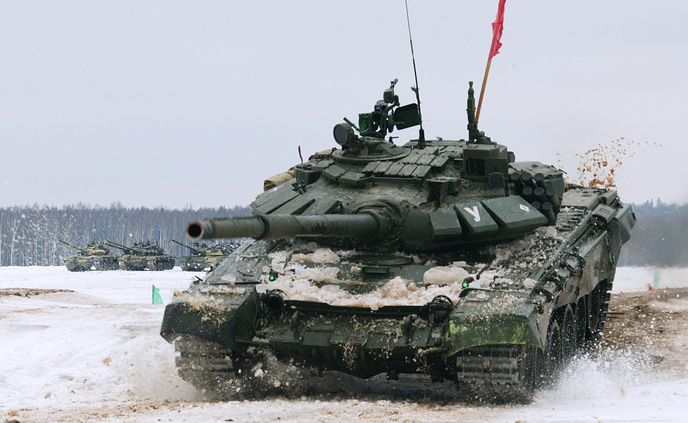
T-73B3 Battle Tank
In service since 1973, the T-72 main battle tank remains widely in use across the world in 45 countries almost half a century later. Despite its age the tank forms the mainstay not just of third world armies with limited defence budgets, but of several highly modern well funded forces such as those of Algeria, India and Russia itself. Russia alone fields well over 10,000 T-72 battle tanks, and continues to upgrade their capabilities to allow the to compete effectively with the most advanced enemy armour today. The most recent example has been the heavily upgraded T-72 B3 variant, with capabilities which in many ways eclipse those of early variants of the newer T-80 and T-90 tanks.
The USSR first deployed the T-72 in 1973, featuring more advanced weapons and armour than previous designs and requiring three rather than the usual four crew due to automated shell loading. The new battle tank saw its first combat service with the Syrian Army during the Lebanon War, with T-72s delivered to the Middle Eastern state alongside state of the art S-200 surface to air missiles and MiG-25 interceptors to allow the country challenge the forces of Israel and the Western Bloc in the region. The platform was far ahead of the most capable Western battle tanks of its time such as the American M60 fielded by the Israeli ground forces, and reportedly even outperformed Israel's Merkeva tanks. Syrian President Hafez Al Assad thus came to refer to the platform as "the best tank in the world." Later variants would see extensive further comprehensive upgrades implemented over several decades, from munitions to protective systems, giving the B3 variant in service today capabilities unrecognisable form those of the original vehicle which entered service almost four decades prior.
The T-72B entered service in 1985, twelve years after the original platform, and had a laser rangefinder and even thicker armour - with composite armour on the turret and several features advanced incorporated from the T-80. This in turn was followed by the T-72B1, with more composite armour and explosive reactive armour - allowing them to destroy incoming shells before they hit the vehicle. The new platforms also incorporated enhanced missile capabilities - allowing them to fire laser guided munitions with a range of over three miles. The T-72B2, in service since 2006, was further equipped with a Shtora-1 jamming system, superior engines and enhanced survivability as a result of the Relickt ERA. The latest iteration of the tank, the T-72B3, is not only cheaper than the B2 variant but also comes with new engines, superior weapons and more advanced fire control systems. While it may struggle against South Korea's fourth generation K2 Black Panther tank or the Russian T-14 Armata, against the vast majority of modern platforms such as the German Leopard II or U.S. M1 Abrams these modernised T-72 variants will at the very least be able to hold their own.
The versatility of the T-72 design and its ability to continuously incorporate upgrades has made it a truly invaluable battle tank for Russia's armed forces. More extensively modified platforms based on the T-72 design include the T-90, in service since 1993, and the BMPT-72 Terminator 2 in service since 2014. While Russia fields 3,500 of the newer and more advanced T-80 tanks, the platform's relative inability to incorporate upgrades means it may well find itself outdated and retired well before the T-72. The T-14 Armata, while a promising platform which appears to be highly customisable, is due to its high costs unlikely to replace the T-72 for the foreseeable future. The T-72 is therefore likely to remain the mainstay of Russian and other modern military forces for decades to come.
