
Hitting America Faster and More Reliably: North Korea Unveils New Nuclear Capable Intercontinental Range Missile
Military Watch Magazine Editorial Staff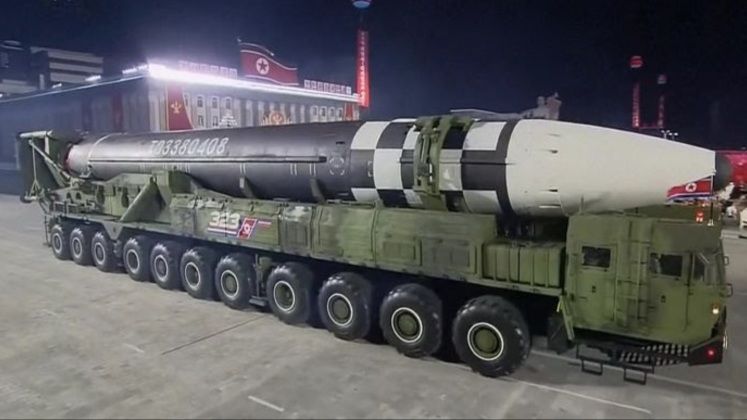
New Korean Intercontinental Range Ballistic Missile
North Korea held a major military parade in the early October 10th, marking 75 years in power for the ruling Korean Workers’ Party, which although smaller and more modest than the last two parades held in February and September 2018 was notable for its featuring of a new intercontinental range ballistic missile. The new missile is thought to make use of a sold fuel composite, and was deployed from a 22 wheel transporter-erector-launcher - the largest launch vehicle seen before. The missile is a successor to the Hwasong-15, which featured in a parade in February 2018 and was flight tested the previous year in November. The Hwasong-15’s launcher notably had only 18 wheels, indicating that the new missile is considerably larger. While the Hwasong-15 already provided a long enough range to strike targets across the United States mainland, as verified a number of times by U.S. intelligence, the new missile is expected to provide new features including a much shorter launch time, the ability to be stored fully fuelled, and likely the ability to deploy multiple warheads. A multiple warhead reentry vehicle would make Korean missile attacks considerably more difficult to intercept for American strategic defence systems such as the GMD, and would likely be much more cost effective allowing a single new missile to do as much damage as several single-warhead missiles.
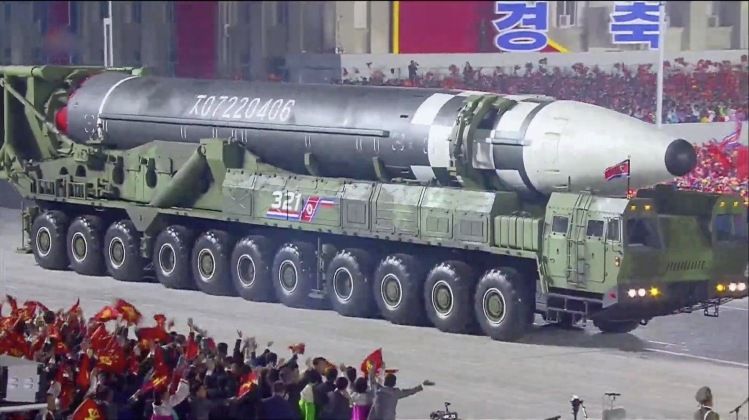
The Hwasong-15 has been in serial production for well over two years, but is likely to be replaced in production by the new more advanced missile - the official name of which remains unknown. The unveiling of a new intercontinental range ballistic missile was reportedly not aimed at any specific country, although with detente between Pyongyang and Washington currently in a fragile position, and with the U.S. having yet to grant relief from the latest rounds of United Nations sanctions which the East Asian state has repeatedly requested, the possibility of a test of the new missile and an escalation of rhetoric cannot be ruled out in the coming months. While a lifting of sanctions is expected to be agreed to in exchange for imposition of some resections on the Korean nuclear weapons program, as no such agreement has yet been made the country haas been free to enlarge its arsenal of miniaturised thermonuclear warheads by processing more nuclear materials over the past two years. This will ensure it retains a considerable stockpile of warheads should its agree to cease producing more in future.
