
Mass Production of Advanced New ICBMs an Obvious Next Step for North Korea; New Hwasong-15 Missiles Manufactured as Part of Growing Deterrent Force
Military Watch Magazine Editorial Staff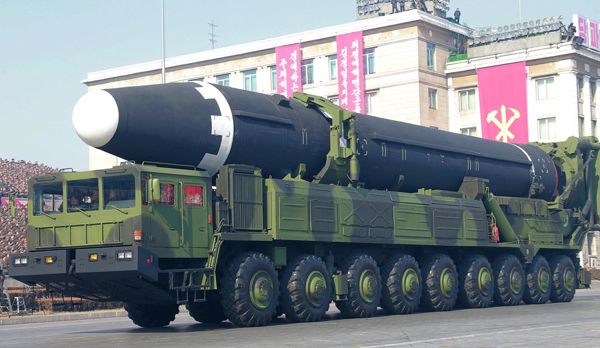
North Korean Hwasong-15 Intercontinental Range Ballistic Missile on Parade
Reports from the United States based on satellite observation indicate that North Korea has continued the manufacture of intercontinental range ballistic missiles, with the country having renewed activity at armaments factories involved in the program. With North Korea widely described as an 'intelligence black hole’ and the Central Intelligence Agency’s (CIA) most challenging target in the world, surveillance satellites remain one of the few sources of valuable intelligence on the East Asian state. Nevertheless with several of the country’s military facilities including weapons factories being based deep underground, and the country being among the most tunnelled in the world and making effective use of its mountainous terrain, even the Untied States’ extensive satellite coverage - which surpasses that over the entire Soviet Union during the Cold War - can only give a very partial picture regarding the country’s military activities.
With the North Korean military having successfully tested a number of new ballistic and cruise missile platforms in 2016 and 2017, including two classes of intercontinental ballistic missiles in the second half 2017 - the Hwasong-14 and Hwasong-15, the country was expected to put these platforms into mass production afterwards. Having ended missile and nuclear testing as of December 2017, and with the country’s leader Marshal Kim Jong Un having declared a formal end to such tests in April 2018, the next step to strengthen Korea’s deterrent capabilities was inevitably going to be the manufacture of newly developed missile designs in larger numbers. Reports in early July, though unverified, indicated that the country was producing Pukkuksong solid fuelled intermediate range ballistic missiles in large numbers - a compact and highly versatile platform with submarine and ground based variants. The unveiling of a new solid fuelled short ranged ballistic missile, reportedly possibly derived from the Russian Iskander design concept, in February 2017, likely also preceded mass production. To complement the capabilities of these missiles placing the Hwasong-15 under mass production - possibly alongside the lighter Hwasong-14 - will provide the country with an advanced and highly versatile ballistic missile deterrent and a means of delivering both strategic nuclear strikes to the United States mainland and tactical strikes to American bases across the Pacific.
Mass production of ballistic missiles could potentially be cheaper than the designing testing phases, and can be carried out considerably less conspicuously. The Sanumdong factory where the Hwasong-15 is reportedly produced is likely to become the new centre of the country’s ICBM program replacing the testing sites which gained much prominence in 2017. U.S. reports regarding both increased activity at Korean nuclear facilities and increased production of advanced composite fuels for ballistic missiles, combined with the considerable funds expended to develop reliable ICBM designs, all strongly indicate that North Korea will push for an expansion of its arsenal to strengthen its strike capabilities and thereby further enhance its nuclear deterrent. With the development of such a deterrent not only key to the country’s security, but also playing an essential role in its economy by facilitating a considerable reduction in expenditures on conventional arms, the program is set to remain a key priority for the country’s armed forces - one which is intended to issue in an era of newfound security unparalleled in the country’s 70 year history.
