
North Korean Air Defence Systems Take Centre Stage - Ballistic Missiles Conspicuous by their Absence; What the Latest Military Parade Signifies Regarding Pyongyang’s Evolving Strategy
Military Watch Magazine Editorial Staff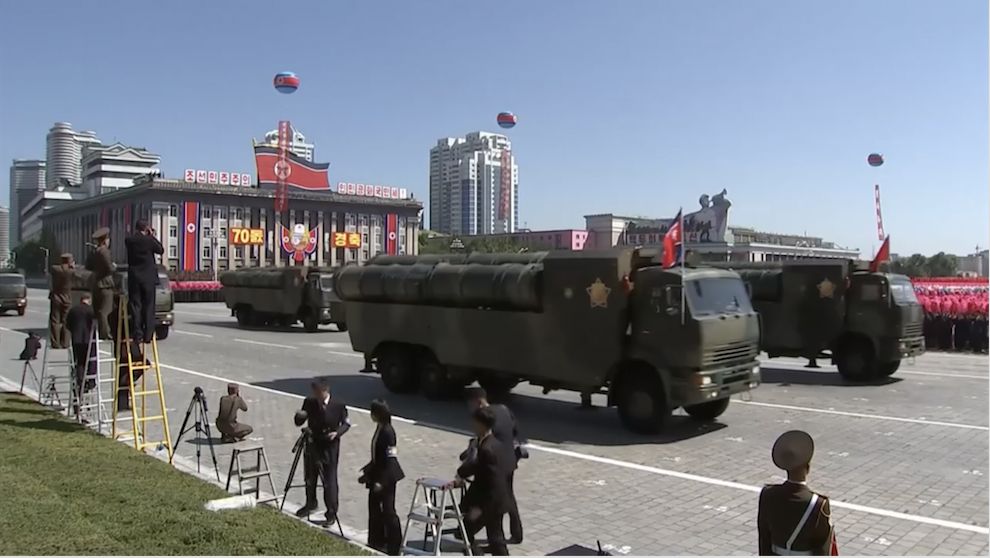
North Korean KN-06 Air Defence Missile Batteries on Parade Marking 70 Years Since The Country's Founding
Holding its second military parade of the year, the first held in February having marked seven decades since the formation of the Korean People’s Army, North Korea celebrated the 70th anniversary of its foundation on September 9th 2018. A country which has for over a quarter of a century been characterised by its unique foreign policy, resisting taking the path of the Soviet Union and its satellites, despite the predictions of the vast majority of Western analysts and considerable external pressure, to become part of the Western led world order, North Korean military parades have since the Cold War’s end long been key demonstrations of force - showing not only the strength of the country’s conventional capabilities but also the potency of its missile and later its nuclear deterrents. The military parade held in February saw ballistic missile systems take centre stage, with the Hwasong-15 intercontinental ballistic missile in particular - a platform which can deliver a hydrogen warhead of several megatons to any point on the U.S. mainland - having been a particularly prolific piece of hardware on display, alongside other advanced missile systems including the Hwasong-12 ‘Guam Killer’, the submarine launched Pukkuksong and an unnamed new solid fulled short range tactical missile.
North Korea’s latest military parade notably did not feature any of the country’s advanced new ballistic missiles, which were conspicuous by their absence given the central role they have taken in the country’s defence doctrine in recent years. Detente with South Korea, and a somewhat tenuous negotiation process with the United States, are considered the prime causes - a sign of good will as Pyongyang seeks a reduction of tensions with its longtime adversaries. While North Korea has reportedly continued to manufacture advanced ballistic missile platforms, with reports confirming large scale production of the Hwasong-15 and Pukkuksong-2, the country has sought not to display these too openly in line with its policy of pursuing better relations with its southern neighbour in particular - and eventually the normalisation of economic ties. The fact that North Korea did not display its deterrent however, in an event closely observed by foreign analysts, demonstrates a new level of confidence in the country’s security situation and the strength of its deterrent force. A shift in policy following the establishment of a sufficiently capable nuclear deterrent, as first announced by Marshal Kim Jong Un in April 2018, was strongly reflected in the parade itself - and rather than a speech by the Marshal on the importance of national defence as took place at previous military events, a speech by the country's Presidium President Kim Yong Nam instead focused heavily on the country's plans for economic development. Economic growth is expected to accelerate considerably as the country explores options for prolific joint projects with its three land neighbours, while development of a nuclear deterrent serves to facilitate a far lower conventional budget and greater investments in the civilian economy.
While ballistic missiles did not take centre stage, North Korea’s special forces and conspicuous new heavy weapons with a distinct high tech appearance were all involved. Central aspects however appears to have been reserved both for civilian displays - namely a procession carrying the national flag and accompanying parade floats and civilian processions - as well as KN-06 air defence systems. With the KN-06’s entry into mass production having been announced in 2017, the long range surface to air missile system was one of the major new additions to the country’s arsenal that year alongside ballistic missile platforms. The weapons system is considered analogous to the Russian S-300 and Chinese HQ-9B, and was first seen just months after Russia and North Korea signed a memorandum on joint air defence and intelligence cooperation. The missile system is suspected of integrating advanced anti stealth capabilities similar to those on Russia’s S-400 missile system, and with Russia's leadership having expressed a willingness to shore up the defences of potential targets for Western attack the provision of key air defence technologies rather than direct sales of the weapons system are speculated to have been a less conspicuous alternative to selling Pyongyang the S-400 outright. The KN-06's induction into service has been a key factor in deterring Western military action against Pyongyang, and while Russian state media has confirmed that North Korea has been a recipient of the S-300 missile system the KN-06 is considered more advanced than most S-300 variants. It is the most capable long ranged system in the country’s inventory today. Displaying the weapons system in large numbers demonstrates that while North Korea may be pursuing a detente, its guard is far from down and its defences are continuing to be strengthened in the face of prevailing threats to its security which may resurface at any moment.
