
KN-06 Surface to Air Missile System Enters Mass Production; The Importance of Air Defence Development for North Korean Security
Military Watch Magazine Editorial Staff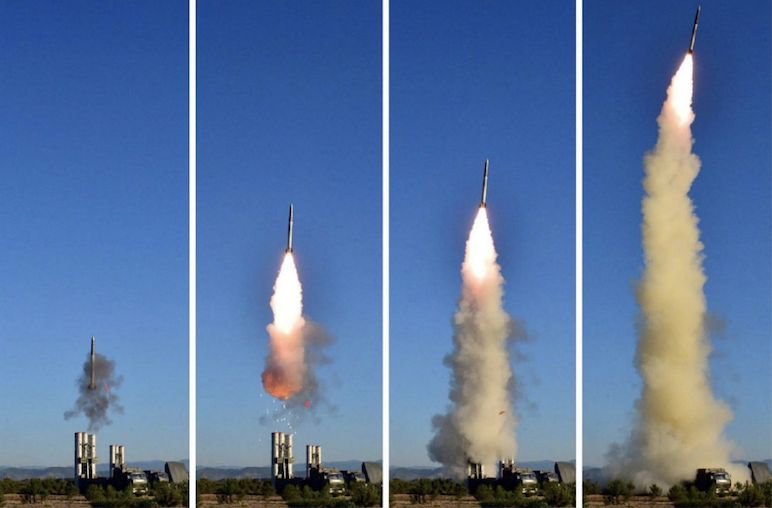
North Korean KN-06 Long Range Surface to Air Missile System
KCNA
Since the Second World War Western military doctrine has relied heavily on the use of aerial assets to project power abroad, and large air formations made their debut in the Second World War over European and Japan on a scale previously unprecedented. The United States Air Force, supported by the country's vast military industrial base, was able to deploy force on a scale other powers could not hope to match, and did so against both military and civilian targets in Germany and Japan. The U.S. Air Force's firebombing of Tokyo on the night of March 9th 1945, which killed an estimated 120,000 residents, remains by far the bloodiest day in the history of warfare to date. Since the Pacific War a number of Western adversaries have seen their ground based assets destroyed, and in some cases such as North Korean and North Vietnam their population centres heavily targeted, as a result of their lack of anti access area denial (A2AD) systems to prevent Western militaries from operating assets in their airspace. North Korea (1950-53), Egypt and Syria (1967 ), Iraq (1991) Yugoslavia (1990s) and Libya (2011) are but a few examples of Western adversaries which have suffered heavily from American and European air attacks, due either to poor training of their personnel (Libya, Egypt, Syria, Iraq) or to a lack of modern anti aircraft weapons systems (North Korean, Yugoslavia.)
With conflicts throughout the latter half of the 20th century serving as critical warnings, potential adversaries of the Western Bloc have often invested heavily in modern arms to protect their airspace. China, Venezuela, Iran and Syria among others have all been customers for Russia's latest surface to air missile systems such as the S-300, S-400, Patnsir and BuK-M2 systems among others - purportedly capable of guaranteeing the security of their airspace against advanced Western made fighters and bombers. North Korea, perceiving a significant threat from the U.S. military which has deployed extensive aerial assets from both its Air Force and its Navy on its borders, has itself invested heavily in developing its own advanced long range surface to air missile system - the KN-06. In appearance the North Korean platform is very similar to the S-300 and S-400 Russian systems, leading a number of analysts to speculate that the Korean military may have received some Russian technical assistance. Considering that North Korea and Russia signed a contract for close cooperation in intelligence and air defence in 2015, this remains a distinct possibility.
With the KN-06 undergoing successful tests in early June 2017, the system has now been put into mass production in North Korea. The production of such weapons systems domestically is wholly in line with the country's doctrine of self reliance, and is critical to deterring military action by the United States and its allies and denying the U.S. Air Force the ability to operate in North Korean airspace. The platform retains the ability to strike aerial targets at ranges and altitudes well beyond those of existing platforms in the country's inventory such as the S-125 and S-200, and like the Russian S-400 makes use of a cold launch system which allows it to engage targets in all directions. Cold launch further allows the platform to be concealed between buildings, in forested terrain, or using other cover in a platforms using less sophisticated hot launch systems such as the S-200 and American Patriot cannot. Like other North Korean air defence systems, the country's KN-06 batteries are likely to be deployed from heavily fortified underground emplacements to offer them a far greater degree of survivability against hostile air attacks, an effective force multiplier for the country's air defence network which forces potential adversaries to rely on heavier, most costly and more cumbersome penetrator munitions to neutralise them. This is in contrast to other states the Western Bloc has targeted in the past such as Libya and Syria, which have failed to invest in such fortifications leaving their missile platforms vulnerable. With the North Korean having lost an estimated 20-30% of its population in the three year Korean War, the majority to U.S. air attacks which levelled all population centres between the 38th parallel and the Chinese border, targeted irrigation dams and rice fields to limit the country's food supply and regularly doused populated areas with napalm, the importance the country's leadership places in developing an adequate air defence network cannot be overstated.
