
Footage Provides First Look at New Su-35 Air Superiority Fighters Flying in Algerian Service
Military Watch Magazine Editorial Staff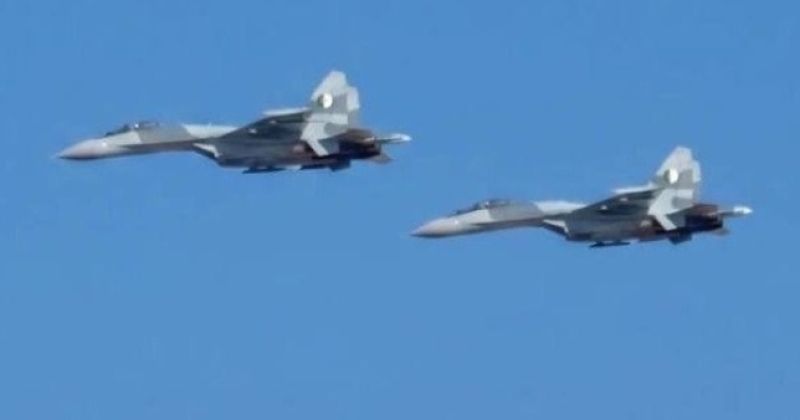
Algerian Air Force Su-35 Fighters
The release of the first image showing Su-35 air superiority fighters in flight in Algerian Air Force service has highlighted the type’s role in what is by far the Africa’s most ambitious combat aviation modernisation effort. Following reports in late 2024 that orders for Su-35s had been placed, the fighters were first confirmed in March 2025 to have begun deliveries. The latest footage of the aircraft notably follows the release of footage confirming the delivery of Su-34 strike fighters in mid-June, and footage confirming the delivery of Su-57 fifth generation fighters in late February. Algeria has thus begin receiving its first batches of all three of Russia’s heaviest and most complex fighter types in production within a 15 month period.
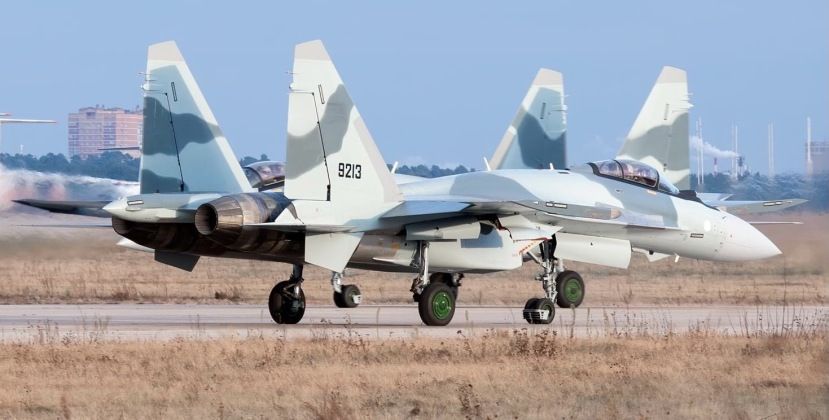
The Algerian Defence Ministry is estimated to have procured 18 Su-35 fighters, which have significant commonality with the the Su-30MKA fighters that form the backbone of the country’s fleet. Over 70 Su-30MKA fighters are in service, with orders having been placed gradually between 2006 and 2019. Both fighter types are heavily enhanced ‘4+ generation’ derivatives of the Soviet Su-27 Flanker fourth generation air superiority fighter, with the Su-30MKA integrating technologies from the cancelled Su-27M and Su-37 air superiority fighters including thrust vectoring engines for extreme manoeuvrability and a N011M phased array radar. The Su-35 was developed close to a decade later, and while having higher maintenance needs, it is a more advanced aircraft with overall superior capabilities in almost all areas, including its range, flight performance, and situational awareness.
As Algeria is by far the largest country in Africa, the country’s air force is required to protect an area roughly equivalent to the areas of France, Germany, Spain, Italy, Belgium, Switzerland and Greece combined, which makes the much longer ranges of Russian fighters relative to their Western counterparts particularly valuable. The Su-35 benefits from supercruise capabilities that the Su-30 lacks, allowing it to patrol the country’s airspace supersonically without compromising its range by using afterburners. The fighter type has a highly successful combat record with very few losses and more extensive air-to-air combat testing than any other post-Cold War fighter type. Although previously constrained in its capabilities by the limitations of the R-77-1 air-to-air missile, its primary anti-aircraft weapon, the confirmed integration of the R-77M air-to-air missile in mid-2025 significantly improved its combat potential.
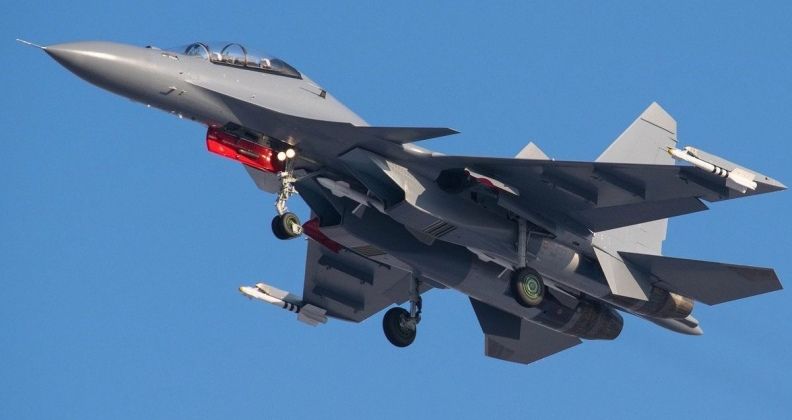
Although the Su-35 was, until the delivery of the Su-57 to the Algerian Air Force, considered the most capable fighter type in Africa, and likely in the Arab world, the fighter is constrained in a number of its capabilities compared to new Chinese and U.S. fighter types. These include not only the J-20, J-35, and F-35, which are currently considered in a league of their own as the world’s most advanced fighter types, but also new fourth generation fighter types including the Chinese J-16, J-15T and U.S. F-15EX. The J-16 and J-15T in particular, although also based on the Su-27 design, make use of more advanced composite materials, weaponry, sensors, and avionics, with their network centric warfare capabilities in particular being far superior. This has raised serious questions regarding whether Algeria will soon begin to procure Chinese fighter types, as the country’s defence ministry has increasingly placed orders for Chinese warships, air defence systems, electronic warfare systems, and other advanced assets. The J-35 in particular is considered a leading candidate to modernise the country’s fleet.
