
Why China Assigning its First Ever J-7G Fighter Squadron to a Training Unit is a Significant Development
Military Watch Magazine Editorial Staff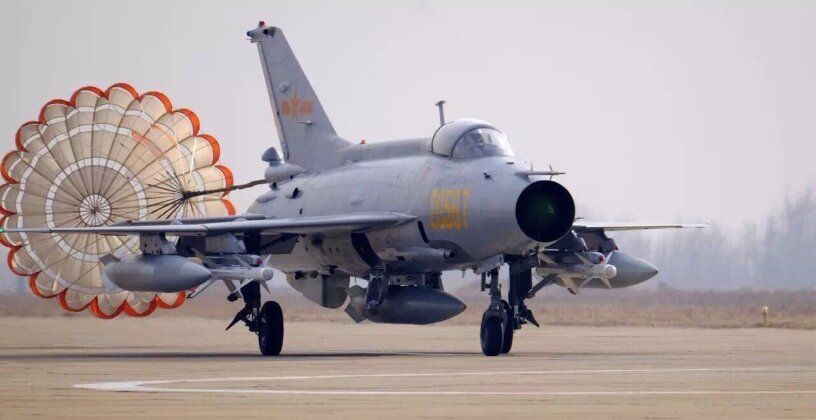
Chinese J-7G Single Engine Fighter
China’s People’s Liberation Army (PLA) Air Force has assigned the first ever unit of J-7G single engine fighters to a squadron specifically for training purposes, with the Xi’an Flight Academy receiving a unit of the aircraft which are expected to replace much older J-7B jets in its 1st Training Brigade. The Chengdu J-7 was the most capable fighter in the PLA Air Force from the late 1960s, when it joined the fleet, until the end of the Cold War after which China began to receive much more capable Su-27 and Su-30 fighters from Russia. The design was based on the Soviet MiG-21, which had served in the Soviet Air Force from 1959, and while initial J-7 models were much less capable than their Soviet analogues sustained Chinese investment in the design led it to become a formidable combat platform. Production of the J-7 continued until 2013, despite the design having been superseded by the indigenous J-10A and J-11B platforms which joined the Air Force from the early 2010s, with the J-7 prized for its low operational costs and ease of maintenance. The J-7G represents the most advanced variant of the J-7 ever developed, and boasts much higher use of composite materials, a full glass cockpit, a new double delta wing, three multi functional HUD displays and HOTAS, helmet mounted sights, a radar cross section reducing fuselage and conformal fuel tanks among other fourth generation features.
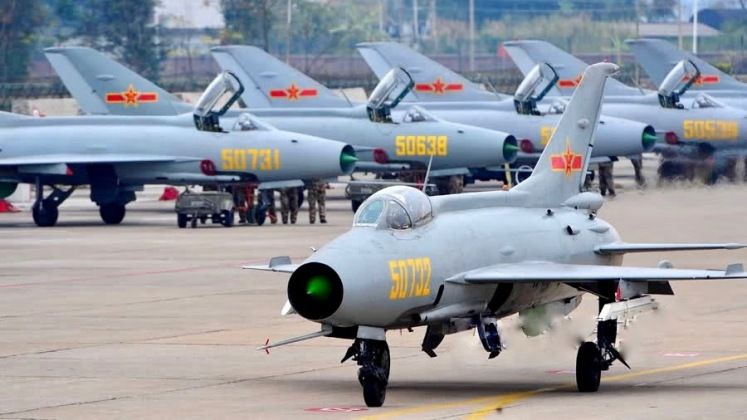
While the J-10 is today in production for the PLA Air Force as a lightweight single engine fighter, the J-7G can be categorised as a ‘very light’ fighter - a kind of aircraft the PLA appears set to phase out entirely from frontline combat roles. Significant numbers of J-7 units have been retired in recent years, transitioning either to J-10 jets or even directly to much higher end and heavier fighters such as the J-16 - which is around three times as large. The retirement of a J-7G unit from frontline service is significant as it shows that even the most capable variants of the J-7 are now being phased out of frontline service in the PLA Air Force and replaced by newer and much lager ‘4+’ and ‘4++ generation’ aircraft. Such a transition reflects an abundance of funds in the PLA, as not only are J-10C and particularly J-16 fighters much more costly, but more importantly their operational costs are far higher than those of the J-7 meaning that while the transition will revolutionise and massively improve unit performance, it will also mean that the costs of operating these units in peacetime or otherwise will be far higher. Such costs are facilitated by consistent high rates of growth of both the Chinese economy and the PLA’s budget.
Allocation of the J-7G to a training unit will provide a much more effectively simulation of a modern fighter's combat capabilities than the obsolete J-7B ever could, due to its sophisticated fourth generation avionics, and the fighters may well be required to fly combat missions as reserves in the event of a major war. The most likely candidate to replace J-7G units in frontline service is the J-10C lightweight ‘4++ generation’ fighter, which has been in service since 2018 and is in production at a higher rate than any other PLA fighter with over 200 already having joined the Air Force. Following the J-7, the Russian supplied Su-27SK heavyweight fighters delivered from 1992 are expected to be the next combat aircraft slated for retirement.
