
Chinese Fighter Units Transition Straight From J-7 (MiG-21) to Cutting Edge New J-16 Jets
Military Watch Magazine Editorial Staff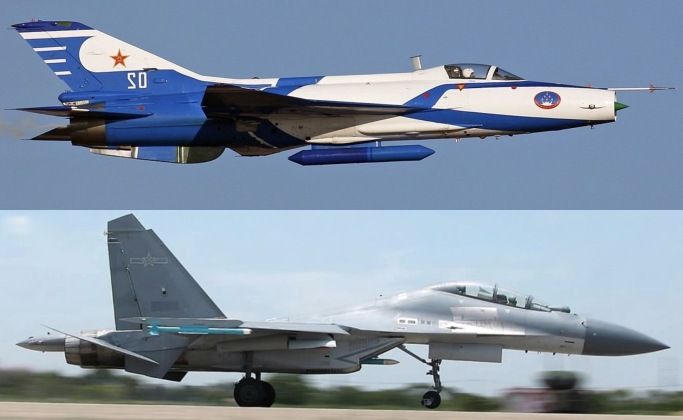
Chinese J-7 (top) and J-16 Fighters
Fighter units deployed under the Chinese People’s Liberation Army (PLA) Air Force Western Theater Command have begun to transition directly from Shenyang J-7 fighter jets directly to the advanced J-16 fighter. The Western theatre command is notably responsible for security in the border regions with India, where tensions flared in June 2020, although the theatre historically has not being prioritised for receipt of the latest hardware. The J-16 is currently the only very high end Chinese fighter deployed under the command, with the PLA Air Force's ‘4++ generation’ J-10C and Su-35 and fifth generation J-20 jets deployed under the eastern and southern commands facing Japan, Taiwan and their Western supporters including the United States Military. With western China having less airbases, and often requiring aircraft to operate at high altitude, the J-16’s very high endurance and flight ceiling make it an ideal asset. The fighter was the first in Chinese service to deploy an AESA radar, which is not only more powerful but also much harder to jam than older designs, and can also deploy the latest PL-15 air to air missiles which themselves benefit from AESA radar guidance and very long ranges.
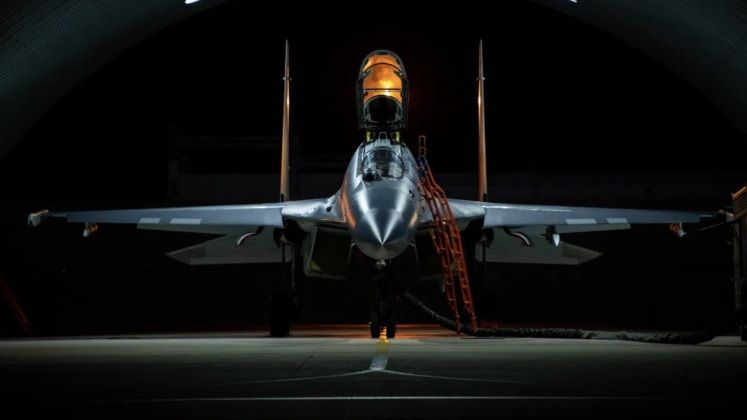
The transition from the J-7 to the J-16 represents a very dramatic shift for the PLA’s fighter units, with the former design entering service from around 1965 and the latter from 2013 meaning they are separated by almost half a century technologically. The J-7 design is even older, however, and is closely based on blueprints for the Soviet MiG-21 which entered service from 1959. In terms of flight performance, avionics, and maintenance requirements in particular, the two could not be further apart, with the J-7 being a very light low maintenance design weighing just 8,350kg with a standard combat load. The J-16 by contrast is one of the world’s heaviest fighter aircraft at 26,000kg, although it notably requires less maintenance than other heavyweight designs such as the Su-27 or J-20. Despite its age, the J-7s in Chinese service are formidable fighters, and remained in production until 2013. The newest variant of the fighter, the J-7G, first joined the PLA Air Force in 2003 and is expected to serve for over a decade more. It can be considered a fourth generation aircraft, with its airframe benefitting from advances in composite material and sensor technologies and having a redesigned wing, which combined with new munitions and electronic warfare systems made it far more capable than any Soviet variant of the MiG-21.
It is no exaggeration to say that a single J-16 is able to more than cover the area of a full J-7 squadron due to its vastly superior range and the much greater coverage of its sensors and missiles, meaning the transition between the aircraft will revolutionise the combat capabilities of the affected PLA squadrons. Despite this, the J-16’s much higher operational cost will place a greater logistical and material strain on the Western Theatre Command’s air units - one which other countries which do not benefit from such high annual growth rates for its economy and defence budget would likely struggle to cover.
