
China is Still Manufacturing Enhanced MiG-21s 50 Years Later - A Look at the JF-17 and JL-9
Military Watch Magazine Editorial Staff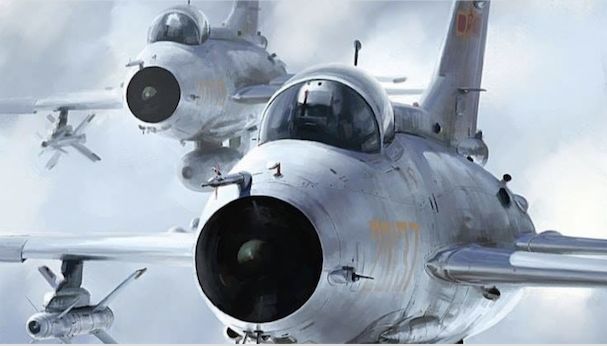
Chinese J-7 Fighters
China’s People’s Liberation Army (PLA) Air Force has manufactured indigenous derivatives of the Soviet MiG-21 fighter design since the year 1965 as the Chengdu J-7, and retains around 400 of these platforms in active service today as highly enhanced derivatives such as the J-7G. Upgrades to the J-7 design have provided it with advanced capabilities considerably exceeding those of early fourth generation fighters - including integration of composite materials for a lighter and stronger airframe, a full glass cockpit, a new double delta wing, Multi functional heads up displays, helmet mounted sights, a radar cross section reducing fuselage, conformal fuel tanks and state of the art munitions and sensors. China’s Chengdu Aircraft Corporation continued to manufacture MiG-21 derivatives under the J-7 designation until the year 2013 - just four years after it would provide the PLA with its first fifth generation aircraft the J-20. These J-7 aircraft were intended both as lighter complements to the heavier J-11B fighters in the PLA, as well as for export to defence clients such as Bangladesh. While 2013 represent the end of J-7 production, it was was far from the end of China’s manufacture of MiG-21 derivatives.
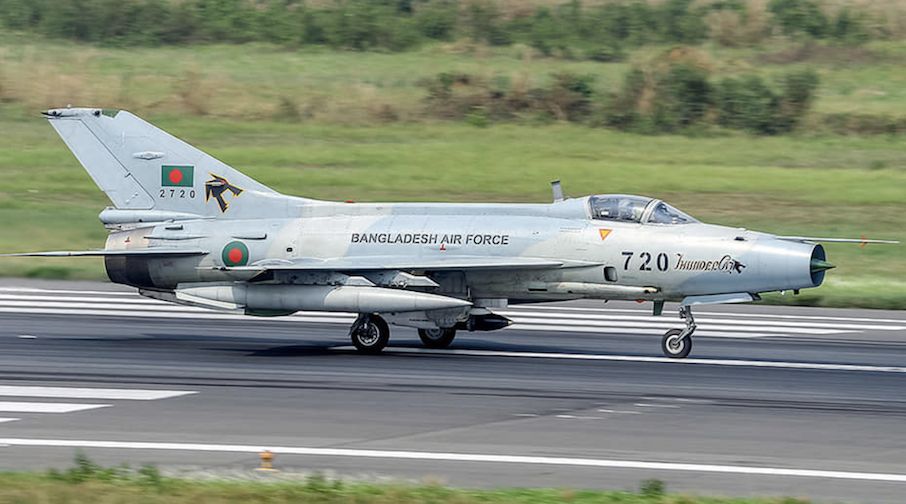
From 2006 China would manufacture the JF-17 Block 1 fighter jets - which were loosely derived from the J-7 design. Unlike the J-7, the fighters had a radically redesigned fuselage which appeared entirely different to the MiG-21 - making use of air inlets on the side of the nose cone rather than in the nose cone to host a larger radar in the randome. This was largely based on experimental J-7 variants, the J-7FS and J-7MS which made use of inlets under the chin. The JF-17 has since been enhanced to the point that it is unrecognisable next to the original J-7 design, with the latest JF-17 Block 3 variants integrating state of the art sensors and missile technologies and specialised radar cross section reducing airframes. Alongside the JF-17, a more direct derivative of the J-7 and MiG-21 was the JL-9 fighter/trainer which also made use of side air inlets. The aircraft retained fourth generation combat capabilities, and saw its first flight in 2003. The platform entered service in the PLA Air Force and PLA Navy in 2014 and 2015 respectively. The aircraft is in many ways similar to the JF-17, although it was not designed for high end air to air combat in the same way and is considerably less costly. The design instead prioritises attack and training roles, and inherits the low cost of the J-7 both to manufacture and to operate.
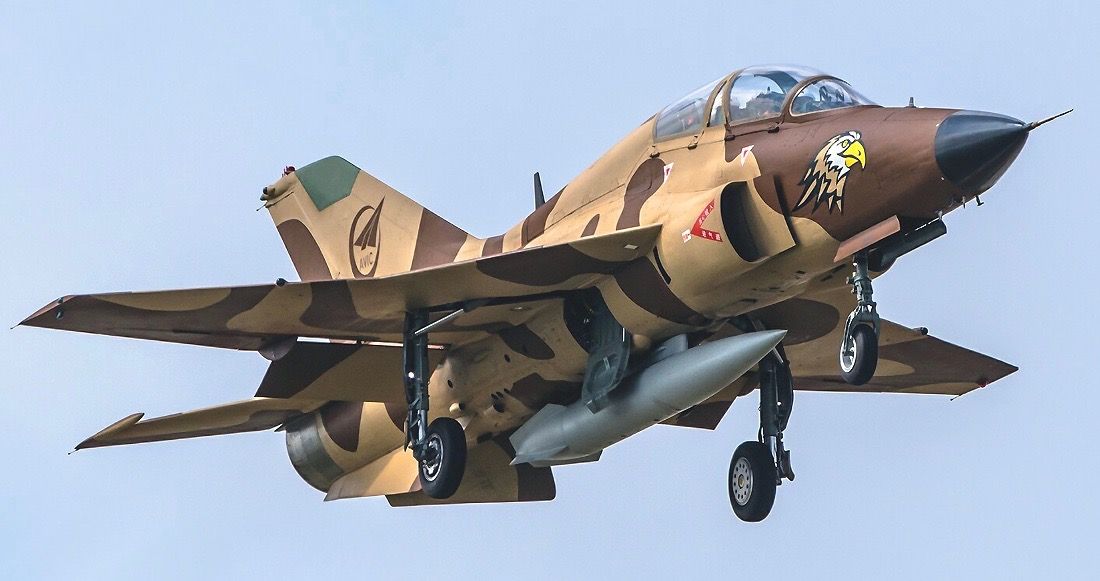
The JL-9 is reportedly set to be developed into a carrier based trainer, the JL-9G, which has a tailhook and a strengthened airframe and is designed for ski jump and possibly catapult assisted takeoffs. The JL-9 design has also been developed into a more combat capable and attack oriented variant, the FTC-2000G, which integrates a new wing and a full glass cockpit and inherits the engine, empennage, and mechanical controls of the J-7. This latter variant has more capable multirole combat capabilities, and entered mass production in late 2018. The FTC-2000G has more weapons hardpoints and a divertless supersonic air inlet, but reportedly has a shorter range than the original variant. The JL-9’s design fulfils a very different role to the original MiG-21 and the J-7G, both of which were designed for high end air to air engagements in their time, but inherits its highly reliable and versatile airframe which has been enhanced successively over more than fifth years by Chinese designers. The fact that China had one of the most capable and sophisticated military aviation industries in the world - the first outside the United States to develop a fifth generation fighter jet - and continues to manufacture derivatives of the MiG-21 design, is testament to the platform’s continued viability despite claims that it has become obsolete. Indeed, Chengdu has taken the design far further than Russia or the Soviet Union ever did - and may well make a carrier based MiG-21 a realty in the form of the JL-9G. The design is set to remain in production well into the 2020s and possibly beyond, and is a potentially highly popular import for China’s third world defence clients due to its combination of high versatility, reliability, ease of maintenance and low cost.
