
Su-35 vs. F-35: Do Russia’s Newly Delivered Fighters Have Any Advantages Over NATO’s Top Stealth Jets?
Military Watch Magazine Editorial Staff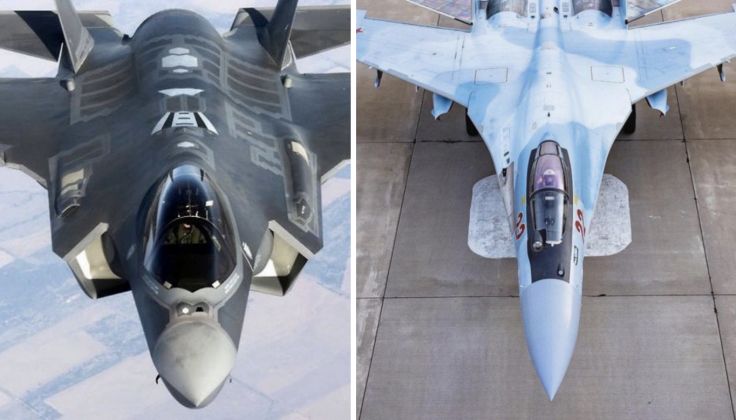
F-35 (left) and Su-35 Fighters
Following confirmation on May 26 that the Russian Aerospace Forces had received a new batch of Su-35S fighters from the state run United Aircraft Corporation, significant questions have been raised regarding the capabilities of these aircraft to provide an effective defence against the F-35 stealth fighters fielded by the country’s NATO adversaries. The F-35 is the only fifth generation fighter type in production in the Western world, and has increasingly formed the backbone of NATO’s air power, winning every tender in which it has competed against other Western fighter types, and rapidly proliferating across NATO, as well as across Russia’s eastern border to Japa. As a ‘4++ generation’ fighter developed by a state with a much more limited scale of research and development, the Su-35 is significantly less sophisticated than the F-35, lacking comparably advanced avionics, stealth capabilities, or weaponry. The Russian combat jet nevertheless retains a number of important advantages that could potentially prove pivotal in a major conflict.
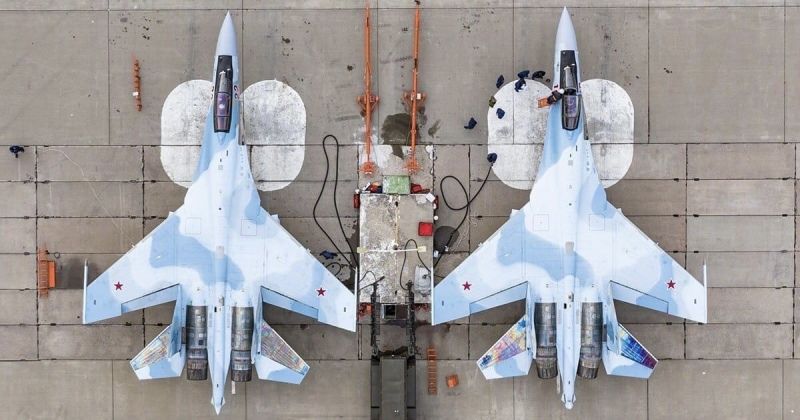
Where the F-35 was developed under the Joint Strike Fighter program primarily for air defence suppression and air-to-ground strike operations, under a program which focused on reducing costs to provide a lighter and cheaper counterpart to the larger twin engine Advanced Tactical Fighter, the Su-35 was by contrast developed with a strong focus on air-to-air capabilities to serve as Russia’s premier fighter type. As a result, the Su-35 is a significantly larger aircraft that integrates a radar close to three times as large and over twice as powerful as the F-35’s AN/APG-81, produces significantly more thrust and power for onboard systems, and can carry a much larger armaments suite. These advantages are not considered sufficient to compensate for the F-35’s stealth capabilities, which the Su-35 almost totally lacks, or for its cutting edge data sharing capabilities which optimise it for network centric operations, but they do give Russian defence planners some areas of strength to plan operations around.
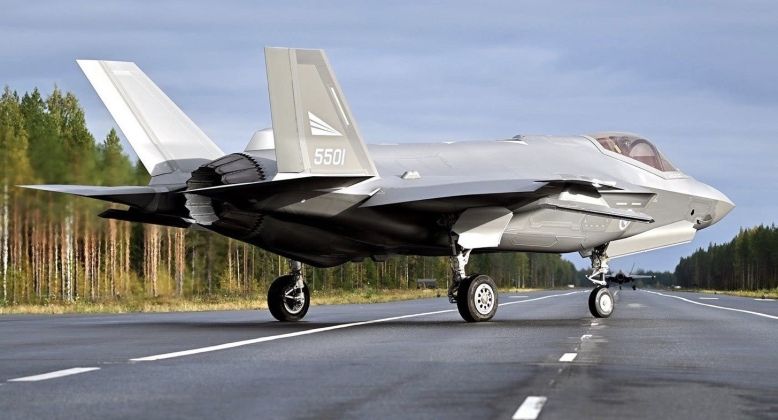
The F-35’s radar evading capabilities and superior network-centric capabilities are complemented by its significantly superior passive electronic intelligence gathering capabilities, which are optimal for locating ground-based air defence systems such as the S-400 that the Su-35 was designed to operate alongside. A primary shortcoming of the F-35 remains its very limited weapons payload and variety of armaments, which is an area where the Su-35 has a particularly distinct edge. The F-35 can currently carry only four air-to-air missiles when configured for stealth, although this will increase to six on the F-35A and F-35C variants once they are belatedly brought up to the Block 4 standard around the year 2030. The Su-35, by contrast, can carry up to 14 air-to-air missiles without significantly compromising its flight performance, reflecting not only its ability to carry missiles externally in standard configuration, but also its much larger size and greater engine power.
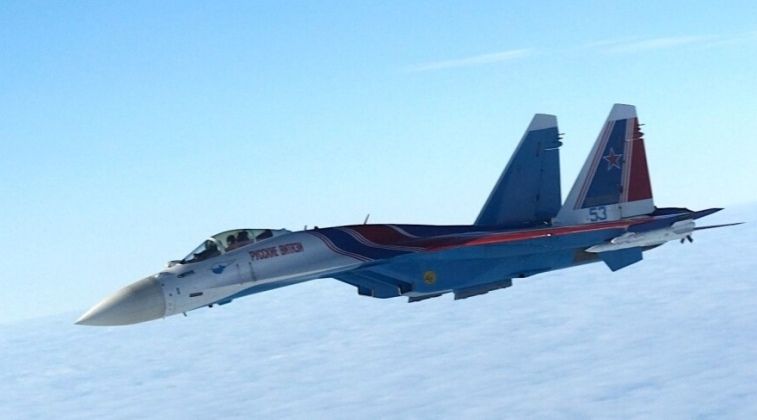
The F-35 for over a decade held a significant advantage over the Su-35 due to its integration of advanced AIM-120D air-to-air missiles, which have ranges approximately 60-70 percent longer than that of the Su-35’s own primary air-to-air missile the R-77-1. This changed in 2025 when the Su-35 in 2025 was confirmed to have integrated the R-77M missile, which has an estimated range of close to 200 kilometres and APAA terminal guidance capabilities optimal for homing in on stealth or high manoeuvrable targets. The F-35 is expected to regain its advantage with the integration of the much delayed AIM-260 missile, a successor to the AIM-120, although the extreme cost of these weapons has raised questions regarding whether a significant number can be allocated to the European theatre. The integration of the R-77M has ended one of the Su-35’s primary disadvantages in its air-to-air performance, although whether this will last remains highly uncertain considering the far larger scale of investment in air-to-air missile development being made in the U.S..
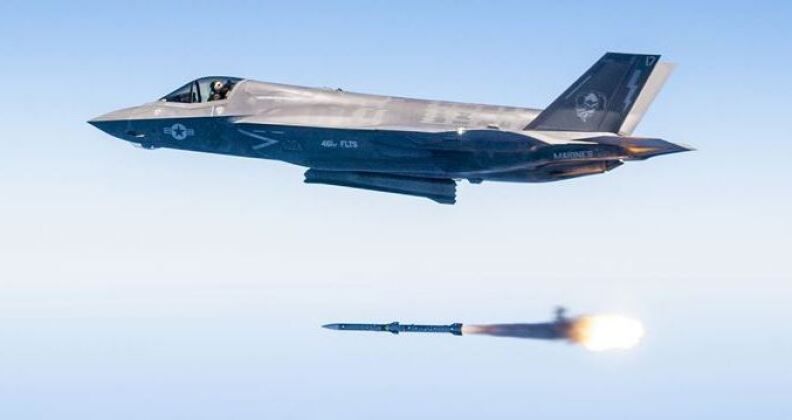
One of the Su-35’s most significant advantages remains its range, which is approximately 180 percent that of the F-35A and over double that of the F-35B, allowing it to patrol Russia’s vast territory, while escorting bombers and pursuing hostile targets far from the country’s borders with a combat radius approaching 1000 kilometres. The aircraft can also cruise at supersonic speeds without using afterburners, which the F-35 is the only fifth generation fighter that cannot do. This provides a significant degree of operational flexibility. The Su-35 can also narrow the gap in air-to-air missile range by launching its missiles from much higher speeds and altitudes than the F-35 can. Its maximum speed is approximately 60 percent higher, allowing the aircraft to more rapidly redeploy to respond to contingencies.
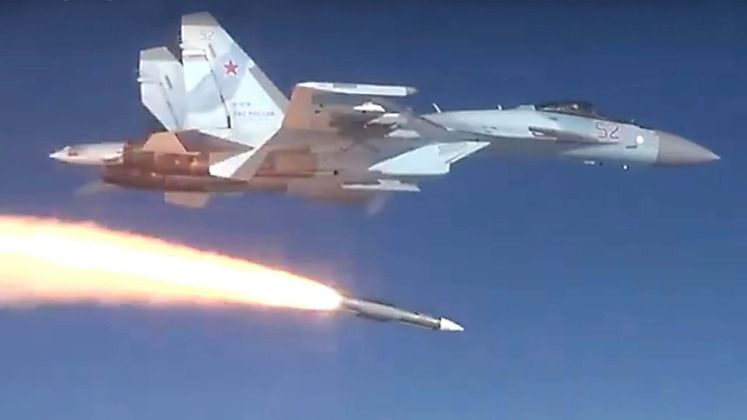
Complementing the Su-35’s advantages in range and weapons carrying capacity, the fighter has an air-to-air engagement range estimated at close to double that of the F-35, with its R-37M missiles being designed to engage targets over 350 kilometres away, where the AIM-120D’s range is limited to 160-180 kilometre ranges. The missile is optimal for engaging high value support aircraft such as E-7 AEW&Cs, which are relied on to compensate for the F-35’s relatively small radar size, and KC-135 tankers, which are relied on to extend its otherwise relatively short range. The R-37 allows the Su-35 to target these aircraft far beyond the retaliatory range of escorting fighters. The fact that Su-35s were designed to operate from makeshift runways, where the F-35A and C in particular require pristine airfields, further increases the latter’s reliance on tanker support by constraining its options for refuelling on the ground.
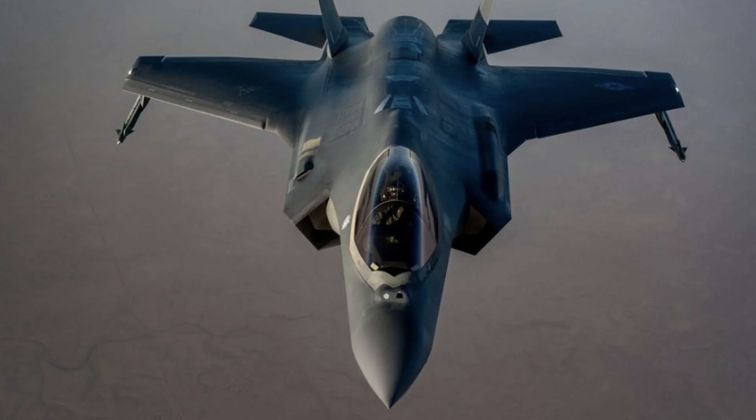
The Su-35’s most distinct advantage may be in its visual range combat capabilities. The F-35’s AIM-9X Block II infrared guided missile can engage targets at much higher off boresight angles than the Su-35’s R-74, with the stealth fighter’s distributed aperture systems ensuring far greater awareness of possible threats and allow pilots to ‘look through’ their aircraft using their advanced helmets. Although the AIM-9X’s superiority is expected to heavily compensate for the Su-35’s superior flight performance, the F-35 cannot accommodate it or any equivalent missile in its internal weapons bays, meaning that unless configured in a way that negates the advantages of its stealth capabilities, it will be highly constrained in its visual range combat capabilities. Should the Su-35 be able to effectively use electronic warfare and other measures to evade targeting, it would retain a significant advantage in a close range fight with a stealth configured F-35.
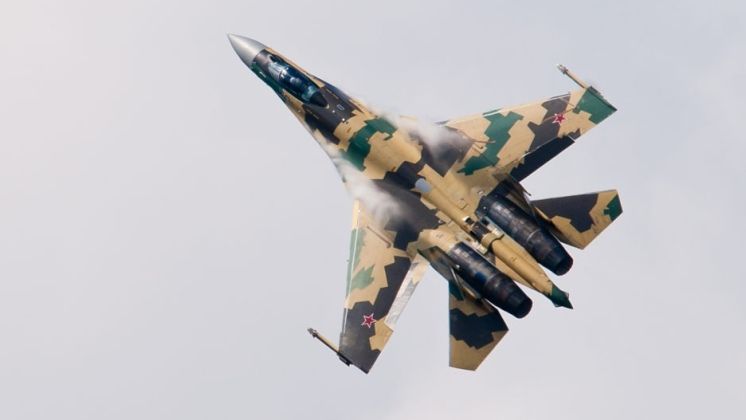
A further major advantage of the Su-35 is that it can integrate a wide range of air-to-ground and anti-ship missiles, where the F-35’s only currently compatible missiles are air-to-air missiles. This makes the Russian fighter significantly more versatile, and in an engagement allows it to potentially target bases and warships hosting F-35s in ways F-35s may struggle to do against Russian bases. The lack of anti-radiation missiles remains a particular shortcoming for the F-35, which was designed specifically for air defence suppression missions but is not compatible with the primary U.S. missile type built for the role the AGM-88, largely due to major delays bringing it up to the Block 4 standard. While the Su-35 is a less sophisticated fighter, which reflects the decline in the standing of Russia’s defence sector since the USSR’s disintegration, it retains a number of important advantages that if effectively exploited could allow it to seriously challenge a NATO air assault spearheaded by F-35s.
