
Should the United States Sell F-35s to the UAE? Benefits and Drawback of Proliferating Stealth Fighters
Military Watch Magazine Editorial Staff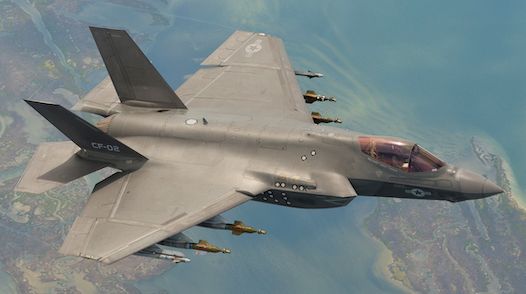
U.S. Air Force F-35A
As the United States government and Lockheed Martin look to expand the F-35 stealth fighter program and market the aircraft beyond the nine original partner nations, the United Arab Emirates has emerged as a leading potential client for the next generation jets which could potentially become one of its largest foreign operators. The UAE has shown a strong interest in procuring the F-35A since long before the aircraft entered service in the U.S. Air Force. The country’s foremost fighter is currently the F-16E/F ‘Desert Falcon,’ the most advanced variant of of the aircraft, which was the first ever exported by the United States with an electronically scanned array radar rather than a traditional mechanically scanned radar. The UAE previously hosted U.S. Air Force F-22 Raptors at Al Dhafra airbase, which carried out sorties in Afghanistan, Iraq and Syria and maintained a strong presence near Iranian borders. The airbase currently hosts a sizeable U.S. Air Force presence including F-35A and F-15C fighters.
The UAE is among United States’ closest strategic partners in the Arab world, and shares a number of common defences interests including combating the Ansurullah Coalition in Yemen and containing Iranian influence. The United States has nevertheless proven reluctant to supply Abu Dhabi with the F-35, largely on the basis that it would undermine the longstanding U.S. policy of denying Arab states access to military equipment which could compromise Israel’s qualitative military edge advantage in the Middle East. Nevertheless, such concerns have been frequently overlooked in the past, most notably with the sale of F-15C/D fighter air superiority fighters and E-3 airborne early warning and control aircraft to Saudi Arabia in the 1980s, and the sale of the F-16E/F to the UAE Air Force which comfortably outmatched any fighters Israel would field for the next decade
Undermining the potential dangers stemming from UAE use of the F-35 against Western or Israeli interests, U.S. control over software codes, the fighter’s extreme reliance on the U.S.-centred Autonomic Logistics Information System, and the maintenance requirements and ‘just in time’ logistics system which leave the fleet particularly vulnerable to spare parts shortages, all ensure that Washington would have little trouble grounding the fleet. This would leave the fleet effectively useless should Abu Dhabi seek to employ the aircraft in ways that were contrary to U.S. interests. Risks could be further mitigated by delivering variants of the F-35 with downgraded software, similar to those previously intended for export to Turkey, as well as by limited access to advanced air-launched weapons such as the AIM-260.
The benefits of an F-35 sale to the UAE are considerably greater when considering the potential costs of denying the country access to the fighter. The UAE is currently developing a fifth generation fighter with Russia under a joint program, and has shown an interest in acquiring Su-35, with the new Su-57 fifth generation fighter having the potential to also gain an appeal. Russian fighters are not reliant on an American centred logistics network , American code, or on U.S.-supplied parts, with their proliferation seriously limiting Washington and its allies’ ability to influence the regional balance of power. The capabilities of such fighters are less well known to the U.S. and its allies, making countering them on the battlefield potentially considerably more difficult than countering a ‘rogue’ F-35. Thus while the risk of the UAE turning its air force against Israel or the United States is already very limited, the threat it could pose would be far greater if it procured uncontrollable non-Western fighters than if it acquired F-35s. The need to deny the Russian defence sector revenues provides a further strong argument for supplying the F-35.
