
Russia’s Two Assault Carriers Under Construction Could Be the Biggest in the World - ‘Jump Jet’ Fighters Likely to Follow
Military Watch Magazine Editorial Staff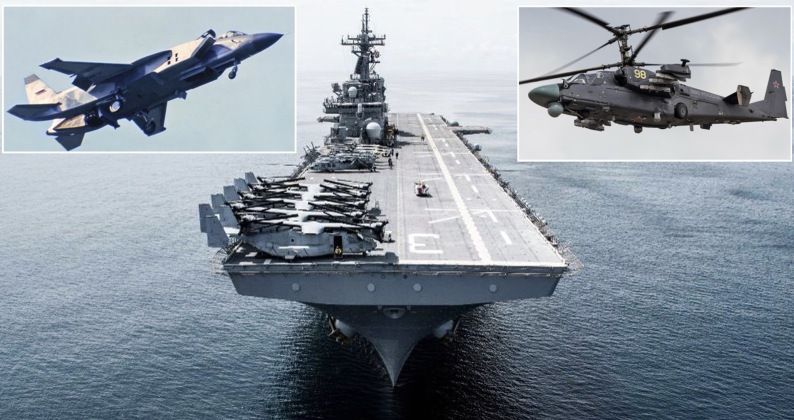
Assault Carrier with Yak-41 and Ka-52
After having been laid down in Crimea in 2020, the two Project 23900 Class carriers currently under construction are expected to be commissioned into service in the Russian Navy in 2025 and 2027. With Russia not having laid down even destroyer or cruiser sized ships for its Navy since the collapse of the Soviet Union, the carriers named Ivan Rogov and Mitrofan Moskalenko represent the most ambitious surface shipbuilding program in three decades. The contract between the Russian Defence Ministry and the United Shipbuilding Corporation was signed in May 2020, and amounted to just $1.36 billion for both carriers. The low price was a result of the weakness of the Russian rouble relative to the American dollar at the time, as well as the fact that some of equipment to outfit the ships such as defensive weapons is expected to be covered under a separate contract. What is particularly notable about the warships is their considerable size, with each displacing approximately 44,000 tons according to a senior Defence Ministry official. It is uncertain whether this represents their fully loaded size or not, and with a full complement of aircraft, armoured vehicles, naval infantry and weaponry the ships could displace 46,000 tons or more.
To place the size of Russia’s new carriers in perspective, the U.S. Navy’s Wasp Class which was formerly considered the largest class of assault carrier in the world displaces approximately 40,000 tons, while its newer America Class ships displace around 45,000 tons each when combat loaded. China’s new Type 075 Class assault carriers are also thought to displace around 40,000 tons each, while the Mistral and Dokdo Class ships produced by France and South Korea respectively displace only around 20,000 tons. The Project 23900 Class thus could potentially be the world’s largest assault carrier - heaver than most aircraft carriers including the continental Europe’s heaviest the 40,000 ton Charles De Gaulle and Japan's heaviest the 27,000 ton Izumo Class. Confirmation of the size of the new Russian ships was provided by Russia’s Deputy Defence Minister Alexei Krivoruchko in an interview with the Russian military's official news outlet Krasnaya Zvezda.
The size of the ships brings into question whether Russia really intends to operate them purely as helicopter carriers and assault ships, or whether like the U.S. Navy it plans to deploy aircraft with vertical landing capabilities from their decks. In the late 1980s the Soviet Union was a world leader in the field of vertical landing capable aircraft with its Yak-41 and Yak-43 programs, the former which reached an advanced prototype stage. Officials have repeatedly indicated that such an aircraft is under development, although whether it will have fourth or fifth generation capabilities and whether it will be developed jointly with another country remain uncertain. Such an aircraft could benefit from new hypersonic air to air missiles, air launched ballistic missiles, AESA radars and other advanced features which new Russian fighters have benefitted from.
