
Russia is Wearing Out America’s High Maintenance F-22s by Loitering Bombers Around Alaska
Military Watch Magazine Editorial Staff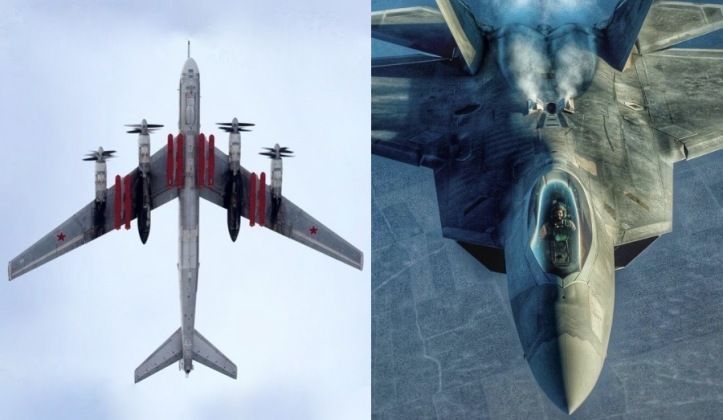
F-22 (right) and Tu-95 with Kh-101/2 Missiles
The U.S. Air Force’s most capable fighter in air to air combat, the F-22 Raptor, has seen a high concentration of deployments to Alaska with a full one seventh of all F-22s stationed at Joint Base Elmendorf-Richardson in the country’s northernmost state. The reason for such deployments has been the territory’s very close proximity to Russia, leaving bases in Alaska on the frontlines in any potential clash between the two powers and in a theatre where the U.S. will have relatively little NATO support. While the F-22 is considered an elite fighter, and one which is fielded in relatively few numbers with only 187 serial production variants ever produced, the aircraft’s very high maintenance requirements and operational costs make fielding it and maintaining availability rates above even 50% very taxing for the U.S. Air Force. Amid heightened tensions with Russia, the Russian Air Force’s operations near Alaska appear to be intended to maximise the strain on the Raptor fleet at a relatively low cost to Russia itself - an issue America officers have lamented.
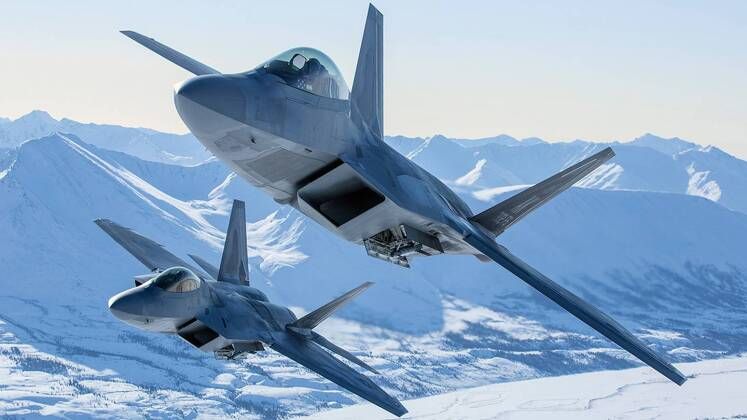
Speaking from Joint Base Elmendorf-Richardson Lieutenant General David Krumm emphasised in March that there was a significant increase in Russian activity near Alaska, with Russian incursions into the Alaska Air Defense Identification Zone being conducted at the highest rates since the collapse of the Soviet Union in 1991. He highlighted that operating F-22s to intercept Russian aircraft was costly, and that there was “a strain on our units” from Russian activities. On March 31, the North American Aerospace Defense Command reported that not only were Russian incursions increasing, but that Russian aircraft were loitering in the identification zone for hours at a time. As the Alaska Air Defense Identification Zone was International airspace, Russian aircraft could legally maintain a continuous presence in it - but the U.S. need to intercept such aircraft and its reliance on F-22s to do so imposed significant costs. Russian aircraft such as the Tu-95 bomber, by contrast, had low operational costs, were ideal for loitering for long periods, and could not not be ignored due to their ability to deploy radar evading nuclear tipped cruise missiles in significant numbers. The cost of keeping maintenance-intensive F-22s in the air for such a length of time was very considerably higher.
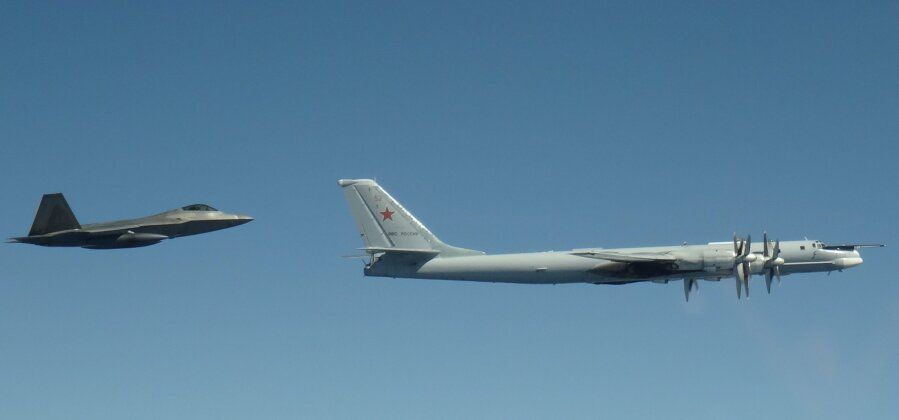
Air Force General Glen VanHerck, who led U.S. Northern Command (NORAD), stated in March regarding Russian operations: “The difference between the past and now is the intercepts are more complex – multi-axis, multi-platforms and often times they’ll enter the [air defence identification zone] and stay for hours. That would be the significant difference. But why this is ongoing? It is playing out as the peer competition that we’ve talked about.” The general told the Senate Armed Services Committee that month that in 2020 “NORAD responded to more Russian military flights off the coast of Alaska than we’ve seen in any year since the end of the Cold War… These Russian military operations include multiple flights of heavy bombers, anti-submarine aircraft, and intelligence collection platforms near Alaska. These efforts show both Russia’s military reach and how they rehearse potential strikes on our homeland. Last summer, the Russian Navy focused its annual OCEAN SHIELD exercise on the defence of Russia’s maritime approaches in the Arctic and Pacific.” He emphasised that these operations represented a form of strategic messaging.
The U.S. deployed F-35 fighters to Alaska in 2020, which are smaller and require less maintenance than the F-22 but which are also still far from combat ready. The country's latest heavyweight fighter, the F-15EX, is expected to receive a new very long range air to air missile designed specifically to neutralise large aircraft such as bombers.
