
North Korea's New Hypersonic Missile Has a Massive 2.5 Ton Warhead and ’Low Altitude Gliding Leap’ Flight Mode
Military Watch Magazine Editorial Staff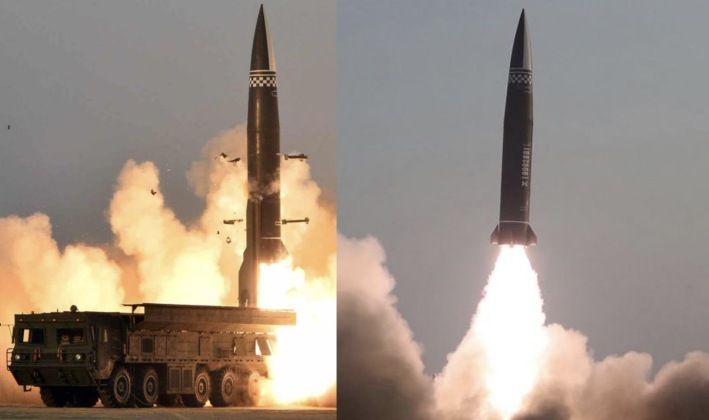
North Korean Hypersonic Missile Test - March 25 2021
KCNA
North Korean state media outlet KCNA announced that the Academy of Defence Science tests fired a “newly develop new-type tactical guided projectile” in the early hours of March 25th. The missile in question was first unveiled in a parade in January, and appears to be a larger version of the KN-23 platform was was first flight tested in 2019. The KN-23 was capable of impacting targets at low hypersonic speeds, and similarly to the better known Russian Iskander missile it was designed with very high manoeuvrability, the ability to follow complex trajectories, and various countermeasures which reportedly made it very difficult to detect for South Korean and Japanese defence systems such as the U.S.-supplied AEGIS. The unnamed new missile is thought to have many of the same capabilities, but carries a larger warhead and has a longer range estimated at approximately 850km.

The new missiles are launched from ten-when transporter erector launchers - which are larger than the eight wheel launchers used by the KN-23 to accommodate the heavier munitions. It remains uncertain whether the new missiles will replace the KN-23 entirely, or whether they will serve in a complementary role alongside them. The missiles make use of solid fuel engines, which allow them to be stored fully fuelled and reduce the launch times considerably. The combined with their deployment from highly mobile launch vehicles makes the missiles much more difficult to seek and destroy. North Korea has previous experience developing missiles into larger heavier versions with longer ranges, with its first ballistic missile the Hwasong-5 developed in the 1980s and early 1990s into the Hwasong-6, Scud-ER and Rodong-1 platforms.
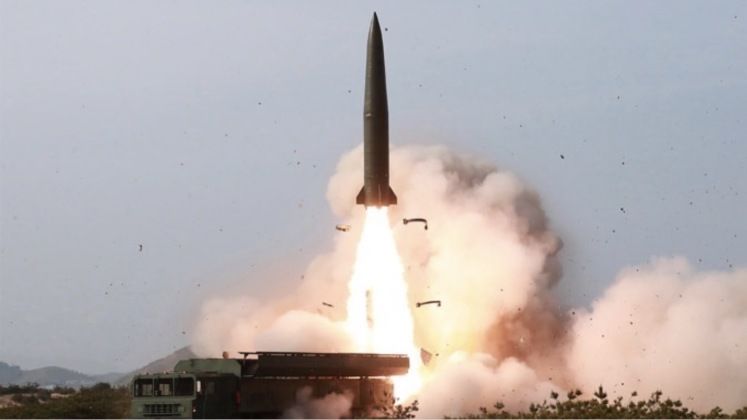
According to KCNA: “Right after the test firing,, the Academy of Defence Science clarified that the test-firing was very successful just as it had been confidently precise, wing that the reliability of the improved version of the solid fuel engine was confirmed through several engine ground jet tests and their test firing processes, an that the irregular orbit features of low-altitude gliding leap type flight mode already applied two other guide projectiles were also re-confirmed.” North Korea fields one of the most diverse ballistic missile arsenals in the world, including three classes of intercontinental range missile two of which have demonstrated the capability to strike the continental United States. The third of these, missiless, unveiled in November 2020, could potentially be tested in 2021 depending on the state of relations between Pyongyang and Washington. The two countries have been technically at war for over 70 years, with the East Asian state focusing on developing its missile arsenal to asymmetrically counter the U.S. Military.
