
North Korea Demonstrates Next Generation Tank’s Cutting Edge Defences Against Javelin-Type Missile and Drone Top Attacks
Military Watch Magazine Editorial Staff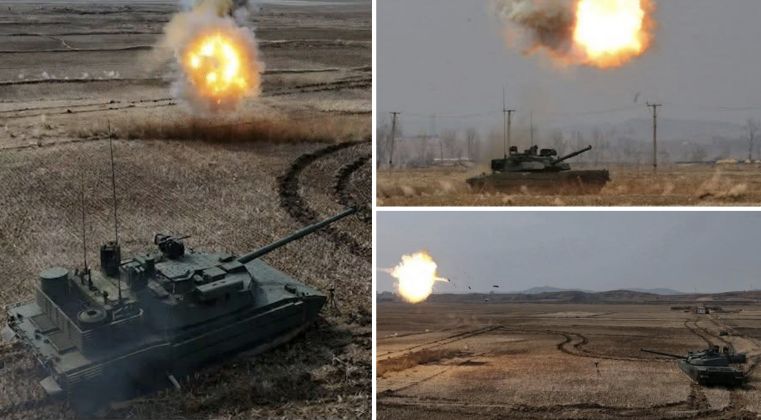
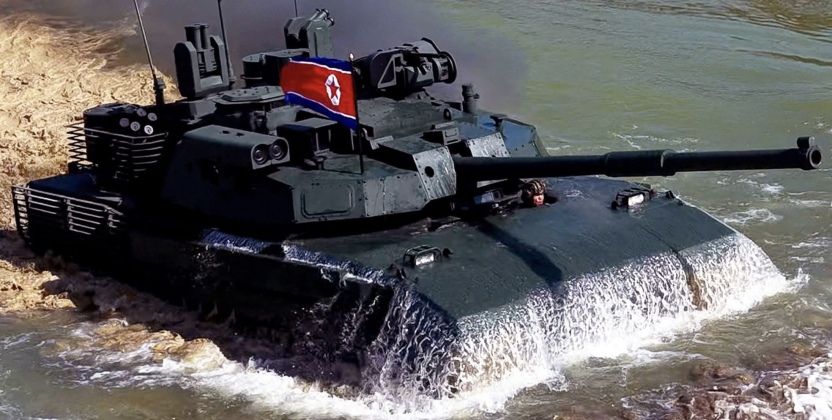
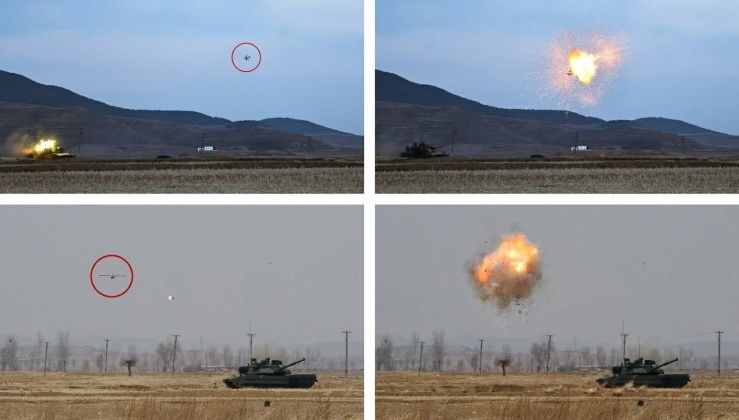
North Korean Chonma 20 Tank Intercepting Targets Using Active Protection System
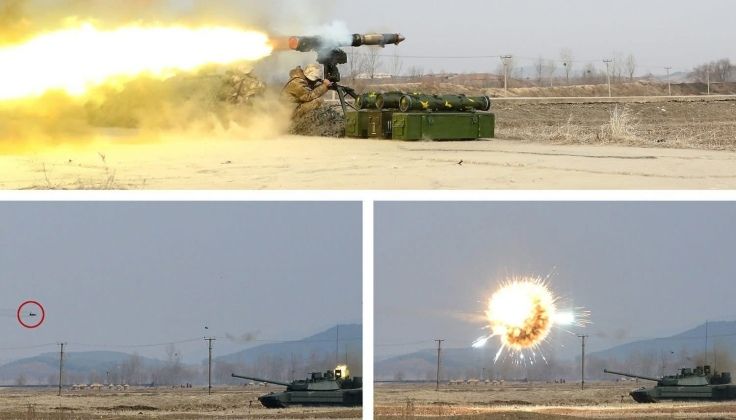
The Korean People’s Army has evaluated the capabilities of the new Chonma 20 main battle tank’s active protection system against multiple type of advanced anti-tank weapons, with live fire tests indicating a very high degree of confidence in the vehicle’s survivability and major advances in associated technologies. Tests conducted on March 29 evaluated the combat effectiveness of the system against projectiles approaching from multiple directions, including a Javelin-type top attack missile launched from which appears to be a derivative of the Bulase-4 system, as well as a shorter range Kornet-type tandem-charge missile, and a rocket propelled grenade resembling the RPG-7. The demonstration of the system’s capabilities has followed years of progress showing incrementally more capable active protection systems under development.
Commenting on the test, state media reported that the Chonma 2 can intercept “almost all existing anti-tank weapons.” Alongside missiles and rockets, the system was also tested against multiple types of drone-like loitering munitions and airborne attack profiles . This appears to be in recognition of the primary role which such systems have played in anti-tank operations on both sides in the Russian-Ukrainian War. The development is notable not only for its implications for the revolutionising of North Korea armoured warfare capabilities, but also because the Chonma 20, and possibly its individual subsystems including active protection systems, are expected to be marketed to Russia.
Russia has already procured tens of billions of dollars worth of North Korean armaments for its war effort in the Ukrainian theatre, and has suffered from growing shortages of main battle tanks as its Soviet era reserves are increasingly depleted, while its production is far from sufficient to replace frontline losses across a long and high intensity frontier. This has led analysts to speculate that procurements of North Korean main battle tanks appears likely. It is possible, however, the Russia will favour procuring older T-62 tanks from North Korea, which can be more easily integrated into its forces and will be significantly less costly, potentially after local modernisation integrates new subsystems such as thermal imaging systems and active protection systems.
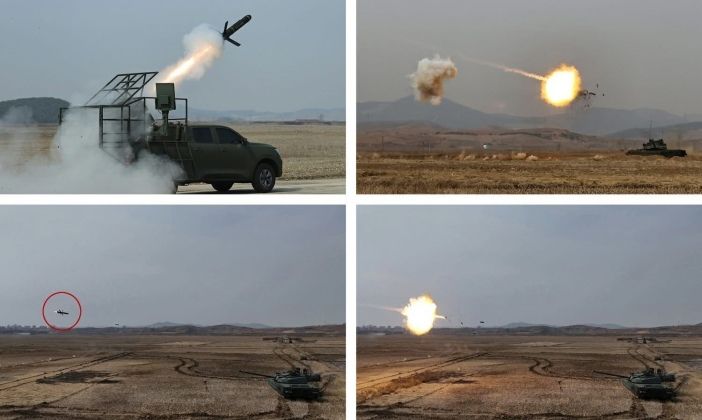
North Korea’s active protection system was first seen in use in footage released in July 2023, and uses radars to continuously monitor their surrounding environments for incoming threats, and when detecting incoming projectiles track them automatically, calculate their trajectories, and deploy protective munitions to intercept and destroy them. Although still ahead of the Western world, Russia fell behind China, Israel, and the two Koreas in developing modern active protection systems for its tanks. North Korean anti-tank missile capabilities have also increasingly eclipsed those of the Russian defence sector, with the Bulsae-4 electro-optical guided long-range anti-tank missile system having been employed in the Ukrainian theatre and boasting advanced long range top attack capabilities that Russian equivalents lack.
The Chonma 20 gained greater publicity following its involvement in exercises on March 19, when it was revealed that the Korean People’s Army tank brigade at the Pyongyang Training Base No. 60 serving under the elite Capital City Defence Corps had been re-equipped with vehicles. The exercises indicated that major advances in network centric and combined arms warfare capabilities had been made, potentially significantly enhancing the armed forces’ ability to conduct offensives against advanced South Korean and U.S. defences. In May 2025, North Korean state media unveiled a large scale new tank factory, at which time chairman of the ruling Korean Workers’ Party Kim Jong Un stressed that replacing the Korean People’s Army’s armoured vehicles of the last century with the latest models had become a primary task of building the armed forces. It was projected at the time that the service entry rates of next generation main battle tanks would accelerate considerably. The technological gap of over four decades separating the Chonma 20 from preceding North Korean main battle tanks makes large scale production and procurements a likely game changer for the balance of power on the Korean Peninsula.
