
Most Valuable U.S. Support Aircraft Destroyed in Iranian Strike: How Losing an E-3 ‘Flying Radar’ Disrupts the War Effort
Military Watch Magazine Editorial Staff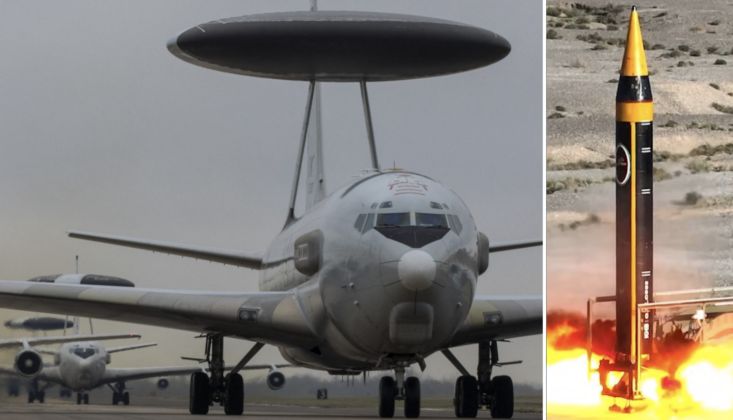
U.S. Air Force E-3 AWACS (left) and Iranian Missile Launch
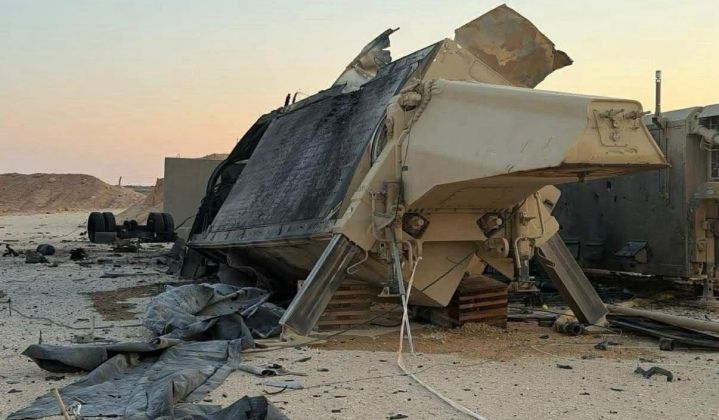
The U.S. Air Force has lost at least one E-3 Sentry airborne warning and control system (AWACS) and three KC-135 Stratotanker airborne refuelling aircraft at Prince Sultan Air Base in Saudi Arabia, after the Iranian Islamic Revolutionary Guard Corps launched multiple ballistic missile and drone attacks on the facility. The strikes on March 27 have caused considerable casualties, with conservative estimated indicating that ten U.S. airmen were wounded, although some estimates have been significantly higher. The destruction of an E-3 AWACS is an unprecedented development, with the aircraft valued at close to $500 million, and representing one of the most costly support aircraft in the Air Force alongside the similarly priced E-4B Nightwatch airborne command post.
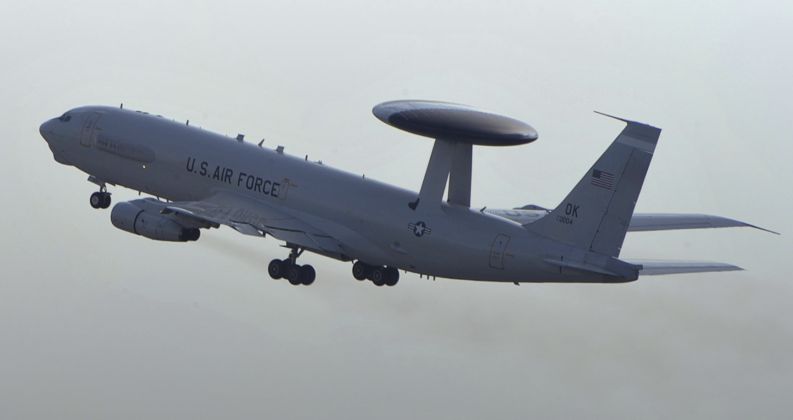
The successful strike on an E-3 AWACS complements major successes the Islamic Revolutionary Guard Corps has achieved in destroying critical ground-based radars that are key to maintaining the U.S. and its strategic partners’ situational awareness. Seventeen U.S. military facilities were attacked by Iran in the two weeks following the U.S. and Israeli’s launching of an assault against the country on February 28, with these strikes having frequently targeted radar systems vital for ballistic missile defence. Notable achievements in the initial days of the war included the destruction of $2.7 billion worth of high value radar systems, including the $1.1 billion AN/FPS-132 radar in Qatar, and two AN/TPY-2 radars in Jordan and the United Arab Emirates valued at between $500 million and $1 billion each. The destruction of an E-3 will limit the Air Force’s ability to compensate or these losses with airborne radar support.
Preceding the initiation of attacks against Iran, the U.S. Air Force deployed the bulk of its global operational E-3 fleet to the Middle East and Europe. In mid-March the Air Force surged the operational tempo of the E-3 fleet over the Middle East, particularly over Jordan, northern Saudi Arabia, southern Iraq, and the eastern Mediterranean, to provide a persistent detection capability against Iranian drones and missiles being fired at targets in Jordan and Israel. Despite air defence systems being particularly heavily concentrated in Israel, Iranian missile attacks have achieved an 80 percent and growing success rate in striking key targets, with Israeli sources attributing this in part to the destruction of the U.S. and its strategic partners’ vast regional network of radar systems. The destruction of the E-3 may thus further improve the success rates of Iranian strikes.
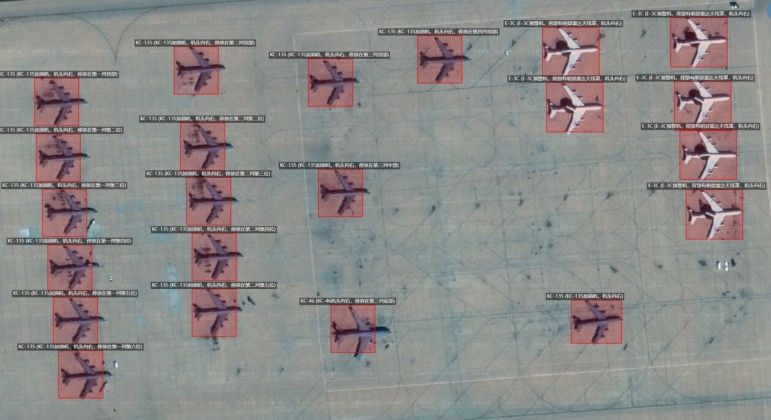
Iranian missile strikes have destroyed multiple types of high value aircraft fielded by the U.S. and its strategic partners, with a prior attack on Prince Sultan Air Base in the second week of March having damaged at least five U.S. Air Force KC-135 Stratotanker refuelling aircraft, placing pressure on the already highly strained tanker fleet. Days later a ballistic missile attack was widely reported to have destroyed a Untied Arab Emirates Air Force Saab GlobalEye airborne early warning and control (AEW&C) system, which has a similar role to the E-3. The aircraft is much smaller and carries a weaker radar, but is also much more modern. The viability of the decades old E-3 fleet has increasingly been called to question, with their radars and other avionics having also increasingly been left obsolete, limiting situational awareness particularly against low observable targets. The destruction of one of the aircraft represents one of Iran’s most significant successes against U.S. aviation, and may result in an increased reliance on operating high value aircraft from air bases further beyond the Middle East such as those in Eastern Europe, placing further strain on the fleet.
