
How Powerful Are the Destroyer and Bomber Fleets China Just Sent to Secure Huangyan Island?
Military Watch Magazine Editorial Staff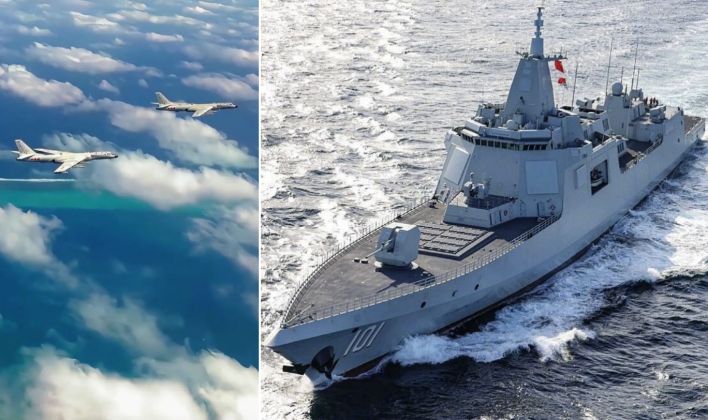
Type 055 Destroyer and H-6 Bombers Over Huangyan Island
The Chinese People's Liberation Army Southern Theatre Command responsible for the defence of Chinese territories in the South China Sea has deployed naval and air units for a combat readiness patrol from January 31, which was carried out in the territorial waters and airspace of Huangyan Island and surrounding areas. The Type 055 destroyer Xianyang led multiple types of warships for operations in the area, while in the air H-6K and H-6J bombers, the former equipped with YJ-12 anti-ship cruise missiles, cruised around the island with an escort of Su-30MKK long range fighters. This major show of force was assessed by analysts to be a direct response to the Philippines' designation of the island as part of a zone for its own military exercises, with the strongly Western-aligned Southeast Asian country having laid claim to multiple Chinese-controlled islands in the region.
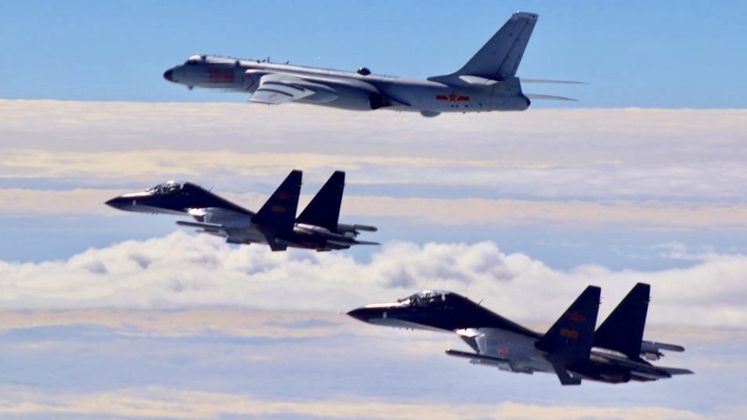
By deploying bombers, fighters, and one of its most capable surface combat ships to pass through the area designated by the Philippines, the the Southern Theatre Command demonstrated China’s effective jurisdiction over the territorial waters and airspace of Huangyan Island, which according to Chinese state sources had the effect of “rendering the Philippine-drawn exercise zone null and void.” A particularly outstanding aspect of the recent exercises was the deployment of a Type 055 class destroyer, which is one of just eight in service, and is widely considered by both East Asian and Western analysts to be the most capable type of surface combatant in the world. The London-based International Institute for Strategic Studies, for one, previously noted in a prominent paper that the Type 055 “may be the most capable multi-role surface combatant currently at sea,” representing “a step change in PLAN [People’s Liberation Army Navy] abilities to mount independent long-range deployments or task-group operations.”
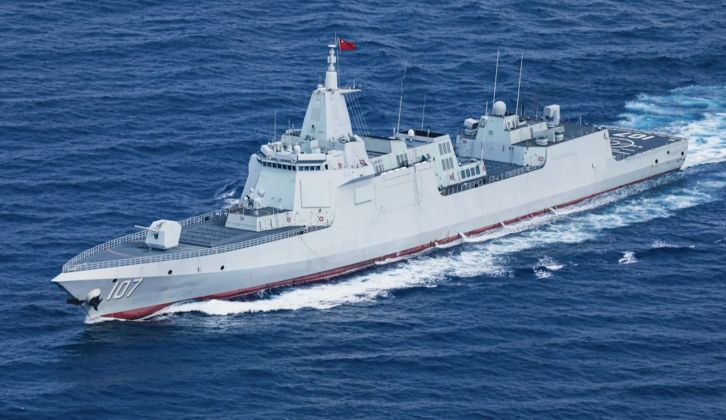
The Type 055 is a versatile multi-role ship equipped for land attack, missile defence, anti-aircraft, anti-submarine warfare and anti-shipping roles, and integrates 112 vertical launch cells as its primary armament, which are equipped with a wide range of missile types for air defence, land attack, and anti-shipping. The YJ-20 hypersonic anti-ship ballistic missile has been integrated in a limited capacity, and will reportedly become fully operational with the ships in 2026. The ships’ situational awareness is particularly outstanding, with the integration of a dual band radar providing over-the-horizon detection capabilities. This is similar to the SPY-3/SPY-4 radar which the U.S. Navy had intended but failed to integrate onto the Zumwalt class destroyer. A single Type 055 class destroyer provides a significantly greater combat potential than the entire Philippine Navy and Air Force combined, with its deployment expected to send a particularly strong signal to potential adversaries.
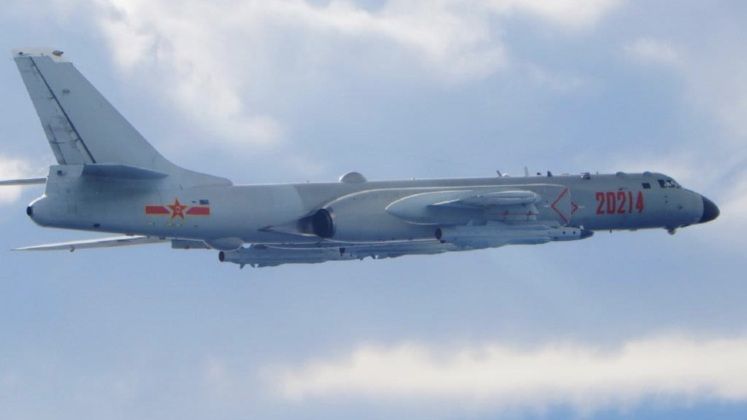
The H-6 is the most widely fielded bomber type in the world, with approximately 270 estimated to be in service. Other than the Russian Tu-160, which is being produced on a small small scale, it is also the world’s only bomber currently in serial production, and has fulfilled multiple significant roles with the Chinese People's Liberation Army Air Force and Navy. The YJ-12 missiles confirmed to have equipped at least a portion of the bombers involved in the latest patrol was developed in the 2010s for high-speed penetration of naval air defence systems, with a United States Naval War College Review report highlighting its superior range than equivalent Western missile types, and its ability to be launched from beyond the engagement range of shipborne air defence systems. H-6 bombers’ targeting capabilities have been significantly improved with the integration of the YJ-21 as a direct successor to the YJ-12, which is an air-launched variant of the YJ-20 that has been integrated onto Type 055 class destroyers.
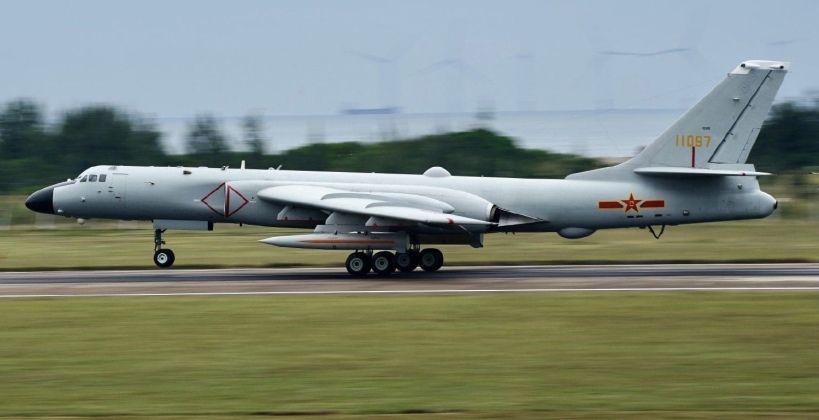
While a single smaller Type 052D class destroyer would likely have been sufficient to send a major show of force to the Philippines, the choice of assets for the recent exercises appears to have been intended to demonstrate overwhelming naval superiority to Manilla’s strategic partners, namely Japan and Western Bloc states such as the United States and Australia. The significant strengthening of Chines anti-ship missile capabilities, which were on display in the latest exercises, was recently highlighted in a Pentagon war game showing how the People’s Liberation Army could utilise its missile, anti-space and cyber assets to engage and destroy the most advanced U.S. Navy carrier groups.
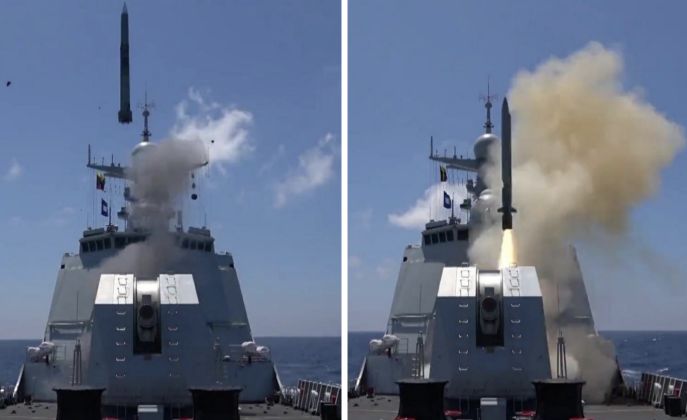
For operations against carrier groups with complex multi-layered missile defences, combinations of supersonic missiles like the YJ-12, hypersonic missiles like the YJ-20 and YJ-21, and various subsonic missiles, are all expected to play important complementary roles. The staging of a major show of force in the South China Sea has taken place as the U.S. Navy has itself redeployed key assets away from the region and towards the Middle East due to high tensions with Iran. American destroyers and bombers lack comparable anti-ship missiles to those deployed by the H-6 and Type 055, and the growth of the Chinese fleet of advanced destroyers at several times the rate as that of the U.S. Navy, are among the factors ensuring that power trajectories in the region remain highly favourable for Beijing.
