
World’s Largest Hypersonic Arsenal Aimed at U.S. Carrier Groups: Pentagon Study Shows How China Would Use It
Military Watch Magazine Editorial Staff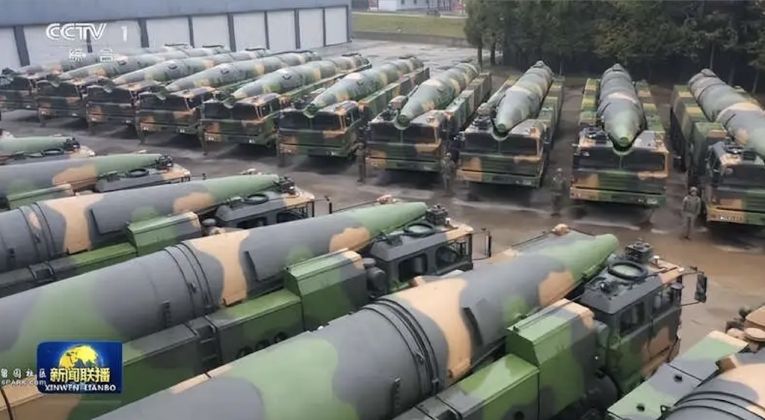
Chinese PLA Rocket Force DF-26 Ballistic Missiles
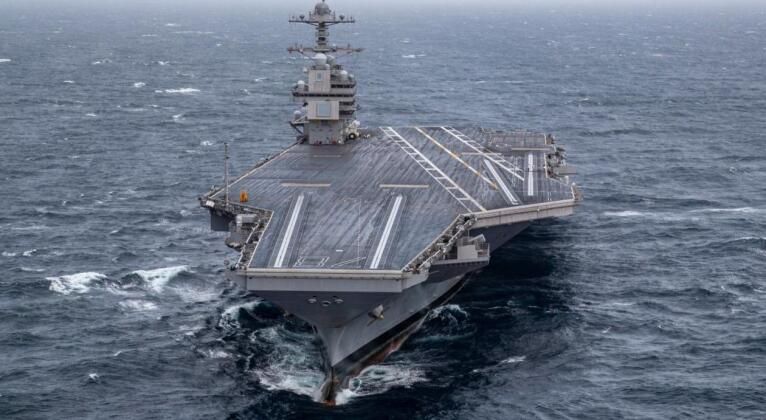
The Pentagon has provided new insight into how the Chinese People’s Liberation Army could utilise its missile, anti-space and cyber assets to sink even the newest and most capable U.S. Navy carrier groups. The leaked Overmatch Brief has concluded based on simulations of multiple engagement scenarios that Chinese forces could employ a wide range of means to achieve this, with cyber operations and anti-satellite attacks playing key roles in crippling American naval operations. Attacks on surveillance and navigation satellites in particular were found to prevent American warships from carrying out targeting, routing, and battle management. Although a primary conclusion reached was that Chinese forces could, under a wide range of scenarios, successfully sink the Navy’s newest Gerald Ford class supercarriers and their strike groups, one of the most outstanding conclusions was the particularly wide range of complementary assets Chinese forces were able to employ to achieve this.
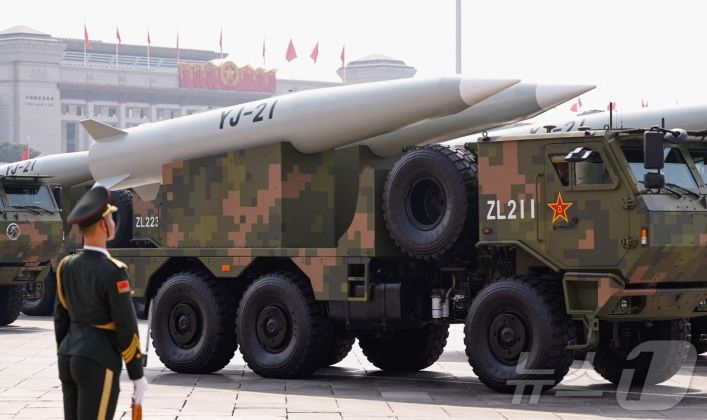
The study highlights China’s growing inventory of advanced anti-ship ballistic missile types, including those deployed from ground-based launchers such as the DF-21D and DF-26, the YJ-21 deployed from destroyers and submarines, and various other ballistic missile types carried by H-6 bombers. It also particularly draws attention to the complementary capabilities of both lower cost anti-ship missiles, which are used to exhaust the defences of carrier groups, and of higher end missiles which are capable of reliably penetrating these defences. The study assesses that the Chinese People’s Liberation Army currently fields up to 600 hypersonic missiles, which can travel at over five times the speed of sound while performing in-flight manoeuvres, making them extremely challenging or near impossible to shoot down.
Chinese forces were shown to be able to employ vast arrays of complementary missile types in coordinated salvos, with targeting data provided by satellites, radars, and unmanned aircraft to generate overlapping engagement zones. The study concluded that once such zones were established around a carrier group led by a Gerald Ford class supercarrier, the American warships faced a high probability of being neutralised before completing their objectives. It highlights border structural issues undermining America’s power projection capabilities, stressing that high-value assets such as carriers, fifth generation fighters, and major satellites, are all vulnerable to relatively inexpensive weapons that can be produced in large volumes by China’s defence sector.

Gerald Ford class carriers are described in the Overmatch Brief as critical platforms, with the loss of just one significantly reducing available American air power, making them key points of vulnerability. The brief highlights that the ships are central to long-term U.S. Navy planning, with the procurement of ten of the $12.8 billion vessels currently planned. It also highlights issues with American force design and industrial capacity, and reiterates the challenges posed by the very wide range of advanced missile types and launch platforms China fields, including hypersonic missiles deployed from bombers, fighters, submarines, destroyers, and ground-based ballistic and cruise missile launchers. The simulated engagements closely coincided with China’s unveiling of several new types of operational hypersonic anti-ship missiles in a military parade in October, and the release of new imagery in November showing a new type of hypersonic ballistic missile, the DF-27, which is expected to extend the range of anti-ship attacks from ground-based launchers to up to 8000 kilometres.
