
Five Belarusian Aerial Warfare Weapons NATO Fears: From S-400 Missiles to Su-30SM Fighters
Military Watch Magazine Editorial Staff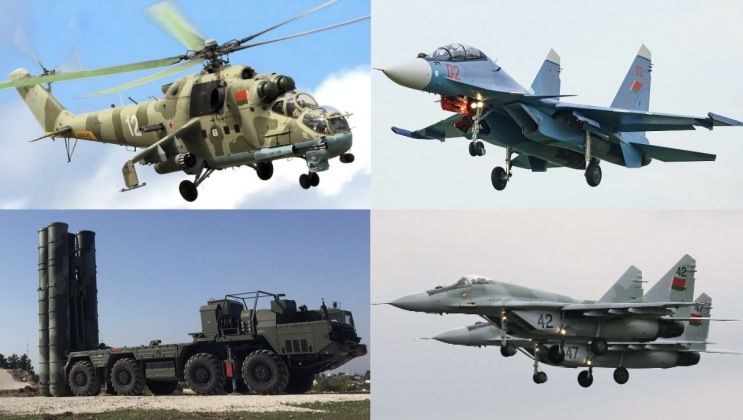
Mi-24P, Su-30SM, MiG-29, S-400 (clockwise from top left)
As NATO member states move to impose a growing number of economic sanctions on Belarus, relations between the Soviet successor state and the Western Bloc are expected to continue to deteriorate. Major riots and protests in the country from late August, which received highly favourable coverage in the West and, according to multiple Russian and Belarusian sources direct Western support, coincided with reports that Belarus perceived a major threat to its security from neighbouring NATO member states - dispatching elite air assault units to its western border to ensure security. The launches of balloons from neighbouring Latvia into Belarusian territory, which carried symbols supporting rioting groups, were met with helicopter gunships which neutralised the threats and formal complaints against the NATO member states involved.
Tensions between Belarus and the Western powers notably predated the recent unrest in the country, with Minsk warning that it would perceive the construction of a major U.S. military base in neighbouring Poland, and the deployment of longer ranged tactical missiles to Europe by the U.S., as a major threat to its security and would respond accordingly. The country is expected to invest heavily in Russian armaments over the coming decade to further modernise its armed forces, but even at its current strength retains a considerable deterrent against possible military action by neighbouring Western powers. A look at the Belarusian armed forces’ most capable aerial and strike assets, which are expected to have the most pivotal impact in the event of a potential conflict, is given below.
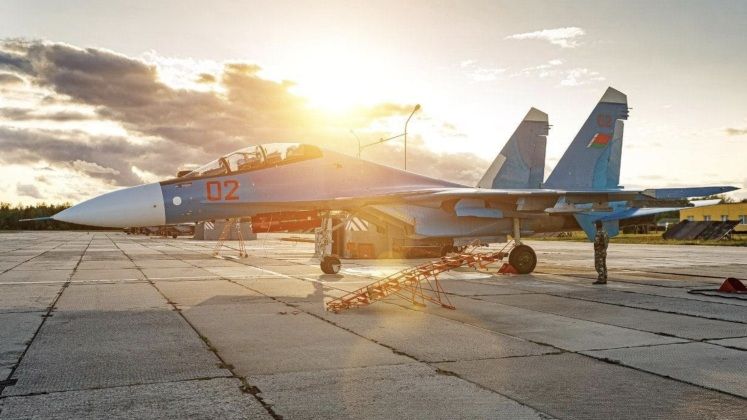
Su-30SM
The elite of the Belarusian Air Force is currently formed by the Su-30SM ‘4+ generation’ heavyweight fighter, with twelve of the jets ordered from Russia to form a single squadron. The jets boast Russia’s latest electronic warfare and sensor technologies, and unlike the Su-35 and Su-34 platforms they are not specialised for either air superiority or strike roles - instead being well rounded enough to perform both. The fighter’s capabilities, ranging from its flight performance to the size and sophistication of its radar, provide it with a comfortable advantage over the F-16s and F-18 which make up the bulk of NATO’s fighter units, and allow it to go head to head with higher end designs such as F-15s on a roughly equal footing. The fighters are prized for their high endurance and their ability to deploy a wide range of standoff missiles for land attack, including very fast Kh-31 missiles which are designed to erode enemy air defences and carry out precision strikes deep behind enemy lines, as well as the R-37M which is faster and has a longer engagement range than any Western air to air missile.
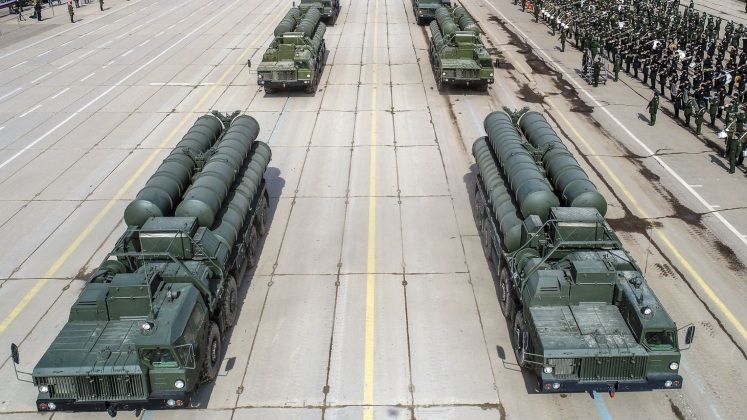
S-400
Belarus was a leading client for Russia’s S-400 air defence system, and is one of just four countries which deploys the platform in active service alongside China, Algeria and Russia itself. The S-400 largely compensates for Belarus’ lack of a large fighter fleet, and is seen to provide a more cost effective means of protecting the country’s airspace than additional fighter units. The missile system was designed to neutralises advanced high performance stealth aircraft such as the American F-22 Raptor, and against less stealthy aircraft with poorer survivability such as the F-35, F-15 or F-16 the system will be able to pose a much greater threat. The S-400 integrates Russia’s most advanced sensor and electronic warfare countermeasure technologies, and can engage up to 80 aircraft simultaneously providing more firepower than a very large fighter squadron. The system’s high mobility and short setup and launch times are key to its survivability. The S-400 is complemented by shorter ranged air defence systems, including one battalion and three regiments of the S-300PS system and shorter ranged Tor-M2E and indigenous Buk-MB3K systems. Reports in early 2021 indicated that Belarus was considering acquiring further S-400 units.
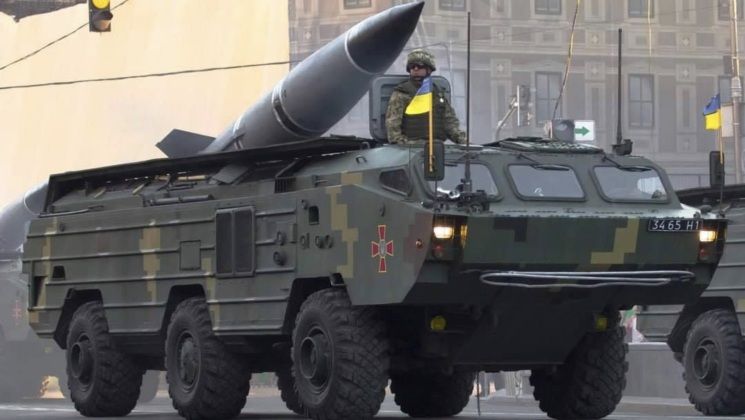
Tochka
The OTR-21 Tochka short ranged tactical ballistic missile its a highly capable weapon in the Belarusian arsenal inherited from the Soviet Union, and has an estimated range of around 190km and a warhead of approximately 490kg. The missile makes use of a solid fuel composite, which allows them to be stored fully fuelled and maintain a very short launch time. Tochka missiles are deployed from mobile transporter erector launchers, making them difficult to track and neutralise and allowing them to quickly be moved to forward firing positions in the wake of advances by ground troops. The missiles have a low hypersonic speed of little over Mach 5, which combined with their manoeuvrability makes them difficult to intercept. Belarus also deploys an estimated 60 older Scud-B ballistic missiles. While these assets are not technically aerial warfare systems, their usefulness in neutralising targets such as airfields and air defence sites makes them potentially decisive assets in an air war.
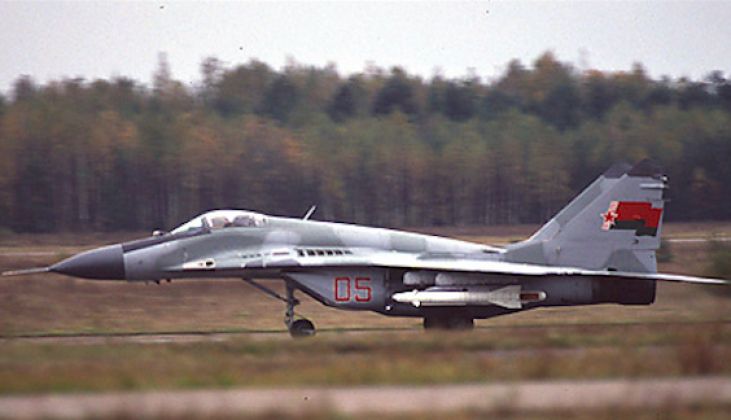
MiG-29 with R-77
The MiG-29 makes up the backbone of the Belarusian fighter fleet, and was chosen over the heavier and in many ways more capable Su-27, MiG-25PD and Su-24M to remain in service after the collapse of the Soviet Union due largely to its versatility and lower operational costs. A primary disadvantage for the aircraft relative to rival designs was its short range, and while this is more than sufficient for air defence duties it limits the fighter's offensive potential. The MiG-29 boasts a flight performance with few rivals in the world, and has benefitted from considerable upgrades to its avionics, electronic warfare systems and weaponry. One of the most notable upgrades to the aircraft has been its integration of the R-77 air to air missile, which provides not only a longer range, but also fully active radar guidance and superior electronic warfare countermeasures. Belarus also maintains 21 Su-27 fighters, which are thought to be kept in combat reserve. While the Su-27 is a higher end airframe than the MiG-29, the fighters were retired due to their much higher operational costs and fuel consumption, and have not received similar upgrades to the MiGs such as modern R-77 missiles and upgraded electronic warfare systems and countermeasures.
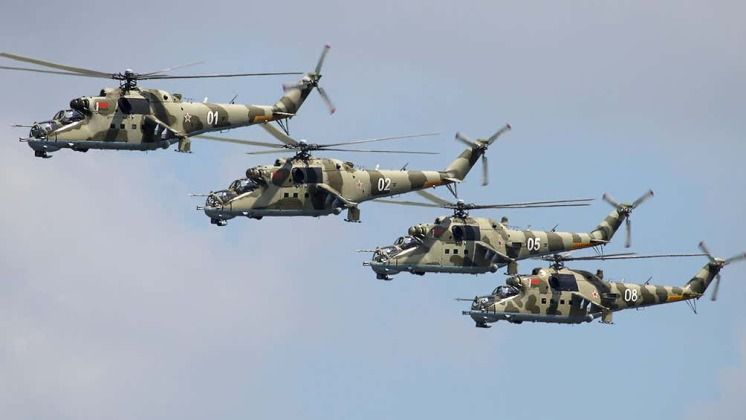
Mi-24P
Belarus deploys an estimated 12 Mi-24 attack helicopters inherited from the Soviet Union, which is the most widely used and one of the most throughly tested aircraft of its kind in the world today. The helicopters are of the Mi-24P gunship version, which deploy fixed side mounted 30mm twin barrelled autocannon alongside the class' standard cannon, missiles and rockets. The aircraft have proven highly survivable in high intensity combat in theatres from Afghanistan to Syria, and is fast, heavily armoured, capable of loitering for long periods, and are well suited to operating in extreme climates. Belarusian Mi-24 gunships are thought to be deployed alongside the country's large special forces brigade of around 11,750 personnel, who are specialised in air assault operations and deploy from Mi-8 transports. These elite forces have the potential to operate deep behind enemy lines, and while their hardware is not the latest available their training standards are considered among the very highest in Europe.
