
China Integrates World’s First Hard-Kill Anti-Torpedo System Onto Supercarrier to Intercept Submarine Attacks
Military Watch Magazine Editorial Staff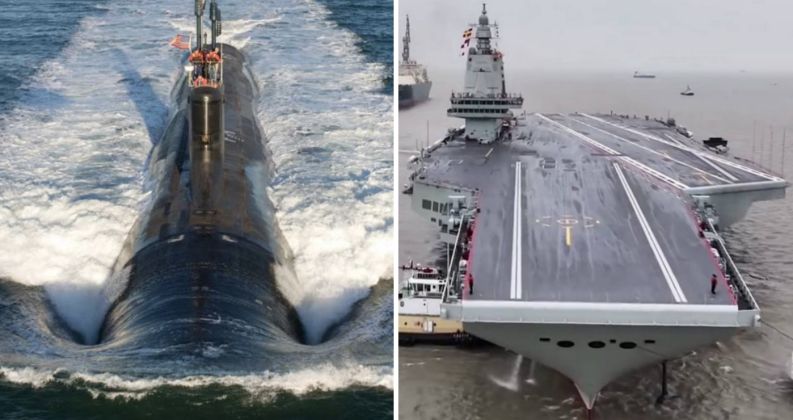
Chinese Supercarrier Fujian and U.S. Virginia Class Attack Submarine
The Chinese People’s Liberation Army Navy’s newest aircraft carrier the Fujian has been widely reported by local sources to be the world’s first aircraft carrier with an operational hard-kill anti-torpedo defence system, with Chinese defence publications and analysts highlighting that launchers visible on the ship are almost certainly intended for the system. The system is designed to detect and physically destroy incoming torpedoes before they reach the carrier, making it distinct from traditional ‘soft-kill’ defences such as acoustic decoys and jammers, which attempt to confuse or divert incoming weapons rather than kinetically target them. The new system has drawn parallels to the new hard-kill active protection systems being integrated onto modern main battle tanks.
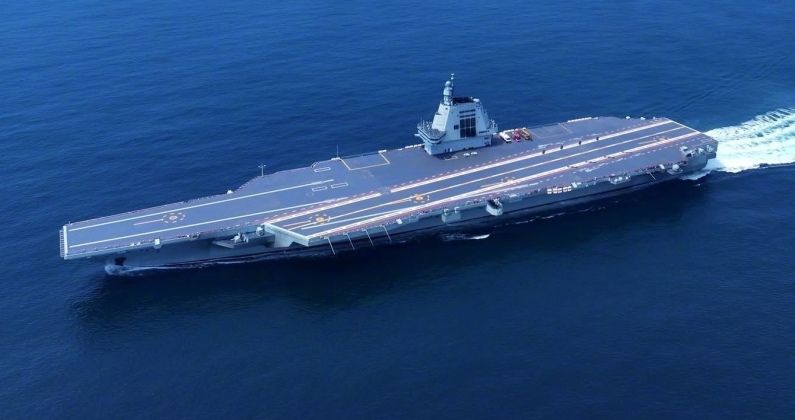
Chinese researchers have noted that the new ATT system achieves “world-class” levels of detection accuracy, interception reliability, and system integration, building on an earlier Chinese anti-torpedo technology demonstrator that was first revealed in 2016. Although the U.S. Navy initiated its own Anti-Torpedo Torpedo Defense System (ATTDS) program, this was ultimately cancelled after failing to meet performance requirements, while a successor hard-kill programme remains under development. If the reports regarding Fujian’s ATT system are accurate, the warship would retain a significant survivability advantage over other aircraft carriers.

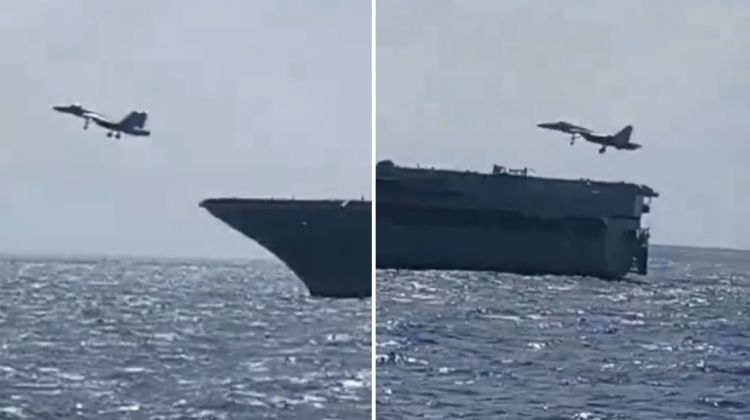
The Fujian’s service entry in November 2025, represented a major landmark in China’s aircraft carrier development, with the warship being the country’s first supercarrier and first aircraft carrier with an electromagnetic catapult system. The carrier is based at Sanya Military Port on Hainan Island, positioning it optimally for operations in the South China Sea, approximately 350 kilometres from the disputed Parcel Islands. At 316 metres long, and 76 metres wide, the Fujian is by far the largest warship in the world outside the U.S. Navy, with its capabilities placing it in a league of its own with the U.S. Navy’s Gerald Ford class supercarriers. The ship is expected to be followed into service by larger nuclear powered supercarriers, the first of which is currently well under construction. These future supercarriers are also expected to integrate ATT systems, with the possibility remaining significant that such systems will also be integrated onto older Chinese capital ships including the carriers Liaoning and Shandong and Type 055 class destroyers.
