
China Unveils New Variant of DF-17 ‘Carrier Killer’ Hypersonic Missile
Military Watch Magazine Editorial Staff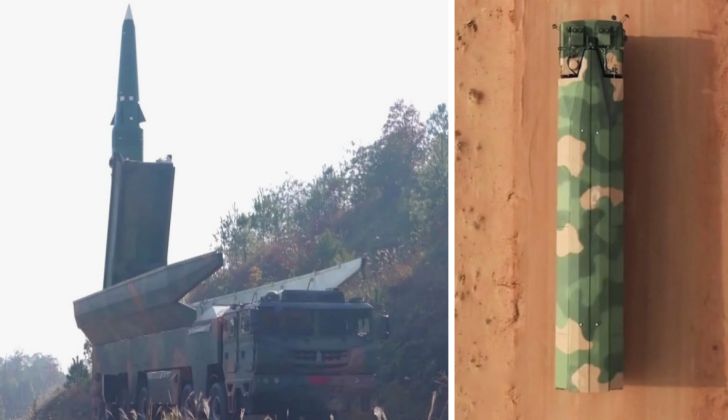
New DF-17 Variant (left) and DF-17
Footage released by Chinese state media has for the first time shown a new variant of the DF-17 medium range hypersonic ballistic missile, which appears to integrate a new kind of hypersonic glide vehicle distinct from the vehicle seen in military parades in 2019 and 2025. Some analysts have assessed that the new glide vehicle is likely a less costly counterpart to the previously seen vehicles, which may be a cost-reduction measure that will allow the missile type to enter service in greater numbers. Following its unveiling in 2019, multiple variants of the DF-17 have been brought into service with incremental improvements made to their capabilities. A new variant announced to have entered service in 2022 was described in state media reports as an “aircraft carrier killer,” indicting that it may have integrated onboard sensors better suited to engaging moving warships at sea.
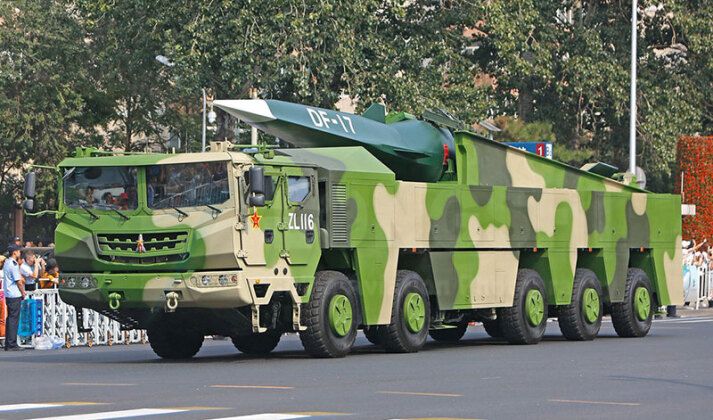
The DF-17 is estimated to have a 900 kilometre engagement range, and has reportedly seen variants brought into service capable of carrying penetrative ‘bunker buster’ warheads. The ability of hypersonic glide vehicles to penetrate deep and very well hardened fortifications has been demonstrated by both the Russian Oreshnik hypersonic missile in Ukraine, and more recently by an Iranian hypersonic missile, likely the Fattah-2, against Israel. This could be of particular value to strike U.S. military facilities in Japan and South Korea, and Republic of China Armed Forces targets across the Taiwan Strait. The ability of hypersonic glide vehicles to manoeuvre in both pitch and yaw, and to maintain extreme speeds in their terminal phases, makes them effectively impossible to intercept. This may be particularly useful in the Taiwan Strait, where U.S.-supplied air defence systems are heavily concentrated.
In January 2021 the DF-17 was revealed to have a new launch vehicle using an integrated cover that enclosed the missile. This could help the missile disguise itself and could also shield it from harsh terrain in sub-freezing or desert climates. Since the missile’s development, China’s defence sector has continued to increasingly lead the world in hypersonic glide vehicle technologies, with Vice Chairman of the U.S. Joint Chiefs of Staff General John Hyten having warned in November 2021 regarding a test of a much longer range strategic glide vehicle: “They launched a long-range missile. It went around the world, dropped off a hypersonic glide vehicle that glided all the way back to China, that impacted a target in China.” He stressed that the vehicle had shown that it could strike targets accurately anywhere in the world, and that this was highly concerning for U.S. interests. In December 2025 Pentagon provided new insight into how the China’s hypersonic missile arsenal could be used to sink even the newest and most capable U.S. Navy carrier groups, with the leaked Overmatch Brief highlighting how the very major losses of U.S. ships to these arsenals were expected in the event of war.
