
Why Britain’s Aircraft Carrier is Bringing U.S. Marine Stealth Fighters to China’s Doorstep
Military Watch Magazine Editorial Staff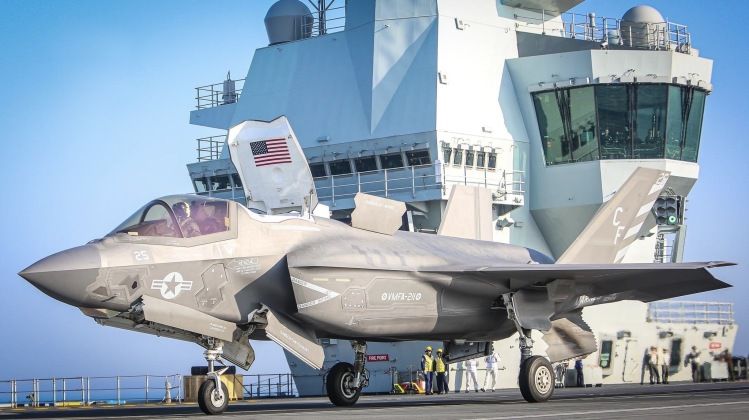
U.S. Marine Corps F-35B on HMS Queen Elizabeth
Britain’s first carrier strike group in decades to field full sized aircraft carriers is set to conduct operations in the Indian Ocean and the Asia-Pacific region, which will be led by the warship HMS Queen Elizabeth alongside attack submarines, air defence destroyers and a range of other supporting vessels. This follows a pledge by British Prime Minister Boris Johnson, who at the time was serving as foreign minister, that East Asia would be prioritised for the first operations of the British carrier group. While both of Britain’s Queen Elizabeth Class ships were intended to deploy 48 F-35B stealth fighters - the most expensive fighter jet in production anywhere in the world today - the slow rate of delivery and expectations for deep cuts to Britain’s planned order for the jets due to economic difficulties means that the Royal Navy’s air fleet falls far short of filling the deck of even a single carrier. As a result, the HMS Queen Elizabeth has accommodated a contingent of U.S. Marine F-35Bs to fly alongside the British-operated jets. The F-35B, although less combat capable and having a shorter range than other F-35 variants, is capable of landing on cheaper carrier classes which lack costly arresting gear or catapult launch systems - including not only the Queen Elizabeth Class but also the U.S. Navy’s Wasp Class and America Class ships where they are flown by Marine pilots. 180 Marines are currently deployed onboard the HMS Queen Elizabeth, which like the Wasp and America Class ships requires only a fraction of the crew numbers of a carrier deploying conventional fighter jets.
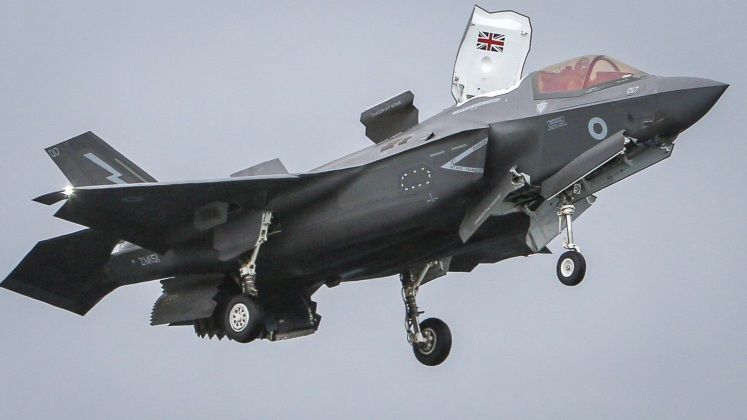
American F-35Bs deployed on the HMS Queen Elizabeth come from U.S. Marine Fighter Attack Squadron 211 (VMFA-211), the ‘Wake Island Avengers,’ with the ship currently deploying 10 Marine F-35s and eight British ones. This combined contingent is 63% smaller than that the carriers are optimally intended to accommodate. It still represents the largest F-35B continent ever to be deployed for such an operation. The commanding officer of VMFA-211, Lt. Colonel Andrew D’Ambrogi, stated regarding the operation: “We have never seen a ship with 18 F-35s out there that is going to transverse half the world like we’re going to do. It’s a pretty bold statement. It’s about power projection… To have the opportunity to go to a ship – any ship, nonetheless a British ship that’s designed for F-35 – is going to allow us the space and the mission sets to allow us to kind of really test what an entire F-35 squadron can do. So I’m very excited to gather that data and determine if we’ve got it right or give the feedback on how to make it better.” He referred to the contingent as: “the largest fifth-generation carrier air wing in the world.”
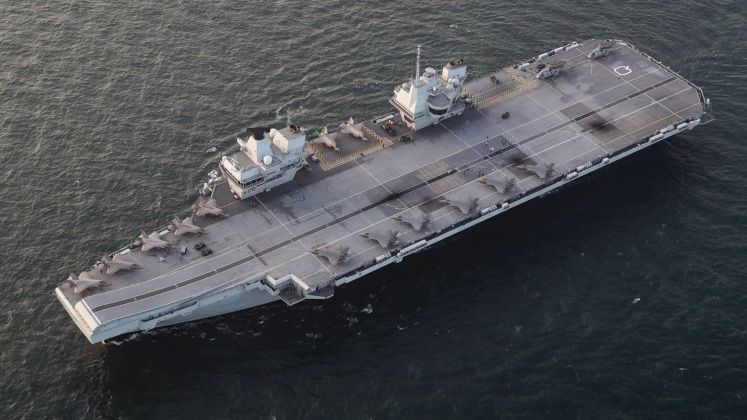
Speaking to USNI news, Lt. Colonel D’Ambrogi elaborate regarding the benefits of the F-35B deployment to the Pacific: “We want to make sure that we’ve got the right type of Marines trained to the right type of jobs. And then make sure that we have the right qualifications to sustain all 10 aircraft and meet the mission cycle flows for what we’re executing. A shipboard environment’s great to do it because you’re isolated. What you’ve got is kind of what you’ve got, and anything you need from the exterior is going to take some time. So if your people aren’t trained or you don’t have that appropriate skillset, or even the tooling – we’ll find it if we have the right tooling and the right supply sparing – that can all be validated for support of an entire squadron…. I think all that is great data. And if we don’t, we come back to the drawing board and say, ‘we need more people in this area. We need less people in that area.’”
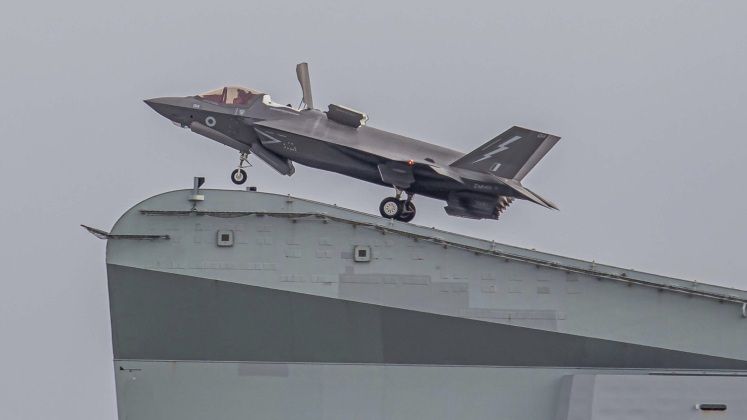
A key reason why the F-35B contingent is the world’s largest is that the F-35C carrier based fighter used by the U.S. Navy is still deployed in limited numbers. The F-35C is cheaper and considerably more combat capable, but notably lacks the ability to deploy from smaller lower end carrier designs. It entered service around four years later than the F-35B, but will eventually be deployed as part of much larger air wings onboard American Nimitz and Gerald Ford Class supercarriers. Although the HMS Queen Elizabeth is a large ship at around 65,000 tons, its lack of nuclear propulsion systems or the ability to accommodate onboard resupply aircraft such as the U.S. Navy’s C-2 Greyhound seriously limits its endurance for longer distance operations - in contrast to American supercarriers which are ideally suited to such a role. The F-35 itself is still considered very far from ready for high intensity combat, and has seen growing and increasingly harsh criticism over the past year from both officials and defence experts due to its deficiencies. The F-35B’s limited range, its reduced manoeuvrability relative to other F-35 variants, and its inability to carry more than four missiles internally, limit its ability to compete on the same level as higher end combat jets even if design issues, which still remain in the hundreds, are eventually remedied.
